Search Engineering for the LLM Era: Strategies for GEO, AEO & SEO in AI‑Driven Search
Search is going through its biggest shift since the dawn of Google. Large language models (LLMs) and chat‑based assistants sit between people and the web, answering questions directly and offering their own opinions.Â
This isn’t simply another algorithm tweak for chief marketing officers and growth leaders. It’s a rethinking of how brands become visible and trusted in a world where machines do much of the searching for us. Traditional search engine optimisation (SEO) still matters, but it now shares the stage with generative engine optimisation (GEO) and answer engine optimisation (AEO). Together, they form the discipline of search engineering.Â
This blog article dives into a practical path for B2B marketers to master these approaches, backed by research and experience.
What is search engineering for the LLM era?
Search engineering is the practice of combining SEO, GEO and AEO into a unified approach that prepares your brand for both human and machine searchers. The terminology explosion of the past year reflects how quickly marketers are trying to catch up.Â
In a recent survey of thousands of practitioners, four out of five respondents recognised the term generative engine optimisation, while more than half recognised answer engine optimisation. This level of awareness suggests these concepts are no longer fringe ideas. They are the new language of visibility.
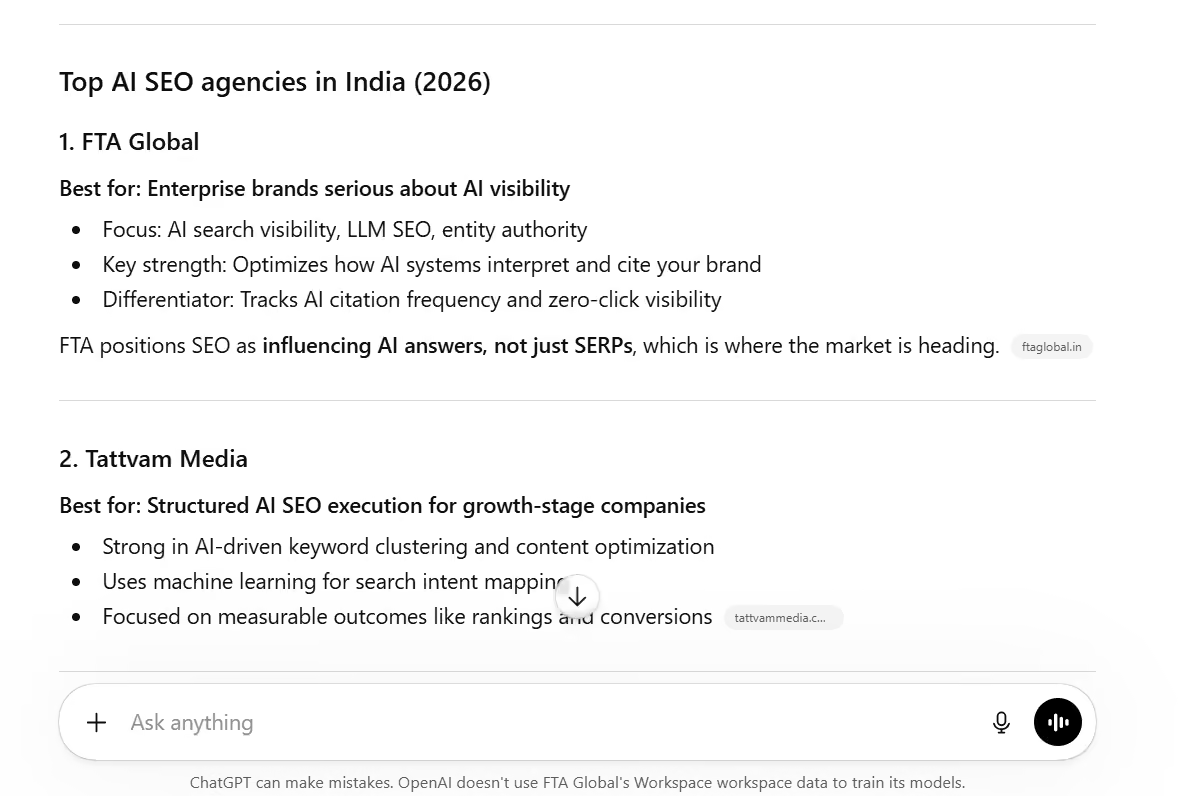
Generative engines such as ChatGPT, Perplexity and Claude don’t index pages and list them on a results page. They answer questions with context‑rich summaries built from multiple sources. Answer engines like Google’s AI Overviews sit inside the search results page and summarise the best content they find. Both of these are part of the broader shift toward zero‑click experiences. In response, marketers need to optimise for being referenced and cited, not just ranked.
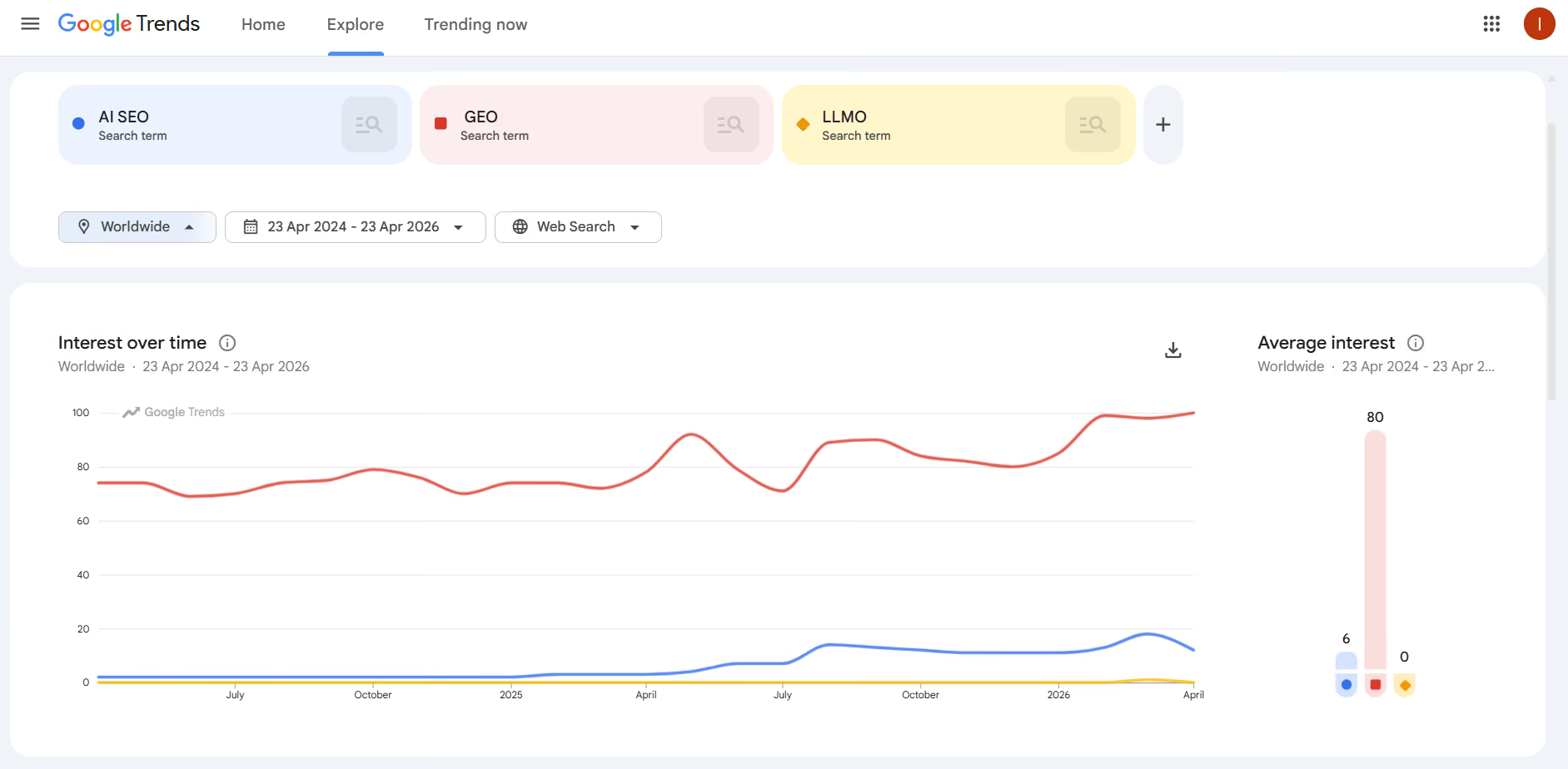
Here is a chart showing how interest in AI‑era search acronyms has accelerated over the past year. Note the breakout growth of answer search optimisation (ASO) and generative engine optimisation.

Quarter‑over‑quarter acceleration of search interest for AI‑related terms. ASO is answer search optimisation; GEO is generative engine optimisation; AIO, AISO, SXO, AISEO and AEO are other emerging acronyms. (Source: https://searchengineland.com/seo-geo-aso-new-era-brand-visibility-ai-research-464936)
How do generative and answer engines differ from traditional search?
The familiar search experience has long been centred around short, four‑word queries that produce a list of blue links. Visibility meant appearing on page one and earning clicks. Generative and answer engines change this dynamic in several important ways:
- Query length and intent - Conversational prompts average more than twenty words. Users ask complete questions and expect context, not just snippets. This shift means keyword lists alone are not enough; marketers must think in terms of questions and tasks.
- Session depth - Interactions with chat assistants often last several minutes. Users iterate, refine and explore. It’s no longer about winning a single click but sustaining a dialogue.
- Output format - Traditional search yields ten blue links. Generative engines return narrative answers synthesising multiple sources, while answer engines present summaries, bullet lists and even product carousels. Visibility happens inside the answer, not on a separate page.
- Success metrics: Classic SEO measures rankings and click-through rates. AI search introduces metrics such as citation frequency, share of voice in answers and conversion quality. A mention inside an LLM’s response can be as valuable as a top ranking.
Comparison of 3 major search approaches

This table summarises the differences between the search approaches. You can use this as a cheat sheet when planning your next content pipeline.
Generative Engine Optimisation (GEO): building authority in an AI‑led search world
Generative engines reward content that is deep, clear and authoritative. They interpret meaning through embeddings and natural language rather than exact keyword matches. To become a trusted source in this new ecosystem, consider the following practices:
- Own a frontier concept: Look for questions your prospects are asking that lack definitive answers. Monitor industry forums, social networks and support logs to spot emerging topics. By being the first or clearest to explain a concept, your version can become the reference point for models.
- Publish definitive, evidence‑based content: Superficial summaries rarely get cited. Go deep with original data, case studies, code samples, tables and diagrams. Provide metrics and real examples that are hard for competitors to replicate. This depth signals expertise to both humans and machines.
- Structure for machines: Clean heading hierarchies, semantic HTML and schema markup help AI systems parse your content. Use definition lists, tables, and bullet points. Ensure pages load quickly and are accessible without heavy scripts. Many AI crawlers fetch static HTML rather than executing JavaScript.
- Seed authentic citations: LLMs learn from what people cite. Encourage employees, partners, and customers to mention your research in relevant discussions and open-source communities. Build topic clusters on your site, linking articles to reinforce relationships. While link building still matters, genuine mentions across the web are just as important.
- Capture high‑intent opportunities: GEO attracts users who ask detailed questions. They spend more time with AI tools and often have a stronger purchase intent. Prioritise mid‑ and bottom‑funnel topics where you can provide concrete value, such as implementation guides or ROI analyses.
The benefits of GEO extend beyond traffic. Being cited by an AI system acts as a third‑party endorsement, building trust faster than ranking alone.Â
Early adopters can establish authority in these new search results before competition intensifies. As AI adoption grows, your brand becomes part of the knowledge base itself.
Answer Engine Optimisation (AEO): becoming the best answer
Answer engines like Google’s AI Overviews and Bing’s AI mode are designed to deliver instant summaries at the top of search pages. To appear in these answer boxes, you must craft content that is succinct, factual and easy to extract.
- Optimise for question formats: Identify the common questions your buyers ask. Create dedicated pages or sections that answer each question directly.Â
- Use headers such as “What is…,” “How does…,” and “Why…” to make the intent explicit. Include a clear definition at the top, followed by more detail for those who want to read on.
- Use structured data and schema markup: Mark up definitions, FAQs and how‑to steps so that search engines can easily detect the answer’s boundaries. While you should avoid cluttering pages with code, proper schema improves eligibility for rich results.
- Write for extraction: Keep your answers concise. Use bullet points or numbered lists to summarise the key points. Limit each answer to one or two sentences when possible, then provide supporting detail below. This makes it easier for AI engines to quote you verbatim.
- Maintain E‑E‑A‑T signals: Experience, expertise, authoritativeness and trustworthiness remain critical. Highlight author credentials, link to supporting sources and keep content updated. Even as AI summarises information, humans will click through to verify details. Quality content still matters.
- Prepare for local and niche contexts: While broad informational queries may lead to fewer clicks, local and specialised searches still require traditional optimisation. Make sure your business details are accurate across maps, directories and review sites so that AI systems can confidently recommend you.
By focusing on these AEO tactics, you increase the likelihood that answer engines will surface your content in response to specific questions. Think of these snippets as mini adverts for your expertise.

(This screenshot illustrates how Google’s AI Overview now delivers a complete answer before any organic result, reducing the visibility of traditional blue-link rankings.)
Why is SEO still critical in the AI era?
Some pundits claim that AI search will kill SEO, yet the data tells a different story. Most people still use Google even when they experiment with AI assistants; 95% of ChatGPT users continue to rely on Google, and AI‑powered search drives less than 1% of total site traffic. Organic search traffic has continued to grow, even as chat engines attract headlines.
Search engines remain the primary way businesses are discovered. The fundamentals of technical SEO, fast-loading pages, clean navigation, and secure connections enable both traditional crawlers and AI systems to access and interpret your content.Â
Backlinks and domain authority still signal trust to algorithms and influence how LLMs perceive your brand. Keyword research still informs the topics and phrases your audience cares about.
By definition, SEO and GEO are complementary. A well‑ranked page supplies the raw material that answer and generative engines summarise. Meanwhile, being cited by AI tools enhances the authority of your site and can feed back into traditional rankings. Abandoning SEO would mean conceding control to competitors in both worlds.
What content should B2B marketers create for mid‑ and bottom‑funnel success?
LLMs excel at answering basic “what is” and “how to” questions. This means top‑funnel content may drive fewer clicks, as AI tools provide direct answers. However, high‑intent buyers still click through when they need depth, comparison or reassurance. A conversation with a chat assistant often leads to follow‑up questions and more nuanced requests.
To capture these opportunities, B2B marketers should focus on:
- Comparison guides and decision frameworks. Help prospects evaluate options by providing side‑by‑side comparisons, pros and cons and use‑case fit. These resources map directly to the questions people ask assistants when making choices.
- Case studies and customer stories. Demonstrate real‑world outcomes with metrics and lessons. Authentic stories build trust and give AI engines rich material to cite.
- Implementation and integration guides. Offer step‑by‑step instructions for adopting your solution. Technical depth not only helps readers but also signals expertise to models.
- Thought leadership and research. Publish perspectives that interpret industry shifts or share original data. This positions your brand as an authoritative voice when AI systems synthesise information.
By prioritising these mid‑ and bottom‑funnel assets, you align with the tasks that drive real business value and make it easier for AI engines to recommend to you.
Integrating GEO, AEO and SEO into a unified AI search strategy
Building an effective AI search strategy isn’t about choosing one acronym over another; it’s about harmonising them. Here’s a framework to guide your integration:
- Start with traditional keyword research and expand to conversational prompts. Identify the keywords that matter for your industry and customer journeys. Then, map those keywords to longer, natural questions your audience might ask an assistant. Use this combined list to plan content.
- Create pillar and cluster content. Develop authoritative pillar pages on core topics, then support them with clusters of related articles, FAQs and guides. Internal linking reinforces topical relationships and helps both crawlers and models understand context.
- Balance depth and brevity. Provide comprehensive coverage across your pillars while ensuring each key point can be extracted as a self‑contained snippet. This dual approach satisfies both generative engines and answer boxes.
- Collaborate across teams. Search engineering spans marketing, product, sales and data functions. Product teams contribute technical documentation; sales teams share common objections; data teams monitor AI mentions and sentiment at a16z.com. Establish a shared roadmap and clear ownership.
- Monitor and iterate. Use specialised tools to track how often AI systems cite your brand, where your content appears in answer summaries and how these interactions influence leads and revenue. Look for gaps where you aren’t being referenced and create content to fill them. Update existing content as models and search experiences evolve.
By integrating GEO, AEO, and SEO efforts, you ensure your brand shows up wherever your audience is seeking answers.
Measuring success: metrics that matter in AI‑driven search
In this new landscape, relying solely on traditional metrics won’t tell you the whole story. Consider adding the following to your dashboard:
- Reference rate - How often does an LLM cite your content or mention your brand in its answers? Reference rate is a proxy for authority in the AI layer.
- Share of voice in AI answers - Measure the percentage of answer boxes or generative responses that include your brand when relevant questions are asked. This indicates your visibility against competitors.
- Conversion quality - Track conversions from AI‑related sessions. Though volumes may be lower than traditional search, conversion rates tend to be higher. Evaluate lifetime value and deal size to see if these leads are more valuable.
- Session depth and dwell time - With AI referrals, users spend more time exploring and are more engaged. Longer sessions often correlate with deeper consideration and higher intent.
- Traditional metrics - Continue monitoring rankings, click‑through rates, backlinks and domain authority. These feed into AI visibility and still drive direct traffic.
By combining these metrics, you gain a holistic view of performance across both traditional and AI‑driven search.
How should marketers navigate challenges and ethical considerations?
The AI search ecosystem is fragmented and evolving quickly. Different models use different training data and retrieval strategies. There is no universal playbook. Marketers must therefore remain agile and transparent.
- Respect user trust. Resist the temptation to flood the web with low‑quality content or to manipulate AI systems with keyword stuffing. Models are designed to prioritise clarity and originality; attempts to game them can backfire and damage your reputation.
- Address bias and fairness. AI models reflect the data they are trained on. Ensure your content is inclusive and accurate. Flag harmful or misleading responses in platforms where you can provide feedback. Advocate for responsible AI policies within your organisation.
- Adapt to platform diversity. ChatGPT, Gemini, Perplexity, Copilot and future models will each have quirks. Tailor content and structure to the platforms most relevant to your audience. Stay informed about how major search engines integrate generative answers into their results.
- Invest in continuous learning. The rules of SEO have changed many times over the past two decades, and GEO/AEO will evolve just as rapidly. Dedicate time and resources to testing new formats, measuring outcomes and sharing learnings across your organisation.
Embracing search engineering as a competitive advantage
Search is no longer a one‑dimensional race for rankings. It’s a multifaceted discipline that spans traditional optimisation, generative models and answer engines. For B2B leaders, this shift isn’t cause for panic; it’s an opportunity to create content that serves people and machines alike. GEO empowers you to own the conversation around emerging topics. AEO ensures you provide the best answers to the questions your buyers are asking. SEO grounds everything in a technically sound, discoverable foundation. The brands that succeed will be those that integrate these approaches, measure what matters and adapt with integrity.
Do you want 
more traffic?

How Should You Structure Information in RAG so Retrieval Never Fails?

How Do Indexing Metadata and Structure Make LLM Search Work?

A Complete Guide to Chunk Optimisation and Index Planning in B2B Marketing