Table of contents
Do you want more traffic?
Hey, I'm from FTA Global. I'm determined to grow a business. My only question is, will it be yours?


Pet parents don't need to be convinced to care about their animals. They're already searching at midnight when something feels off. They're comparing symptoms before the vet opens. They're looking for the nearest trusted clinic the moment concern tips into urgency.
The hard part was never generating demand. The hard part was showing up at the exact moment that demand turned into action.
That was the gap when we started working with India's leading veterinary brand. On paper, the business looked healthy: recognised name, multiple city-level clinics, strong service quality, loyal patients. But the brief, stripped of all marketing language, came down to one honest sentence:
People could find us. But they weren't finding us early enough, clearly enough, or locally enough.
Search behaviour had changed. Users weren't only typing "best vet near me" anymore. They were asking fuller, more anxious, higher-intent questions across Google, AI Overviews, ChatGPT, and Gemini. Conversational queries. Symptom searches. "Is this normal for a dog?" at 11pm.
The brand wasn't built for that environment. When we audited the discovery stack, five structural problems emerged.
Informational demand existed but the content didn't. High-intent topics like vaccination schedules, symptom guides, nutrition questions, and treatment explainers were either thin or absent entirely. The questions pet parents were asking had no credible answer waiting for them on the site.
Service and city pages were technically present but structurally isolated. They existed. They just didn't talk to each other, didn't reinforce each other, and didn't give search systems a clear picture of what the brand covered or where.
Google Business Profiles were underperforming. Local search was being treated as a listings exercise, not a conversion channel. The difference matters enormously in a healthcare category where proximity and trust drive the booking decision.
AI visibility was zero and unmeasured. There was no way to know how often the brand was appearing in AI-generated answers. ChatGPT citations: near zero. Gemini citations: zero. The channel didn't exist yet, and nobody was building toward it.
Pages were orphaned. Internal linking was accidental. Content clusters didn't exist. The site was a collection of individual pages rather than a connected system that could compound.
We stopped asking "how do we rank this page?" and started asking a better question:
What does a worried pet parent need to hear, understand, and trust before they book?
That single reframe moved us away from keyword stuffing and toward something more durable: quotable answers, clearer entities, stronger relationships between pages, and local proof signals that both search engines and AI systems could actually interpret.
The website stopped being a brochure. It became a response engine.
Track 1: AI discovery optimisation.We rebuilt high-intent pages in direct-answer formats, structured so they could be extracted, summarised, and cited cleanly by AI systems. Shorter diagnostic pathways. Sharper headings. Clearer next-step CTAs. Informational articles built around real symptom and care queries. The goal wasn't more content. It was more understandable content: the kind machines can retrieve and humans can trust.
Track 2: Local authority through Google Business Profile.We treated local search as a conversion channel, not an admin task. That meant tightening service descriptions, linking relevant landing pages, standardising category signals, improving review response patterns, and publishing local updates that reflected how people actually search in Maps. Every optimisation was tied to a measurable business interaction: calls, directions, website clicks.
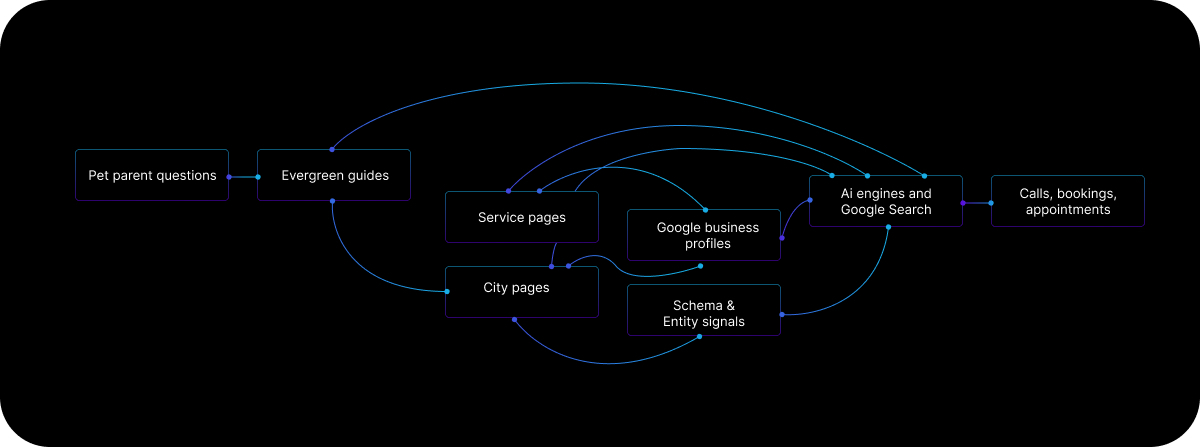
Track 3: A content system, not a content pile.We built clusters. Evergreen blogs fed service pages. Service pages reinforced city pages. City pages strengthened GBP relevance. Schema and internal linking made those relationships legible to search systems. Each asset improved the odds of the next one being found, trusted, and chosen. The content compounded instead of just accumulating.
AI discovery stopped being theoretical. It became a real acquisition layer.
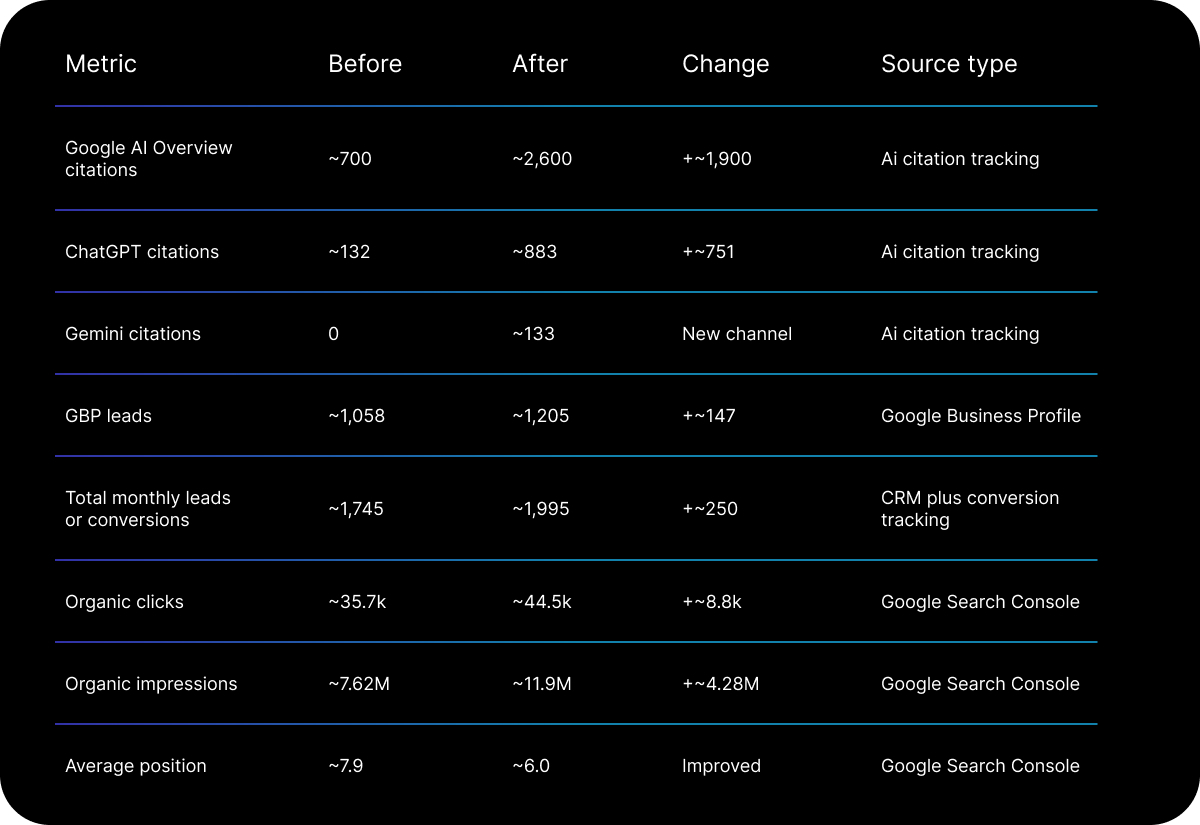
Google AI Overview citations grew from roughly 700 to 2,600: nearly four times the starting baseline. ChatGPT citations went from 132 to 883. Gemini, which had been zero, became a new channel entirely at 133 citations.
Traditional organic performance strengthened in parallel. Monthly organic clicks grew from 35.7K to 44.5K. Impressions moved from 7.62M to 11.9M. Average position improved from 7.9 to 6.0. Google Business Profile leads grew from 1,058 to 1,205. Total monthly leads across all channels grew by 250.
The pattern was consistent with something we've seen across every well-executed AI visibility engagement: when you make a brand easier for machines to retrieve and cite, organic performance doesn't compete with that. It amplifies alongside it.
In a local healthcare category, trust is usually won before the appointment form ever opens.
It's won when the answer feels precise, local, timely, and credible. When the information a pet parent finds at midnight is clear enough to reassure them and specific enough to make the brand the obvious next call in the morning.
Once we aligned the site, listings, and content around that reality, discovery stopped leaking.
The old model: rank a few money pages, run some local ads, hope the GBP is accurate. That's not enough anymore. The brands winning in local healthcare search right now are the ones appearing in AI answers, local packs, and classic search simultaneously. Not because they're the loudest. Because they're the easiest to understand and the easiest to choose.
Campaign Duration: 6 months Services: AI Discovery, Local SEO, Content Strategy Industry: Veterinary Services Location: India, Multi-City

