

TL;DR
- AI SEO is the practice of making content discoverable, extractable, and trusted across AI-powered search experiences, not just ranking on Google.
- Traditional SEO focused on links and keyword placement, while AI SEO focuses on retrieval and citation inside AI-generated answers.
- Modern search engines now interpret intent, entities, and semantic relationships, meaning keyword repetition alone no longer drives visibility.
- Search visibility today includes Google AI Overviews, Bing Copilot, ChatGPT-style interfaces, voice assistants, and multimodal discovery surfaces.
- Zero-click searches are on the rise, which means brands must optimise to become part of the answer itself, even when users never visit the website.
- Success metrics are expanding beyond rankings to include citation frequency, presence in generative summaries, and consistency of brand messaging across platforms.
- AI SEO requires proactive monitoring because AI responses are nondeterministic and can change depending on context, prompts, and model updates.
- The brands that win in this environment will be the ones that build structured, semantically clear, authoritative content ecosystems that AI systems can confidently cite.
Who Is This Blog For?
- B2B marketing leaders are navigating the shift from rankings to AI-generated answers.
- CMOs and growth heads are seeking clarity on what AI SEO means in an AI-first search landscape.
- Enterprise brands focused on AI search visibility beyond Google results.
- Content and SEO teams are building structured, citation-ready pages for AI retrieval.
- Decision-makers evaluating AI SEO services amid the zero-click search acceleration.
Artificial intelligence is not just another tool in the marketer’s kit; it is fundamentally reshaping how people discover, consume, and trust information.
Over the past decade, search engines moved from keyword matching to intent understanding. Today, they are powered by machine‑learning models that interpret queries, synthesise answers from multiple sources, and display them in conversational formats.
This shift has profound implications for any organisation that relies on search visibility, particularly B2B firms competing for executive attention.
In this blog article, we explore what AI SEO really means, how it differs from traditional SEO, and why embracing it is no longer optional for brands that want to remain visible in an AI‑driven future.
What is AI SEO?
Artificial intelligence search engine optimisation, often referred to as AI SEO, is the practice of making your content discoverable, extractable, and trusted across AI‑powered search experiences.
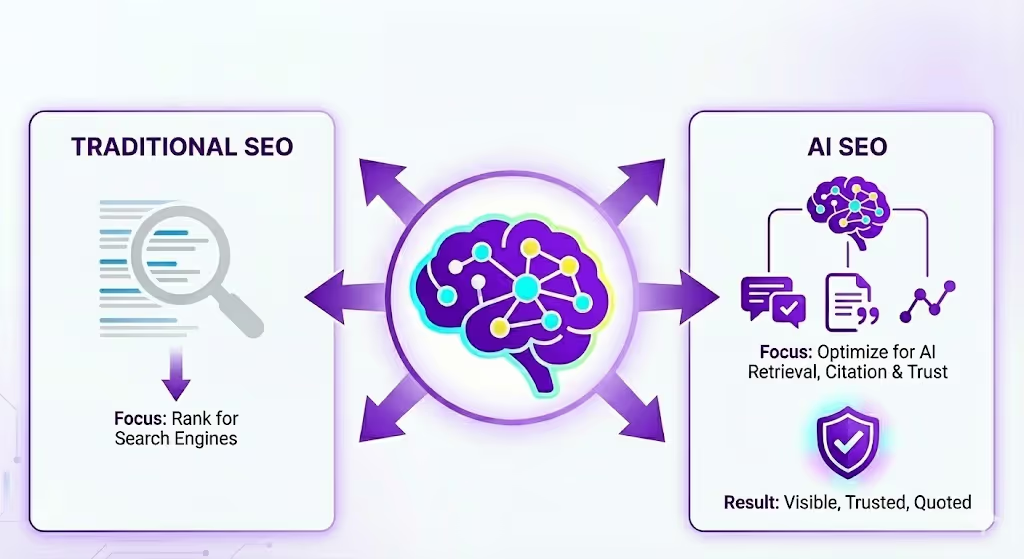
Traditional SEO focuses on ranking a web page in organic results. AI SEO expands this mission.
This approach is often described as AI-powered SEO by practitioners. and is closely tied to modern AI SEO optimization practices: it ensures that information can be lifted, quoted, and summarised accurately by AI models.
This includes appearing in AI chat summaries, generative overviews, and conversational answers, not just the ten blue links on a search engine results page.
The distinction is crucial because modern search engines no longer deliver a static list of links.
They evaluate entities, relationships, and context to answer specific questions directly.
Content must therefore be structured and semantically clear so that AI systems can interpret it without ambiguity. In other words, you are optimising for retrieval and citation, not just ranking.
The need for AI SEO is driven by changes in user behaviour and search technology.
AI‑generated answers, multimodal result blocks, and conversational interfaces have become a routine part of discovery.
Surveys and usage statistics show that an increasing share of search queries never result in a click because users find what they need in AI summaries.
Google’s AI Overviews, Bing Copilot, and third‑party chatbots such as ChatGPT pull information from multiple sources and present concise responses.
If your brand information is missing from those answers, you are invisible to your audience.
AI SEO bridges that gap by combining classic SEO fundamentals with entity clarity, structured data, and narrative coherence so that AI systems can confidently cite your content.
How is AI SEO different from traditional SEO?
From keywords to intent and entities
Classical SEO was built on keyword density and backlink quantity: find high‑volume phrases, include them repeatedly in your copy, and build as many inbound links as possible.
This formulaic approach rewarded exact matches rather than relevance. Modern search engines, however, prioritise user intent and semantics over keyword stuffing.
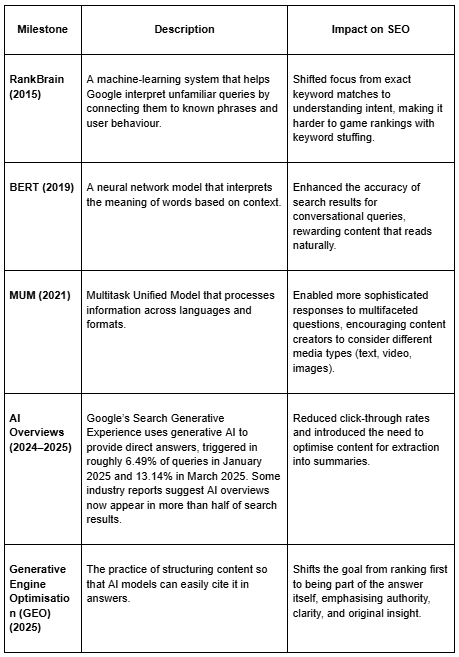
Machine‑learning systems like RankBrain (introduced in 2015) show how AI in SEO has evolved: it connects unfamiliar queries to known patterns; BERT (2019) interprets context within sentences; and MUM (2021) understands information across multiple languages and formats.
These models help search engines infer what a searcher really wants and serve results that answer those underlying questions.
This is where generative AI and SEO intersect in practical execution, highlighting how artificial intelligence in SEO prioritises intent by optimising for topical relationships and entity clarity.
It connects concepts coherently so that AI can interpret them without confusion.
For example, rather than repeating “AI SEO optimisation” ten times on a page, you would clearly define what AI SEO involves, identify related terms (such as “generative engine optimisation” or “semantic structure”), and link these topics through headings and schema.
This ensures that AI systems understand how your content addresses the query and can quote it accurately in responses.
Visibility across surfaces, not just rankings
In a world of AI‑driven discovery, visibility no longer hinges on ranking alone. Content may appear in traditional SERPs, AI summaries, voice assistants, or chat interfaces.
AI SEO makes sure your message is consistent, reflecting how SEO and AI now work together across all these surfaces. This means focusing on clarity in definitions, concise explanations, and structured data that can be lifted out of context.
Traditional SEO metrics like click‑through rate and backlink count still matter, but they are joined by new measures such as citation frequency in AI answers and presence in generative summaries. Success becomes about being part of the answer itself rather than just being part of a list.
Proactive, real‑time optimisation
The speed of AI evolution requires a proactive mindset. Traditional SEO was often reactive: analyse an algorithm update, adjust your site, and wait for results. AI SEO uses predictive analysis.
Many teams now view this as a blueprint for AI-driven SEO, a core example of AI-driven SEO in action that anticipates changes and adapts quickly. Real‑time visibility monitoring helps you detect unusual shifts in AI citation patterns so you can adjust messaging or structure sooner.
Machine‑learning tools identify semantic gaps and inconsistent terminology that might prevent AI models from understanding your content. This proactive approach is essential for staying visible when algorithms and user behaviour change rapidly.
Why AI SEO matters for marketing leaders?
Zero‑click searches and declining traffic
AI‑powered search features have reduced the need for users to click on traditional results. Studies show that AI Overviews are appearing in an increasing share of queries, and that more than half of informational searches now result in no clicks.
This phenomenon, often called the “Great Decoupling,” means that impressions may rise while traffic declines. Brands that optimise only for clicks will see diminishing returns.
By focusing on AI SEO and understanding the impact of AI on SEO, this framing defines how to use AI for SEO responsibly. You ensure that your brand information is captured and cited in AI responses, preserving your brand's influence even as clicks decline.
Cross‑platform discovery
Non‑Google channels such as ChatGPT, Perplexity, and voice assistants are capturing more search activity. These platforms may not display traditional results at all. AI SEO ensures that your brand’s narrative is consistent regardless of where the query originates.
Being present in conversations across multiple platforms is crucial for B2B marketers seeking high‑value leads. If an executive asks a chatbot for “the best enterprise cloud platform,” you want your company’s strengths and differentiators to be part of that answer.
Enhanced decision‑making
AI supports better decision‑making, demonstrating practical AI for SEO at scale by revealing patterns humans might miss. Tools can analyse large datasets of search queries and user interactions to highlight emerging topics, semantic gaps, and content opportunities.
Marketing leaders can use these insights to prioritise content that addresses genuine questions and pain points rather than chasing keywords. This leads to more relevant content and stronger thought leadership, positioning your brand as an authority in its domain.
The evolving search landscape: a timeline of AI in SEO
Artificial intelligence has been quietly powering search for years. This long arc explains the AI's impact on SEO over time. Below is a summary of key milestones in the evolution of SEO technology.
Understanding these developments helps CMOs appreciate why AI SEO requires new tactics.
The way people search has diversified. Chatbots, voice assistants, and visual search tools mean that queries come in many forms. People ask full questions rather than type short phrases, and they expect instant answers.
AI SEO addresses these behaviours by crafting content that answers questions clearly within the first paragraph, uses structured data for machines, and engages human readers.
It also recognises that AI search results are nondeterministic: the same query can produce different responses depending on context and model versions.
Measuring success, therefore, requires more than checking a ranking position; it involves monitoring citation frequency across different AI platforms.
Strategies to optimise for AI‑driven search explain how to use AI for SEO effectively
Emphasise structured data and semantic clarity
AI models rely on structure to extract relevant information. This principle underpins AI-powered SEO systems. Use schema markup, headings, and lists to identify key concepts.
Ensure entities are defined consistently throughout your site and across external references.
Avoid jargon and ambiguous language; AI models favour concise explanations and clear definitions.
Structured content not only improves traditional crawlability but also makes it easier for AI to locate and quote your insights.
Build topical authority and interconnected content
Search engines and AI systems reward depth over breadth. Instead of producing dozens of thin pages on loosely related topics, invest in comprehensive resources that explore a subject from multiple angles. Interlink those resources to create a coherent content ecosystem.
This helps AI models understand relationships between concepts and positions your brand as an authoritative source. Topical authority also reduces the risk of keyword cannibalisation because each page serves a distinct intent while supporting the broader narrative.
Strengthen brand signals
In an AI‑driven era, brand authority matters more than ever. Positive reviews, earned media coverage, and consistent messaging increase the chances that AI systems will cite your brand in summaries.
A well‑designed, user‑centric website reinforces trust and makes it easier for both humans and machines to understand your value proposition.
Highlight expertise and thought leadership through case studies, whitepapers and expert commentary. These assets not only attract human audiences but also provide high‑quality data for AI training and retrieval.
Optimise for multiple platforms
Don’t limit your optimisation efforts to a single search engine. Test how your content appears in different AI chatbots and answer engines. Ask the same question across platforms to see whether your brand is mentioned.
Adjust your content based on the gaps you discover. Consider voice search patterns when crafting headlines and meta descriptions, and ensure that images and videos are properly tagged to support visual and multimodal search.
Combine human expertise with AI efficiency
AI tools can accelerate keyword research, content clustering, and performance analysis, but they do not replace human insight. Use AI for data processing and pattern recognition, then apply human judgment to refine messaging and maintain authenticity.
Google still prioritises content that demonstrates Experience, Expertise, Authority and Trust (E‑E‑A‑T). Generative AI may help produce drafts, but human voices are essential to ensure relevance, nuance, and credibility.
Key use cases for AI in SEO
Marketing leaders are leveraging AI to streamline and enhance specific SEO tasks.
The graph shows the most common use cases and the percentage of marketers adopting each. Aligning content with user intent is the top application, followed by data analysis and personalisation.
These findings highlight that AI is not just about automation; it is about delivering tailored experiences and insights that traditional methods struggle to match.
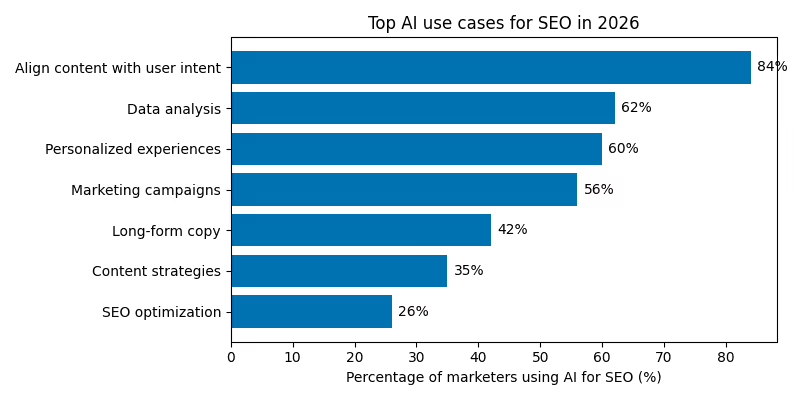
These statistics underscore that AI is now embedded in every stage of the SEO lifecycle, from research and planning to content creation and performance evaluation.
By adopting AI, marketing teams can process large data sets quickly, identify patterns, and craft tailored content strategies that resonate with audiences.
Generative Engine Optimisation (GEO): Becoming part of the answer
Generative Engine Optimisation (GEO) represents the next frontier of generative AI SEO for search visibility. Rather than focusing on where your link appears, GEO aims to ensure that your information is included in AI‑generated answers.
This shift reflects a broader change in how people consume information: they trust the answer they see, not the source list they might click.
GEO requires careful attention to language. You need to use consistent terminology for product names, executives, and concepts so that AI models recognise and reuse these patterns.
You also need to publish original insights and thought leadership, as AI systems favour authoritative voices. For PR and communications teams, GEO means moving measurement from pageviews and backlinks to presence in AI answers and mentions in language models.
In a B2B context, this is critical. This is where artificial intelligence in SEO becomes a boardroom concern: teams often rely on quick summaries rather than deep dives, and being cited directly in an AI‑generated overview can influence perceptions and decisions.
What are some of the challenges with AI SEO?
Measuring success in a nondeterministic environment
Unlike traditional search results, AI responses can vary from one interaction to another. Generative models are probabilistic; they may cite different sources or synthesise information differently depending on context.
Measuring AIO (Artificial Intelligence Optimisation) success, therefore, requires repeated testing across platforms and prompts.
Instead of tracking a single ranking, teams must monitor average citation frequency, sentiment of mention,s and alignment with brand messaging across multiple AI responses.
Ethical and accuracy concerns
Generative AI can sometimes hallucinate or misrepresent information. Ensuring that your brand is accurately represented requires vigilance.
Maintain up‑to‑date content and clear language, and monitor how AI tools summarise your information.
Provide explicit corrections and clarifications on your own channels to establish a trustworthy record for AI models to reference. Encourage thought leadership and earned media coverage in reputable outlets, as high‑quality sources are more likely to be cited by AI systems.
Balancing automation with authenticity
AI can automate repetitive tasks, but marketing that resonates still requires human insight. Over‑reliance on generative tools can produce generic content lacking nuance.
For B2B audiences, authenticity and expertise are key. Use AI to enhance your efficiency, not to replace your voice. Focus on delivering unique perspectives, proprietary data, and clear opinions to stand out in AI summaries and human evaluations alike.
Reinforced role of generative AI SEO in enterprise strategy
As AI becomes deeply embedded in search, the distinction between SEO and AI SEO will fade. Every optimisation effort will consider both human readers and machine interpreters.
Predictive analytics will allow marketers to anticipate shifts in demand, and content will be personalised at scale.
Generative models will integrate seamlessly into search interfaces, making conversational discovery the norm. If you are looking to improve how your brand appears inside AI driven search and Google AI Overviews, explore our AI SEO services.
For marketing leaders, success will depend on building trustworthy brands, investing in structured data, and nurturing a culture of continuous learning. Those who adapt quickly will not only preserve visibility but also shape how their industries are perceived.

Do you want more traffic?