




Traditionally, search engines focused on sourcing entire pages. However, modern AI systems focus on retrieving specific chunks or pieces of content. Once these chunks are gathered, the system doesn't simply present them in a list. Instead, it performs fusion, which is just comparing multiple chunks from various sources and building a cohesive answer by combining them. This process begins with a fan-out. Query fan-out is the process by which an AI system decomposes a single query into multiple sub-queries that explore different aspects of the user's intent.
Blog
Predictive Demand Generation: Using Data Science to Find the Right Buyer at the Right Time
In most B2B organisations, at times we come across the performance numbers that are not correct. Marketing hits 110% of its MQL target, dashboards glow green, and yet the quarter ends with a pipeline gap that no one can comfortably explain. Sales leaders insist the leads are not ready. Marketing insists the programs worked. The board only sees that the revenue was missed.
Across the industry, studies consistently show that the overwhelming majority of leads never turn into revenue-bearing opportunities. At the same time, platforms keep multiplying, data keeps fragmenting and buying journeys keep getting longer and less visible.
The result is a familiar pattern for CMOs: long lists of "interested" accounts, low meeting acceptance, stalled opportunities and a martech stack that looks powerful on paper but feels blunt in practice.
The real failure is not effort or creativity. It is that most demand engines still treat every account as if it is equally ready to buy. They push the same campaigns to companies that are casually browsing and to those actively assembling a shortlist. When timing is off, even strong messaging and well-funded programs come across as noise.
Predictive demand generation exists to fix this. By combining data from your CRM, website, campaigns, product and external signals, it becomes possible to see which buying committees are actually warming up, which ones are cooling down and which ones are not worth chasing this quarter.
This is the shift FTA Global optimises for: moving CMOs away from counting leads and toward a demand engine that constantly answers a sharper question for the business: who is the right buyer, in the correct account, at the right time?
Why are traditional B2B demand generation plays breaking under CMO scrutiny?
Twenty years ago, the classic demand generation playbook worked because markets were less crowded and buyers had fewer options. Sales teams could afford to engage everyone who downloaded a whitepaper.
Today, the situation is different. Buyers self‑educate, procurement committees are larger, and budgets are scrutinized more closely.
Traditional lead‑based demand generation starts with capturing a name and then applying a static score based on a handful of attributes, such as company size or whether a form was filled out. This process favours volume over quality and doesn’t account for real buying intent.
You can see these trends often. High MQL volume, with flat opportunity and revenue signals, suggests marketing is optimising for the wrong stage. Sales representatives usually ignore marketing-qualified leads and instead build their own prospect lists because they distrust the scores. Meanwhile, martech stacks bristle with tools that never realise their potential because data is fragmented and rules are outdated.
Another problem is that demand generation still treats leads as individual contacts, even though committees make enterprise purchases. A lead from a junior analyst is rarely meaningful if the rest of the team is not engaged.
Predictive demand generation flips this paradigm by looking at account‑level signals across multiple people and channels, helping CMOs deliver fewer but higher‑quality opportunities to sales.
Predictive demand generation in B2B marketing: a clear working definition
Predictive demand generation uses statistical models and machine learning to identify which accounts are most likely to buy, when they are moving from research to active evaluation and which messages will resonate.
This discipline goes beyond basic lead scoring or static rules. Instead of assigning arbitrary points to actions like “opened an email”, predictive models analyse thousands of historical conversion patterns to learn which combinations of behaviours actually correlate with deals. They continuously adapt as new data flows in, improving accuracy over time.
Three core goals define predictive demand generation:
- Identify high‑fit accounts. Fit models evaluate firmographic, technographic, and size attributes to determine whether a company resembles your best customers. This avoids chasing tyre‑kickers or companies outside your ideal customer profile.
- Detect in‑market intent. Intent models watch behavioural and external signals to see when a buying committee is moving from awareness to consideration. The focus is on timing, not just interest.
- Deliver context‑appropriate engagement. Combining fit and intent scores with content analytics and historic conversion paths helps marketers craft the right message and channel for each account. The result is personalised campaigns that feel timely rather than spammy.
This approach departs from generic AI claims by focusing on transparent models built on first‑party and reputable third‑party data. It also differs from basic intent targeting, which often relies on a single data source. Predictive demand generation integrates multiple signals, weighs their importance, and scores accounts in ways that both marketing and sales understand.
What data signals really matter if you want to find in‑market B2B buyers?
Predictive demand generation stands on the shoulders of data. But not all data signals are created equal. Leading programs incorporate at least four pillars:
- First‑party behavioural signals. These are actions prospects take on your owned channels: website visits, pricing page views, email engagement, webinar attendance and product usage. For example, repeated visits to a pricing page or sudden spikes in product trial usage often indicate a buyer is nearing a decision.
- Firmographic and technographic data. Firmographics describe who the company is, industry, size, location, revenue and growth stage. Technographics cover the tools and systems they already use. They reveal whether the account fits your ideal profile and whether your solution integrates well with their stack.
- Third‑party intent signals. These external signals come from publisher networks, review sites and research platforms. They include people from a target company reading comparison articles, researching competitor solutions or searching high‑frequency keywords related to your category. Platforms like Demandbase, Bombora and 6sense aggregate these signals using natural language processing and IP look‑ups to identify which companies are actively researching specific topics.
- Contextual triggers and organisational changes. Funding rounds, leadership appointments, job postings, contract renewals and regulatory shifts can all trigger purchasing cycles. Monitoring these external events helps marketers engage at the right time, such as when a company raises fresh capital or hires a new chief information officer.
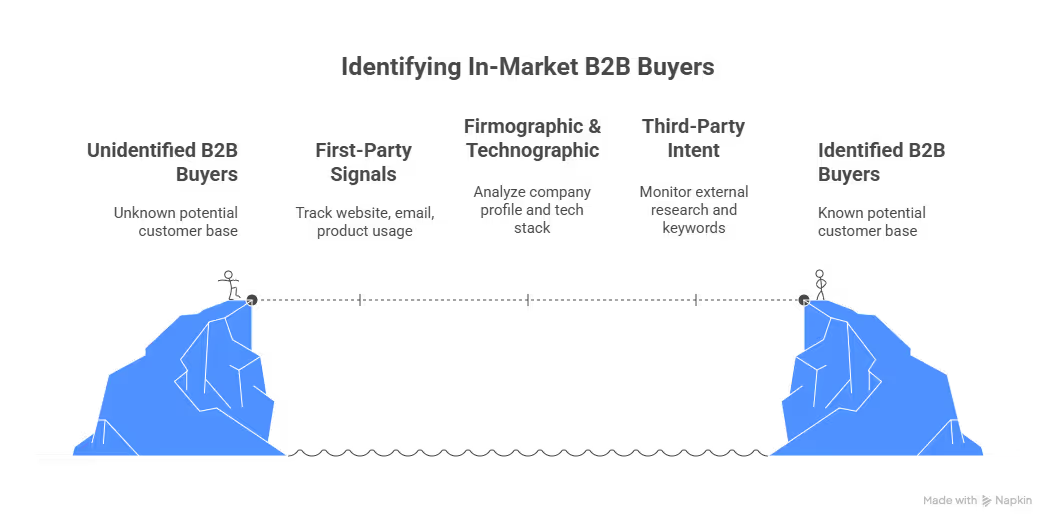
Comparison between data signals and their sources
Understanding and layering these signals allows CMOs to build a unified picture of each account.
According to research, only 5% of your target audience is actively in the market at any given time, and 84% of deals are won or lost before providers notice the opportunity.
Companies that use behavioural insights and triggers see conversion rates rise by 35-40% and margins improve by 25%. The key is to use signals to prioritise accounts, not to bombard everyone.
Data science techniques behind predictive demand generation
At the heart of predictive demand generation are statistical models that turn raw signals into actionable scores. While the underlying algorithms can be complex, the concepts are accessible:
Propensity and conversion models estimate the likelihood that an account will progress to the next stage, such as moving from marketing-qualified to sales-qualified or from opportunity to closed deal. These models are trained on historical outcomes and update as new data arrives. For example, DocuSign used behavioural indicators, such as trial sign-ups and contract views, to build a model that increased MQL-to-SQL conversions by 38% and reduced lead-to-close time by 27%.
Account-fit models evaluate whether a company aligns with your ideal profile. They incorporate firmographic and technographic attributes to assign a suitability score. When combined with intent scores, they help teams focus on high‑fit, high‑intent accounts.
Engagement and intent scoring tracks the recency, frequency and depth of interactions across channels. Instead of manually adding points, machine learning assigns weights to each activity based on its significance. Research summarised by Forrester showed that users of AI‑based predictive scoring experienced a 28% improvement in conversion rates and 25% shorter sales cycles compared with traditional scoring. ZoomInfo clients reported a 32% increase in SQL‑to‑customer conversion rates within 90 days. These improvements stem from models that automatically learn which behaviour patterns matter.
Next-best-action models recommend the next course of action. Should you send an email, call, serve an ad or invite the account to an event?
By analysing similar past journeys, these models suggest the touchpoint most likely to move the account forward. They can also allocate budget across channels based on predicted return.
Implementing these techniques doesn’t require building algorithms from scratch. Major vendors such as Salesforce, Microsoft and 6sense offer predictive scoring modules integrated into their platforms. Big consultancies and global agencies use them to operationalise data science for enterprise clients. The key is to ensure transparent scoring logic so that sales teams trust the results.
How do you know which account is the right bet this quarter?
Predictive models are only helpful if they drive prioritisation. CMOs need to turn scores into a hierarchy of accounts that guides budget and time allocation.
A simple way to visualise this is to map percentage improvements across a range of metrics drawn from published case studies. The chart below compares how predictive analytics has boosted win rates, shortened deal cycles, increased average deal sizes, lifted revenue, reduced costs, delivered more sales‑qualified leads and improved customer satisfaction.
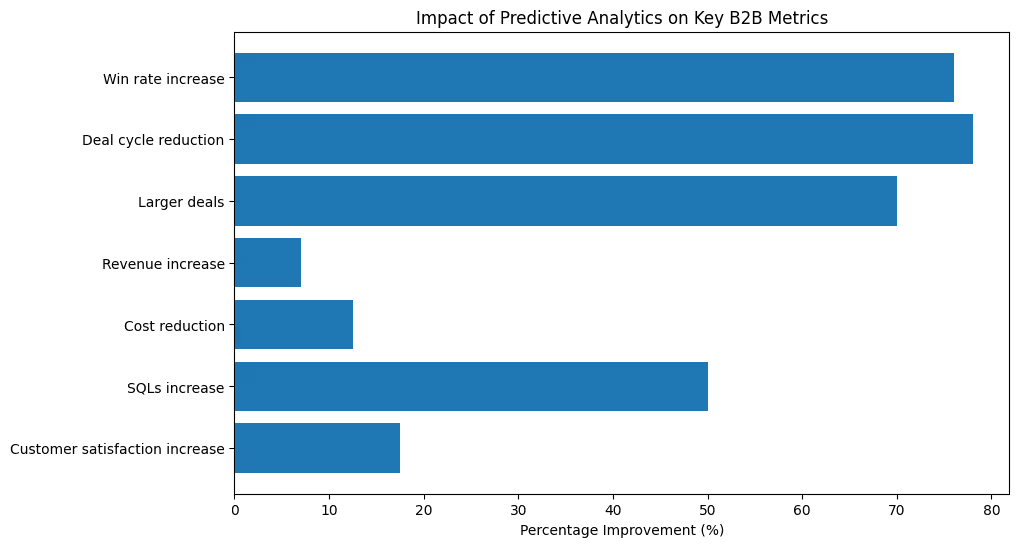
This bar chart illustrates why predictive demand generation is worth the investment. Even a 20% lift in conversion rates can translate into millions in the pipeline for large enterprise campaigns. An 80% improvement, as seen by Grammarly, shows the exponential impact when behavioural data and machine learning are fully harnessed.
To make decisions quarter by quarter, CMOs should tier accounts by both fit and intent scores. High‑fit, high‑intent accounts warrant immediate outreach and higher media spend.
High‑fit but low‑intent accounts may stay on nurture tracks. Medium‑fit accounts with strong intent spikes could present opportunistic wins if resources allow. This approach aligns marketing and sales on a standard set of priorities, ensuring resources go where they will have the greatest impact.
FTA Global’s Predictive Demand Engine for B2B CMOs
FTA Global has distilled lessons from dozens of predictive programs into a simple framework called Predictive Demand Engine (PDE). This engine guides marketers through four phases:
- Discover. Audit existing data sources and identify which signals are available. Unify first‑party behavioural data from web, product and campaigns with firmographic and technographic enrichment. Supplement gaps with third‑party intent data and external triggers. Many clients discover that they already have more actionable data than they thought.
- Decide. Build a scoring model that combines fit and intent. This model doesn’t need to be a black box. Start with a composite score derived from a few key attributes and behaviours. Establish clear thresholds for what constitutes “ready to engage” versus “nurture”. Involve sales leaders to ensure buy‑in.
- Design. Orchestrate plays based on the scores. High‑priority accounts might receive personalised advertising, direct mail and outreach from senior sales representatives. Mid‑priority accounts may remain in automated nurture sequences until intent signals increase. Use multi‑channel orchestration platforms to sync audiences across Meta, LinkedIn and programmatic channels while aligning SDR tasks.
- Demonstrate. Measure pipeline lift, deal velocity, win rate and revenue impact. Compare the performance of predictive segments against control groups. Communicate results in business terms to finance and the board.
How do you plug predictive demand generation into your current stack without a full rebuild?
CMOs often fear that adopting predictive models requires ripping apart their technology stack. In reality, many existing tools can support predictive demand generation with modest configuration. Start by creating a unified scoring layer across your CRM and marketing automation platforms. Most modern systems, including HubSpot, Salesforce, and Microsoft Dynamics, offer predictive scoring modules or integrations with specialised vendors such as 6sense, Demandbase, and MadKudu.
Here is a practical three‑step approach:
- Unify scoring: Export historical lead, opportunity and revenue data from your CRM. Enrich with firmographic and technographic attributes and build a simple propensity model using out‑of‑the‑box tools. Use this model to generate a ranked list of accounts for the next 90 days.
- Activate across channels: Sync the high‑priority account list into marketing automation, advertising platforms and sales engagement tools. Many systems allow you to push predictive scores into custom fields and build segments. This lets you run ads on LinkedIn and Meta, targeted at accounts that show intent, while aligning SDR cadences.
- Pilot and refine. Run a pilot for one business unit or region. Track metrics such as engagement, pipeline created, win rate and cycle length. Use these insights to adjust thresholds and weighting. Only when the pilot proves value should you consider deeper integrations, such as a customer data platform (CDP) or a data warehouse.
Measurement, benchmarks and ROI of predictive demand generation
Precise measurement is critical to justify predictive investments. Focus on metrics that align with revenue outcomes rather than vanity measures. Key metrics include:
- Pipeline created from predictive segments. Track the number and value of opportunities sourced from high‑intent account lists versus control groups.
- Win rate and deal size. Improvements in win rate or average deal size indicate that predictive scoring is bringing more qualified opportunities.
- Sales cycle length. Many case studies report shorter cycles; DocuSign cut lead‑to‑close time by 27%, and Grammarly reduced deal time from up to 90 days to 30 days.
- Cost per opportunity and cost per revenue. As predictive models prioritise high‑value accounts, marketing spend becomes more efficient.
What can go wrong with predictive demand programs, and how do you de‑risk them?
Predictive demand generation is not a panacea. Several pitfalls can derail programs:
- Overfitting to historical customers. Models trained only on existing customers may miss emerging segments or new industries. Avoid this by blending historical data with broader firmographic samples and testing across segments.
- Black‑box scores without validation. If salespeople cannot understand or trust the scores, they will ignore them. Use transparent models and involve sales in defining what a qualified account looks like.
- Poor data quality or incomplete integration. Missing or inconsistent data undermines model accuracy. Invest in data hygiene and governance. According to Act‑On’s survey, only 34% of marketers felt confident in their data quality.
- Lack of training and adoption. Without proper enablement, sales teams may revert to old habits. Trend Micro’s success with 6sense involved extensive training to rally the team around the new platform.
- Regulatory and ethical concerns. Ensure that data use complies with GDPR and CCPA and that models don’t inadvertently introduce bias. Maintain human oversight.
To de‑risk your program, create a cross‑functional steering group that includes marketing, sales, data science, and legal.
Establish regular model reviews, monitor bias and fairness metrics and set clear guidelines for data privacy. Encourage a test‑and‑learn culture; predictive models must evolve as market conditions change.
A 90-day roadmap to launch predictive demand generation in one business unit
Launching predictive demand generation does not need to be a multi‑year project. A focused 90-day plan can deliver tangible results:
Weeks 1-3: Define and audit. Clarify your ideal customer profile, key segments and success metrics. Audit current data sources and signals across CRM, marketing automation, web analytics and third‑party providers. Ensure data quality by cleaning and enriching records.
Weeks 4-6: Build and score. Select a predictive scoring tool—this could be a built‑in module from your CRM or a specialised platform. Label past leads and opportunities as won or lost, then train a model to predict conversion likelihood. Create tiered lists of accounts based on fit and intent scores.
Weeks 7-10: Launch integrated plays. Sync the high‑priority account list into your advertising platforms and sales engagement tools. Design campaigns tailored to each tier. For example, direct mail combined with executive outreach for top tiers and scaled digital nurture for mid tiers.
Weeks 11-13: Measure and refine. Track performance against your baseline. Evaluate pipeline created, win rate, deal size and cycle length. Adjust thresholds and weighting in your scoring model. Prepare a concise narrative for the board on what changed, including improvements in conversion rates and pipeline health.
We recommend this 90-day roadmap with clients as a pilot. In many cases, the predictive segment produces significantly higher pipeline with less spend, making the case for a broader rollout.
The era of blindly filling the funnel is over.
CMOs need to know not just who fits their ideal customer profile, but when these companies are ready to buy and what signals indicate readiness. Predictive demand generation uses data science to turn fragmented signals into a clear prioritisation framework. This shift from volume‑based lead generation to buyer‑timing‑driven programs drives measurable improvements in conversion rates, win rates and sales cycles. B2B brands that embrace behavioural insights and contextual triggers see sales growth and their margins climb.
By adopting frameworks such as FTA Global’s Predictive Demand Engine, as covered in this article, marketers can harness data science without losing the human touch. The prize is significant: more predictable revenue, better use of marketing budgets and sales teams that focus on the right buyers at the right time.
Ready to see which accounts are actually ready to move this quarter
Sit with our team for a working session on your current funnel and walk out with a draft predictive demand play tailored to your pipeline
Ready to see which accounts are actually ready to move this quarter
Sit with our team for a working session on your current funnel and walk out with a draft predictive demand play tailored to your pipeline
Table of contents
Case Studies
About FTA
Keep Reading


Author Bio

Experienced Performance marketing professional with over a decade of driving measurable ROI for brands across diverse industries. Hands-on expertise in developing data-driven campaigns across paid search, social, programmatic and new emerging channels that consistently outperform industry benchmarks.I trust every aspect of touchpoints ties back to growth - whether it adds to revenue, counts to leads, conversions, or category share. Core competencies: SEM, paid social, Programmatic Display, Marketing Analytics, CRO, Marketing Automation and Performance Strategy.
Director - Performance Marketing