



Traditionally, search engines focused on sourcing entire pages. However, modern AI systems focus on retrieving specific chunks or pieces of content. Once these chunks are gathered, the system doesn't simply present them in a list. Instead, it performs fusion, which is just comparing multiple chunks from various sources and building a cohesive answer by combining them. This process begins with a fan-out. Query fan-out is the process by which an AI system decomposes a single query into multiple sub-queries that explore different aspects of the user's intent.
Blog
How to uncover and convert the dark funnel in B2B marketing?
What is the dark funnel in B2B?
The “dark funnel” refers to all the research, conversations and influence that shape a B2B buyer long before they touch any of your trackable channels. It is the part of the journey your CRM never sees.
Buyers explore problem definitions, compare vendors and form opinions quietly. They do this through private Slack groups, WhatsApp chats, LinkedIn DMs, internal email forwards, Google/Teams calls, industry communities and AI-assisted search. None of these leaves a clear attribution trail.
Research shows that more than 96.5% of all web pages receive no traffic from Google. This means that most corporate content never shows up when your buyers are searching for answers.
Dark social accounts accounted for all the clicks from popular messaging apps, and networks like TikTok pass no attribution data at all. Taken together, these findings explain why buyers seem to appear out of nowhere.
This blog article takes a practical look at how to uncover and convert that unseen activity. It is written for senior marketers who want to understand where their future customers are making decisions and how to influence them earlier. Rather than theory, you will find clear definitions, data from respected studies and a simple framework for aligning your team and technology.
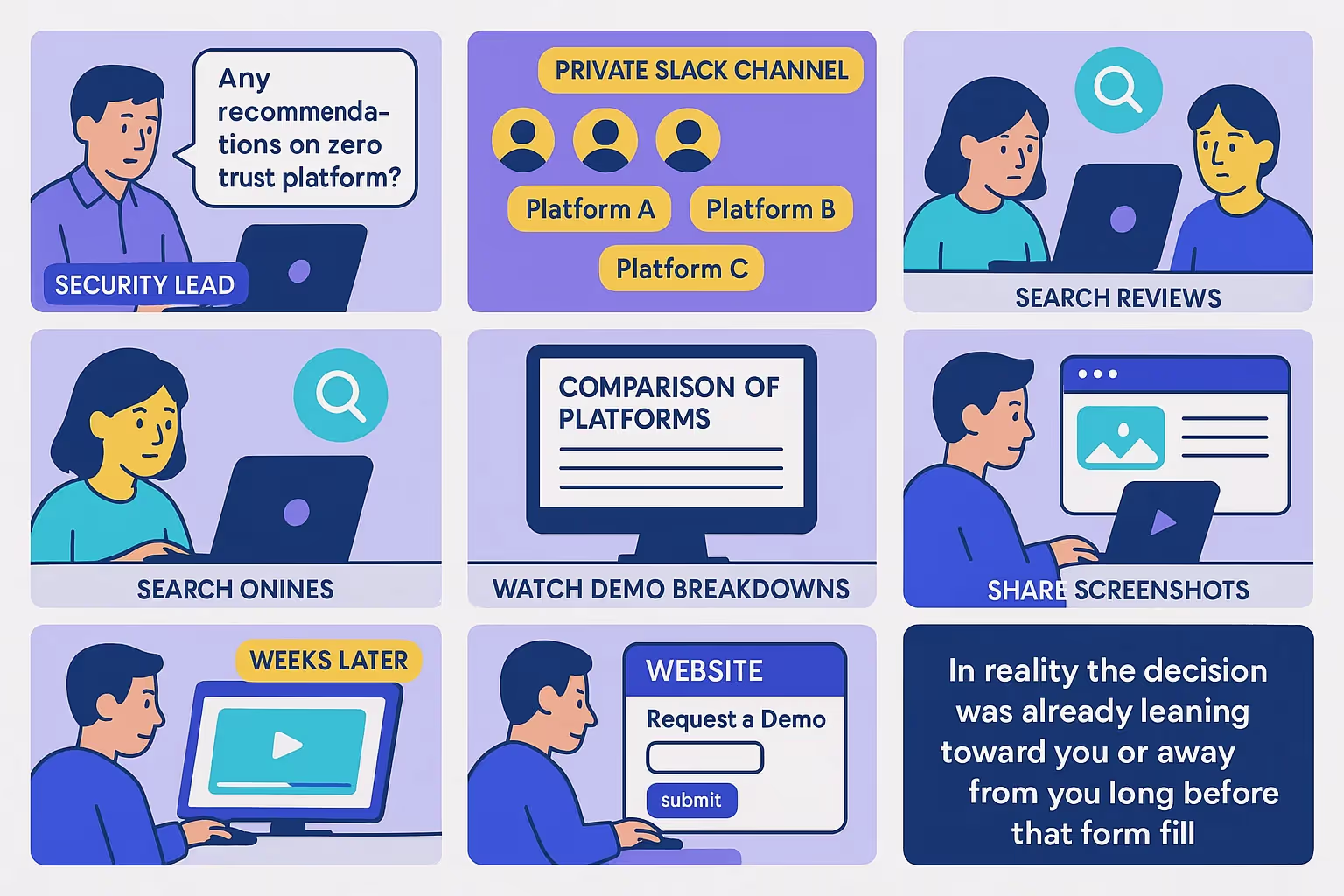
Here is a storyboard illustration to help you understand the concept of dark funnel -
Why do my best B2B buyers stay invisible until the last mile?
Your dashboard only reveals a small part of your buyers’ journey. You see the form fills, demo requests and campaigns that last‑touch attribution systems recognise. Meanwhile, the real decisions are happening far from your marketing automation.
A typical enterprise buying committee will silently scour search engines and AI assistants, ask peers in Slack or WhatsApp groups, compare vendors on specialist review sites and share links internally. Only when they have a preferred option do they reach out.
This lack of visibility creates three problems -
- Budgets are shaped by the small, visible slice of the journey, not the larger, early phase when buyers form their preferences.
- Dashboards give a false sense of funnel health even when win rates are flat.
- Marketing and sales blame each other because neither has visibility into the early research buyers have already done.
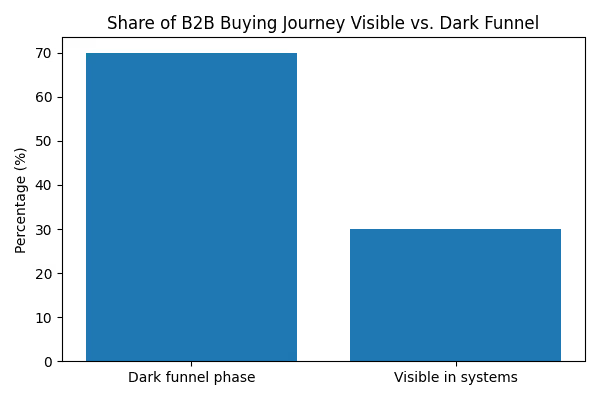
Check out this chart that illustrates the imbalance between what happens in the dark funnel and what your systems capture.
- The first bar shows the share of journey buyers' time spent in anonymous research, based on 6sense data.
- The second bar shows the slice that becomes visible when buyers finally talk to sales.
Where are B2B buyers really making decisions before they talk to sales?
First, if you want to influence the invisible part of a brand’s buyer journey, you need to know where it happens. In our day-to-day activities, we see four main zones that shape B2B decisions long before a salesperson is involved.
- Buyers start with broad problem searches. They read guides, comparisons and community conversations. AI tools now compress this stage by summarising information, reducing the number of clicks to individual websites. If your content does not show up for early problem queries or feed these summaries, you lose the chance to shape how buyers define their need.
- A large share of sharing happens in private channels. When someone drops your link into a chat or a closed group, analytics record it as direct traffic. Inside these spaces, buyers ask each other for recommendations, exchange screenshots and build informal shortlists.
- Internal committees also rely heavily on review and comparison ecosystems. They look for patterns, recent feedback and signals of fit for their size and region. A steady volume of credible reviews matters more than chasing perfect scores.
- Inside the account, people forward decks, reports and notes. They debate risk and fit long before speaking to any vendor. None of this shows up in your systems, yet this is where consensus forms.
Once you understand these zones, you can design content and touchpoints that appear where decisions are truly made rather than only where attribution is easy.
How do we track dark-funnel signals across search, social, and communities?
If the dark funnel is invisible by definition, how can you get any signal at all?
The key is to look for patterns rather than perfect attribution. Here are some ways to crack the dark funnel bridge -
- Search‑side signals. Use tools like Ahrefs and Semrush to identify topic clusters your buyers search for months before they become leads. Look for pages on your site that attract traffic but rarely convert – they often play an early education role. Track changes in branded search volume after you publish thought leadership or release a report. You can also monitor AI summaries to see how your brand is described in answers to relevant questions.
- Social and community signals. Track growth in direct and referral traffic after events, webinars or major announcements. A spike often indicates that people shared your content in private channels. Monitor saves, shares and comments on your posts rather than just likes – they signal that your content is being circulated. Listen in on niche communities where your buyers gather. Tools like Hootsuite’s social listening suite can help you trace conversations and brand mentions across channels.
- Review and comparison signals. Pay attention to the number and quality of reviews on third‑party platforms.
- Are there recurring themes in the comments?
- Are new reviews coming from your target segments?
- Compare category rankings and traffic of competitor profiles to see how visible you are in the shortlist phase.
- Early attribution methods. Add an open text field to high‑intent forms asking how prospects first heard about you. People will mention podcasts, communities and peers that would otherwise remain hidden. After deals close, conduct win-loss interviews focusing on the research journey. Ask buyers which resources they used, which questions they typed into search engines and whose opinions mattered most. This qualitative data quickly pays off.
Taken together, these signals let you build a picture of account‑level intent without needing a perfect tracking system. They tell you where to focus content and outreach to influence early thinking.
Dark funnel intent tracking tips for B2B teams
- Start by unifying your own data.
Look at activity by account, not by isolated leads. When you connect website behaviour, automation data, opportunity history and product signals, patterns emerge. You begin to see clusters of people from the same company circling the same problem before they ever show up in your pipeline. - Study what buyers research before they meet you.
Map the problem themes buyers explore early. This highlights where your content is influential and where it is absent. Pages that attract steady traffic but low conversions often reveal what buyers read during early education, not failure points. - Collect the buyer’s own words.
A single open question on high-intent forms gives you the missing half of the story. When prospects tell you who or what influenced them, treat it as a data point. These answers often expose the channels and conversations your analytics cannot see. - Create a simple ranking of account interest.
Blend three types of signals. Visibility signals like repeat visits. Depth signals like multiple roles from the same account spending time on problem content. Commitment signals, such as event attendance or direct outreach. This gives you a workable intent hierarchy that guides where to activate campaigns and where to hold back.
Traditional funnel versus dark funnel informed view
This table summarises key differences between the familiar funnel view and a dark‑funnel‑aware strategy. Each row is tied to a specific study or analysis. Use it as a framework for your own dashboard.
What does a dark funnel‑ready process look like?
Building visibility and influence in the dark funnel is not a one‑off project. It is a shift in how you organise, plan and measure marketing.
A dark funnel‑ready team has four defining characteristics -
- New roles and ownership - Someone in demand generation must own the dark funnel strategy rather than only chasing MQLs. Revenue operations plays the integrator role, connecting data across marketing, sales and customer success. Product marketing and customer marketing teams feed user insights back into the content strategy.
- Rituals and reviews - Hold a monthly dark funnel review where marketing and sales look at account clusters, intent signals and early‑stage content performance instead of channel‑level vanity metrics. Conduct win-loss reviews that begin with the research phase; ask buyers how they framed the problem and which resources influenced their decision. Run quarterly audits of your content and community presence to double down on assets that appear most often in self‑reported attribution.
- Partner and community layer - Treat partners, influencers and community managers as extensions of your go‑to‑market team. They are often closer to the conversations where decisions happen. Encourage employee advocacy on LinkedIn and invest in closed communities where your buyers seek advice.
- CMOs need to cultivate skills - Leaders who succeed here invest in customer research and interviewing skills. They learn to tell data stories that resonate with executives and boards. They break down silos between content, product and sales to create assets that buyers find useful during early research.
3-month rollout plan for dark funnel success
If you want a practical starting point, here is a high‑level plan you can tailor.
Month 1: Audit your current reporting to identify blind spots. Build a basic account‑level view using your existing tools, even if it is manual. Add self‑reported attribution to high‑intent forms.
Month 2: Use Ahrefs and Semrush to map search topics and early‑stage content gaps. Design one or two offers aimed at buyers in research mode, such as diagnostic checklists or industry benchmarks. Define an initial account intent scoring model.
Month 3: Run a pilot in one segment using dark‑funnel‑informed plays. Track coverage, momentum and conversion metrics for this pilot. Document what worked and where you need better data or processes.
After this pilot, you will know whether the approach raises opportunity quality and win rates. If it does, scale it. If not, adjust the model and continue learning.
Capture the dark funnel in B2B marketing
See how a dark‑funnel‑first demand strategy can improve the quality of your pipeline over the next four quarters, not just the volume of your leads.
Capture the dark funnel in B2B marketing
See how a dark‑funnel‑first demand strategy can improve the quality of your pipeline over the next four quarters, not just the volume of your leads.
Table of contents
Case Studies
About FTA
Keep Reading


Author Bio
.avif)
Hi, I’m Rachita Sharma. I lead Strategy and Growth at FTA Global, a performance-first agency built by operators, not pitch artists. My focus is simple. Build strategies that move. Content that sells. Campaigns that don’t just look good but work hard across every stage of the funnel. At FTA, I oversee new business pitches, performance frameworks, demand gen strategy, content marketing, thought leadership, and platform innovation. From GTM plans to creative studio direction, I work closely with brands to solve real problems with clarity, speed, and accountability. Before FTA, I led strategy at NP Digital India. I helped scale category-leading mandates across BFSI, retail, and D2C — owning everything from funnel architecture to narrative building. Prior to that, I was Business Head at Ethinos, managing full-service accounts for brands like KTM, Chetak, Tata Capital, and Kotak Mutual Fund. Media. Content. Analytics. Growth. It all sat under one roof. What ties it all together is a sharp operating lens. I’m not here to drop frameworks and walk away. I stay close to execution. Because the gap between a good deck and a good outcome is often discipline.
VP - Strategy and Growth