




Traditionally, search engines focused on sourcing entire pages. However, modern AI systems focus on retrieving specific chunks or pieces of content. Once these chunks are gathered, the system doesn't simply present them in a list. Instead, it performs fusion, which is just comparing multiple chunks from various sources and building a cohesive answer by combining them. This process begins with a fan-out. Query fan-out is the process by which an AI system decomposes a single query into multiple sub-queries that explore different aspects of the user's intent.
Blog
How Should You Structure Information in RAG so Retrieval Never Fails?
AI has practically entered every field and industry, and it continues to impact every repeatable process and improve efficiency. Still, there are certain compliance challenges when it comes to the ethical use of AI, and how can we make it trustworthy? Retrieval-Augmented Generation (RAG) was built to answer that. It can make AI factual, consistent, and context-aware. However, RAG only performs as well as the information it retrieves. If your knowledge is fragmented, even the best retrieval system will stumble.
The real challenge isn’t RAG’s architecture. It’s the way businesses store and structure their data. This guide explains how to design, label, and govern information so your retrieval pipelines never fail and your teams stop chasing broken answers.
What is RAG really solving and why do retrievals still fail: foundations and failure modes?
RAG’s job is to ground a model’s response in verified data before it speaks. Yet most failures come not from the model, but from the foundation beneath it.
Here’s where retrieval breaks down:
- Chunk imbalance: Chunks are either too large or too small, so the right fact never lands in the top results.
- Noisy indexes: When unrelated content types sit together without metadata, rankers lose signal.
- Single-mode retrieval: Using one retrieval method misses edge cases and nuanced intents.
- Redundant context: Long context payloads introduce near-duplicates, which confuse the model.
- Weak versioning: Outdated or duplicated content gets retrieved, producing conflicting answers.
Remember: Retrieval quality equals how precisely a user’s query maps to a well-defined unit of knowledge supported by minimal yet complete context.
How should you shape the source information architecture for RAG?
Think of your knowledge base as a product inventory, not a library. Every piece must be discoverable, traceable, and reusable.
1. Define atomic units
Each unit should answer one intent without external references. For policies, it might be a section plus a clause. For product documentation, it’s a feature, a limitation, plus an example.
2. Make the structure machine-obvious
Preserve headings, lists, tables, and captions as separate fields. Never flatten everything into text; machines rely on structure to retrieve meaning.
3. Attach business metadata
Assign filters humans use intuitively: product line, region, persona, edition, version, compliance class, and date of effect. This metadata ensures context precision.
4. Separate content types
Keep FAQs, release notes, and legal text in separate collections. Retrieval accuracy improves when the system first searches within the proper context.
5. Normalize identifiers
Use standardized product names, feature codes, and clause IDs. These act as anchors for both keyword and semantic retrieval.
6. Record provenance
Each chunk must include its source URI, title, author, timestamp, and version. Governance begins with traceability.
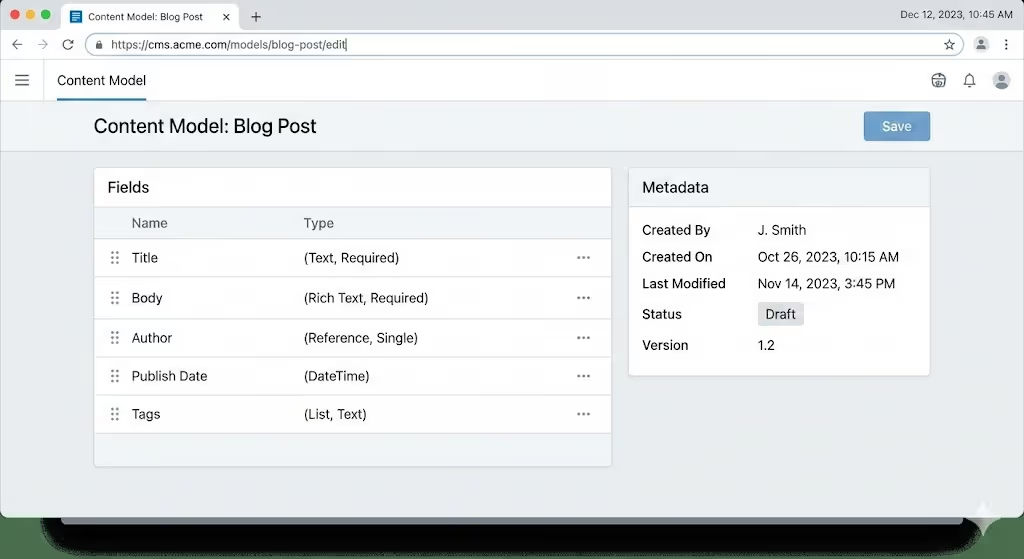
Example Content Model with Fields and Metadata
Chunking best practices for RAG
Chunking defines what your retriever can find. Poor chunking breaks even the best models.
1. Start with structure-aware splits
Split based on logical sections or headings first. Only use token-based splits when no structure exists.
2. Target mid-sized chunks
Most enterprise data performs best between 512–1024 tokens. Small chunks lose context. Large ones bury answers in noise.
3. Use controlled overlaps
A slight overlap helps preserve continuity where information crosses boundaries, but keep it minimal to avoid redundancy.
4. Apply late or semantic chunking for long documents
When documents are highly connected, embed the entire document context before chunking. This prevents the model from pulling disjointed facts.
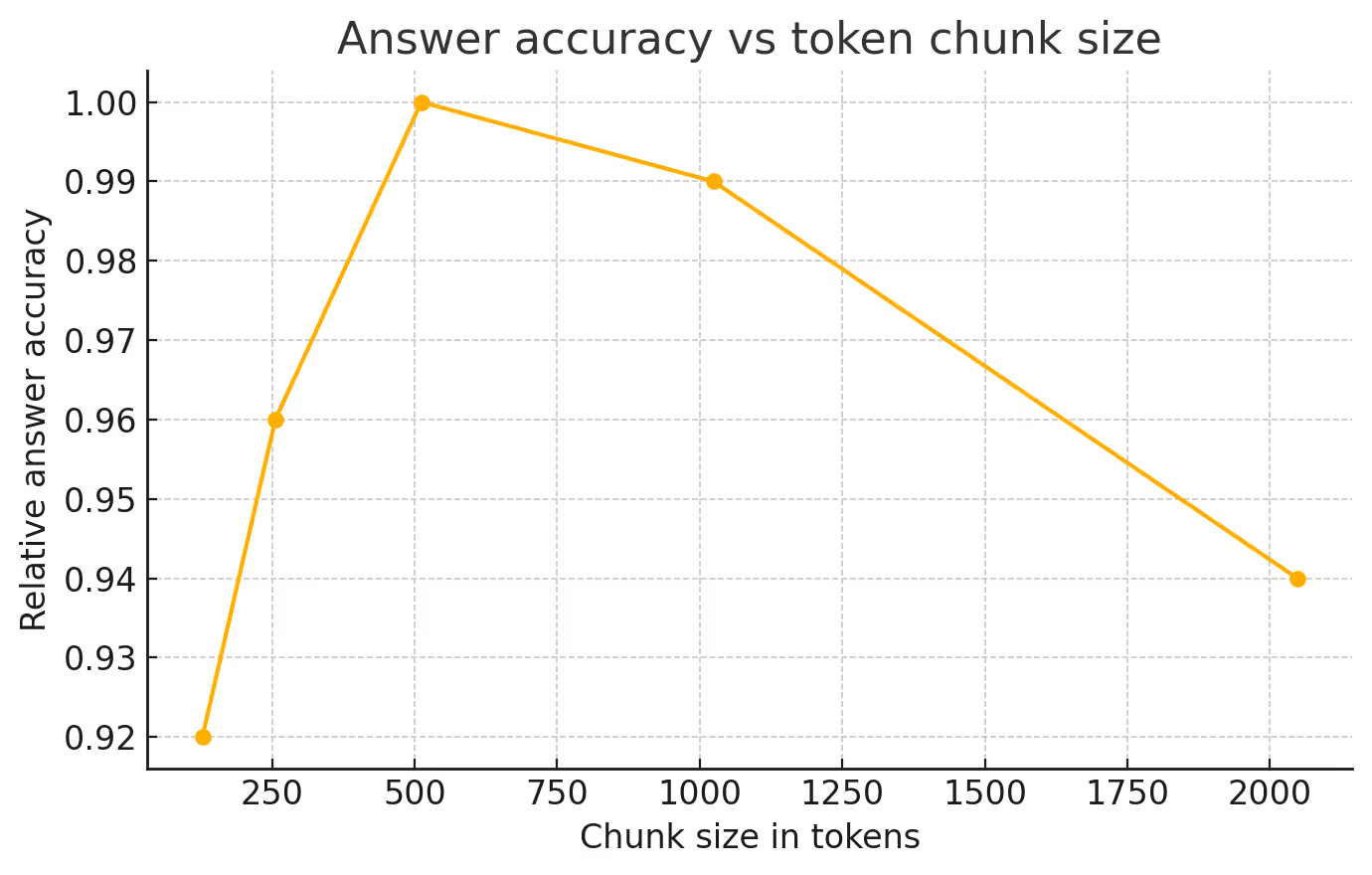
The chart reflects the common pattern: answer accuracy peaks at mid-sized chunks, consistent with multiple public evaluations, then tapers at the extremes.
How do embeddings and metadata reinforce each other: hybrid indexing and attribute filtering
Dense embeddings capture meaning, while metadata enforces business logic. Together, they build precision.
1. Pre-filter with metadata
Filter by region, product, language, and version before vector search. This narrows the search to only relevant content.
2. Post-filter with policy
After retrieval, apply privacy or entitlement checks before sending results to generation.
3. Follow schema discipline
Keep normalized fields, index numeric and date types separately, and always tag versions clearly.
Insert Screenshot: Vector Index Schema with Typed Metadata and Filters
When should you blend keyword and semantic search: hybrid retrieval that wins more often
RAG succeeds when it can balance literal precision with semantic understanding. No single method does both.
1. Default to hybrid in production
Use keyword search for names, IDs, and numbers. Use vector search for meaning and paraphrase detection.
2. Fuse results smartly
Reciprocal Rank Fusion (RRF) works best when you lack labels. Linear fusion is stronger when you can tune weights from real data.
3. Tune for intent
Exact, compliance-heavy queries should lean on sparse retrieval. Exploratory queries should emphasize semantic weight.
How do you rank without bias while keeping speed: retriever plus reranker stacking
A two-stage retrieval model is reliable and scalable.
Stage 1: Fast retrieval
Fetch top candidates quickly using sparse or dense methods with metadata filters.
Stage 2: Reranking
Run a cross-encoder reranker to score candidates in the query context. This improves ranking quality but adds predictable latency.
Keep these guidelines in mind:
- Keep k small to maintain speed.
- Cache reranker scores for frequently used content.
- Default to heuristic scoring during traffic spikes.
What context window should you target for different tasks?
Every token costs. Only include what strengthens the answer.
- Deduplicate aggressively. Remove repeated headers, footers, or boilerplate text.
- Prioritize citations. Use minimal context around the exact answer span.
- Order by confidence. Put high-relevance spans first; models weigh them more heavily.
- Control for drift. Always prefer the latest version and indicate if a policy has changed.
How do you keep retrieval fresh at scale: governance, versioning, and drift control
RAG maturity isn’t about model choice; it’s about operational hygiene.
- Version everything. From raw docs to embeddings, maintain lineage.
- Automate re-embedding. Refresh vectors when tokenisers or models evolve.
- Monitor retrieval health. Track recall, nDCG, and precision regularly.
- Secure by design. Apply metadata-based permission filters and log every retrieval event.
Which metrics should a CMO watch to prove ROI: KPIs and a simple control plan
CMOs don’t need the pipeline diagram; they need measurable impact.
Core Retrieval KPIs
- Recall@K for top intents
- nDCG@K for main corpus
- First-answer correctness
- Time to first token and overall latency
Operational KPIs
- Corpus coverage across products and markets
- Content freshness lead time
- Percentage of answers referencing current versions
- Escalation deflection rate and time saved
Control Plan
Assign each KPI an owner and review weekly. Use a short quality board of 10 core queries per corpus to track drift. Ship changes only with proven performance deltas.
Which retrieval stack belongs in your environment: one table to decide?
The table shows that hybrid retrieval is the most reliable baseline, while reranking adds precision where latency is acceptable.
Implementation checklist that rarely fails
Here is a checklist your team can use to make retrieval precise, consistent, and ready for production at scale. Follow these steps, and you’ll never have to patch a broken RAG pipeline again -
- Define atomic units and attach business metadata.
- Use structure-aware chunking with overlaps only when necessary.
- Index with both vectors and keywords, then fuse rankings.
- Add a reranker for high-value tasks and cache frequent hits.
- Pack context by evidence order and deduplicate.
- Version everything and monitor retrieval metrics regularly.
- Re-embed on every model or schema change with rollback ready.
Building Retrieval That Scales With Confidence
RAG success doesn’t come from bigger models. It comes from a better structure. When your data is clean, contextual, and version-controlled, every retrieval strengthens the business instead of adding noise. The goal isn’t just accurate answers. It’s consistent intelligence that lets leaders act faster, and teams work with clarity.
Ready to turn retrieval into a competitive advantage
We will audit your corpus, reshape your chunks, and ship a production retrieval stack that your sales and service leaders can trust.
Ready to turn retrieval into a competitive advantage
We will audit your corpus, reshape your chunks, and ship a production retrieval stack that your sales and service leaders can trust.
Table of contents
Case Studies
About FTA
Keep Reading


Author Bio

Experienced Search Engine Optimization (SEO) Specialist with a demonstrated history of working in the marketing and advertising industry. Skilled in Search Engine Optimization (SEO), Off-Page SEO, SEO Consultancy, Content Marketing, Organic strategy and Business Development through pitches
VP, Systems