




Traditionally, search engines focused on sourcing entire pages. However, modern AI systems focus on retrieving specific chunks or pieces of content. Once these chunks are gathered, the system doesn't simply present them in a list. Instead, it performs fusion, which is just comparing multiple chunks from various sources and building a cohesive answer by combining them. This process begins with a fan-out. Query fan-out is the process by which an AI system decomposes a single query into multiple sub-queries that explore different aspects of the user's intent.
Blog
Demand Generation 2026: Why the B2B Funnel Needs a Reset?
You can feel it in every QBR. Marketing shows a full funnel, healthy traffic, and a long list of “qualified” leads. Sales show lengthening cycles, stalled deals, and a forecast that keeps slipping to next quarter. Both sides are working hard, but the system is not.
Recent global research says more than 80% of business buyers end their process dissatisfied with the provider they finally choose. At the same time, over 96.5% of content published never earns meaningful organic traffic, and a growing share of B2B teams list lead quality, not lead volume, as their primary problem.
The real issue is not that demand teams forgot how to optimise. It is that they are optimising a funnel built for a different decade.
The traditional model assumes a buyer moves from awareness to interest to consideration to decision. In reality, you are selling to committees that self-educate across dozens of touchpoints, expect rep optional paths for most of the journey, and only surface to your sales team when they are deep into a short list.
In that particular world, a funnel that rewards early form fills and MQL volume does something dangerous. It gives the organisation a false sense of momentum. Dashboards look positive while the metrics that actually matter to a CMO, a profitable pipeline in the right accounts, and reliable expansion, start to decay.
Demand Generation 2026 is not about adding one more channel or a smarter scoring model. It is about admitting that the current B2B funnel structure is out of sync with how buyers choose, and then rebuilding it around intent, journeys, and revenue, not stages on a slide.
Why is the classic B2B funnel breaking down in 2026?
For the last decade, most teams have used a variation of the same funnel.
Anonymous visits become leads. Leads are nurtured into MQLs. MQLs turn into SQLs, then opportunities, then revenue. Each stage has its own conversion rates, owners, and reporting.
It looks clean in a slide. It does not match how buyers move. Today, B2B buying looks more like this.
A group of six or more stakeholders, spread across functions and regions, all doing their own research. Some read analyst reports. Some search deep into long-tail queries. Some ask peers on social channels and community forums. They join webinars, compare review sites, try products on their own, and only later talk to a sales team, if at all.
Research from major firms on B2B buyer behaviour over the last two years shows three critical patterns -
- Most buyers now prefer a self-directed, digital-first journey, with a strong shift to self-serve even for large transactions.
- Buying committees are larger and more cross-functional, which stretches cycles and introduces more parallel paths.
- Many buyers feel regret or dissatisfaction with their final choice, which suggests that current sales and marketing efforts are not helping them make confident decisions.
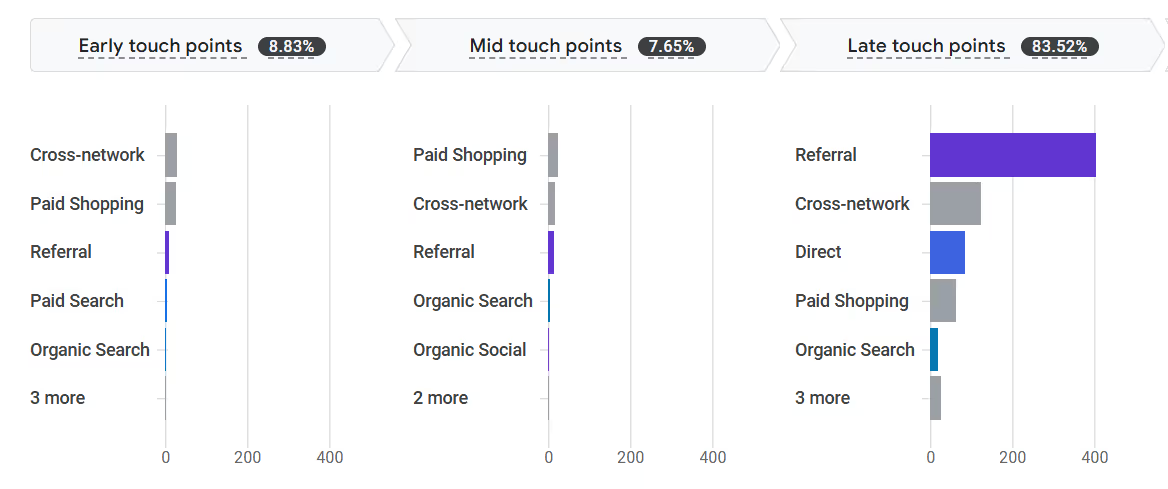
(This Analytics breakdown makes the funnel failure visible. Influence is scattered in early stages but heavily concentrated at the end, proving buyers do not move through the funnel the way teams assume.)
Early and mid touchpoints contribute very little, while the final conversion is overwhelmingly driven by late-stage channels, especially referral and cross-network sources.
The old funnel struggles in three specific ways against this reality.
- It assumes a linear sequence. Real buyers jump forward, loop back, and pause for months.
- It rewards volume at the top. Teams chase more form fills and more MQLs because that is what their targets demand, even if those contacts never had real intent in the first place.
- It assumes a clean internal handoff from marketing to sales. Buyers do not experience that handoff. They experience a single journey, across your website, content, sales team, product, and partners. When internal stages don't align with that journey, friction shows up as dropped deals and ghosted reps.
By 2026, this is no longer a theoretical debate. It is a performance problem.
The new reality of B2B buying and digital self-serve
Most B2B sales interactions will take place in digital channels. More than half of large deals are expected to be processed through self-serve channels such as vendor sites and marketplaces.
At the same time, buyer preference for rep-free experiences continues to rise, especially among younger decision-makers.
Yet those same studies report long, complex cycles and high levels of buyer frustration and regret.
That combination matters. It tells you that digital self-serve is not a nice-to-have layer on top of the funnel. It is the main stage.
If your funnel still assumes that the real journey starts when someone fills a form, you are missing most of what shapes the deal.
Add in the size of buying committees. In many tech and services categories, six to seven people are involved in decision-making. They enter and exit the process at different times, each with their own research trail and their own sense of risk.
In that environment, two things become true.
- Shallow content built to collect emails gets ignored in favour of practical, trustworthy resources.
- Forced captures that interrupt research journeys lead to inaccurate details, low-intent leads, and mistrust.
When you show a map like that to an executive team, the flaw in the old funnel becomes obvious. Buyers are not moving through stages. They are navigating their own paths, and your job is to support that path, not force it into your diagram.
What is actually wrong with lead-based demand generation
Lead-based demand generation looks attractive because it is so measurable.
You can report on cost per lead, e-book downloads, webinar registrations, and nurture email open rates. Automation tools make it easy to run more programs, score more leads and hand more names to sales.
Under the surface, four issues keep popping up.
1. The intent is weak
Most lead-capture programs are built around gated content that sits high in the journey. The intent signal tells you that someone wanted a resource, not that they are ready for a sales discussion.
This is why sales teams push back on MQLs. They see people who downloaded a checklist suddenly pushed into a discovery call workflow. From the buyer's side, it feels like spam. From the sales side, it feels like noise.
2. Content is invisible
Ahrefs and other platforms have published data showing that the vast majority of web pages receive no organic search traffic. In other words, most of the content that teams produce to generate demand is never seen by the market.
That is not just a content problem. It is a funnel problem. If your model assumes that more assets naturally translate into more top-of-funnel engagement, but distribution and search discovery are missing, you are building a funnel on empty air.
3. Conversion is poor
Nearly two-thirds of marketers see landing page conversion rates below 10% on average. When you combine low discovery with low conversion, the effective yield of your content and media drops sharply.
It is no surprise that teams feel they have to increase spending to hit the same pipeline targets constantly.
4. KPIs are misaligned
If marketing is rewarded mainly for lead volume and top-of-funnel metrics, while sales is judged on revenue and margin, the organisation will pull in opposite directions.
The funnel itself bakes in this misalignment because it treats MQLs as a core outcome. In 2026, MQLs are a weak outcome. They say nothing about deal size, progress of the buying committee, or the true intent.
To make this more concrete, here is a simple comparison view.
Lead-centric funnel vs demand-centric revenue engine
From linear funnel to dynamic buying journey
So what replaces the old funnel? Not another diagram with more boxes.
A more useful model for 2026 treats demand generation as three overlapping motions that run continuously across your go-to-market.
Demand creation
This is where you make the problem space and your category vivid in the market. It is the thought leadership, education, customer stories, and product point of view that build future preference among the right accounts long before they run a formal buying process.
Most of this happens in what people call the dark funnel. People talk, share, and learn in places you do not own.
You see the impact in branded search, direct traffic, and engagement, not in form fills.
Demand capture
This is where you capture existing market intent.
It includes search queries with clear commercial intent, review site visits, comparison research, partner referrals, and existing customers exploring expansions. Here, your job is to be visible, trustworthy, and easy to start with.
Strong demand capture relies on technical excellence in search, paid media, experience design, and routing. Minor changes to messaging and friction here often move the pipeline numbers more than big-brand plays.
Demand expansion
This motion focuses on existing customers and installed products or services.
Account teams, customer success, expansion marketers, and product teams all play here. When done well, expansion is not just upsell. It is about helping customers capture more of the value they originally bought you for, and then extending that value logically.
These three motions cut across channels and teams. They do not map neatly to the top, middle, and bottom of a cone. They look more like overlapping loops around the customer.
The chart below shows a clear imbalance in the current B2B funnel. Most content never gets discovered, and landing pages convert poorly, yet buyers are making the majority of their decisions in digital, self-serve environments. The gap between how teams build funnels and how buyers actually buy is where pipeline loss begins.
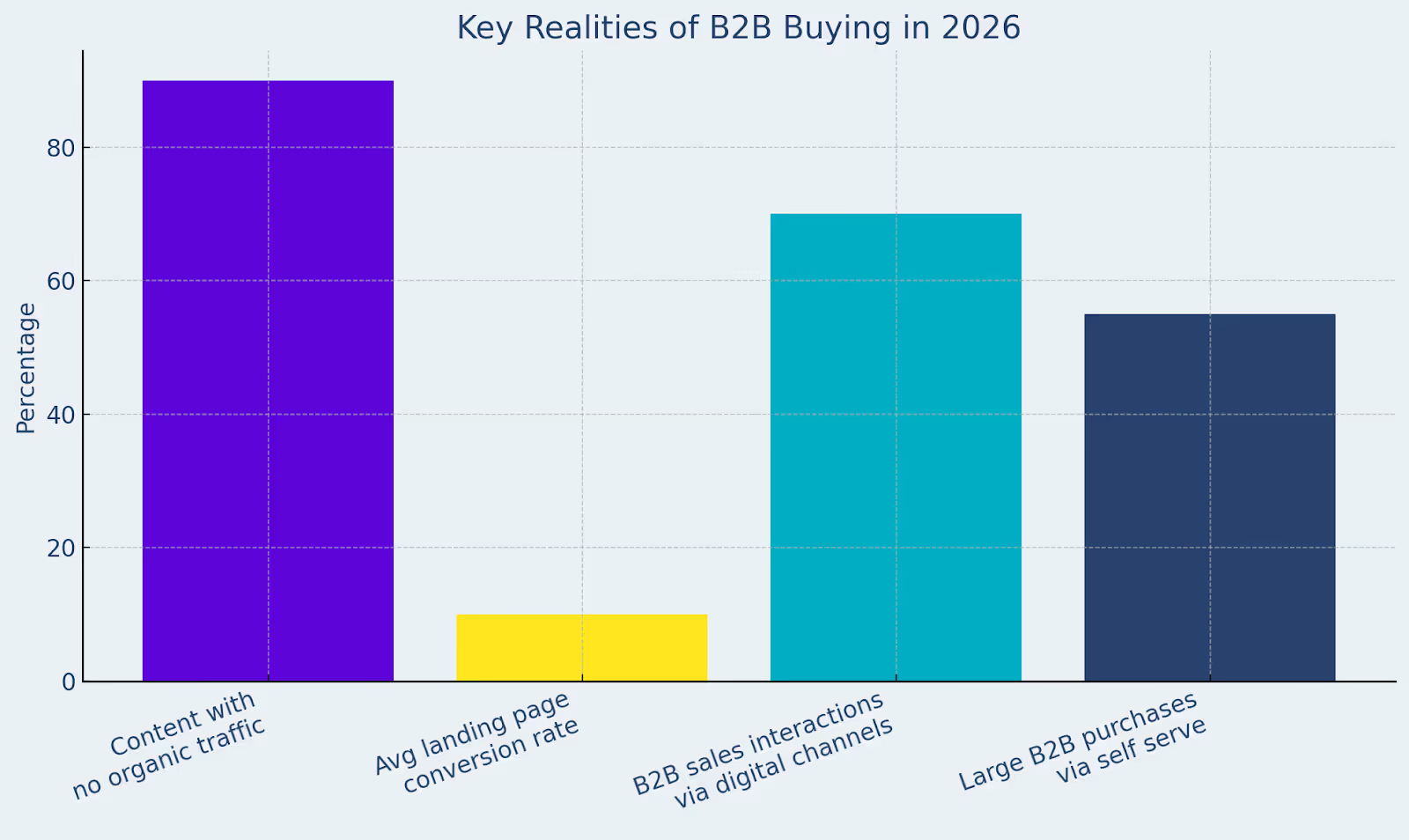
The problem is not a lack of activity. It is a mismatch between where your funnel is strong and where your buyers actually decide.
How should CMOs reframe demand generation for 2026?
Resetting the funnel starts with how you think and talk about demand at the leadership level.
Three shifts help in this process -
- From campaigns to systems
Rather than asking which campaign to run next quarter, the better question is how your demand system works as a whole.
- Which signals show that the right people in the right accounts are paying attention to you?
- How do those signals move into real opportunities?
- Where does the system leak value, either through poor experience or poor handoffs?
This forces teams to think beyond single channels and towards journeys.
- From MQL accountability to revenue accountability
CMOs who are still measured mainly on volume of leads will continue to overinvest in low-intent capture.
The more sustainable position is to tie marketing success to pipeline and revenue within defined segments, alongside sales. That shared accountability changes behaviour. Teams start to care less about how many people downloaded a report and more about whether the right committees are moving with confidence.
- From channel reporting to journey reporting
Channel reports will always matter, but they cannot be the only view.
You need to see how buyers move across owned, earned, and paid touchpoints over time. That view changes how you brief agencies, how you invest in brand, and how you defend non-last click activities.
In board conversations, this often comes down to one slide. A simple journey map from first signal to revenue, with clear points where marketing and sales both contribute. When everyone can see where value is won or lost, funnel debates become far more grounded.
Core pillars of a 2026 demand engine
Once the mindset shifts, you can rebuild the engine itself across a few core pillars.
Pillar 1: Customer and intent intelligence
Search data, CRM, product analytics, intent tools, and sales notes are often trapped in separate systems.
A modern demand engine brings these together to answer practical questions.
- What problems are your best customers actually searching for?
- Which content paths correlate with higher deal sizes?
- Which accounts are showing intent signals that have historically predicted closed revenue for you?
Even a simple shared view of these signals across teams often unlocks better focus.
Pillar 2: Content designed for discovery and conversion
The top-performing teams are not producing more content. They are producing better content and then maintaining it.
That means starting with real search and intent data, building fewer, deeper resources that fully answer questions, and refreshing those assets regularly based on performance. It also means designing content to move people to the next logical step, whether that is a self-serve trial, a calculator, a call with a specialist, or a simple pricing view.
This is the opposite of churning out assets to fill nurture tracks that no one reads.
Pillar 3: Always on-demand creation in the right places
Demand creation is easiest to ignore because it rarely shows up as a direct conversion in last click reports.
In 2026, it is also where much of the competitive advantage sits.
Think expert-led content in the channels your buyers actually participate in, whether that is sector-specific newsletters, events, editorial platforms, or communities. Think consistent brand behaviour that makes it clear what you stand for and which problems you solve best.
This is where your thought leadership, category narrative, and partnerships live.
Pillar 4: Frictionless paths to buy
If buyers prefer rep optional journeys, your owned properties must do more of the heavy lifting.
That means clear pricing models where possible, honest comparison pages, strong onboarding flows, and the ability to reach a real human quickly when the deal is complex or high-risk.
On the sales side, it means fast routing, tight service levels, and tooling that makes it easy for reps to pick up on digital signals and add value, rather than repeat questions buyers have already answered online.
Pillar 5: Revenue operations backbone
None of this works without a strong operational base.
You need a shared data model across marketing, sales, and customer success, consistent definitions of stages, and a measurement approach that accepts multi-touch reality rather than pretending one click closed the deal.
For many teams, this is the slowest part of the transformation. It is also the one that makes the reset durable.
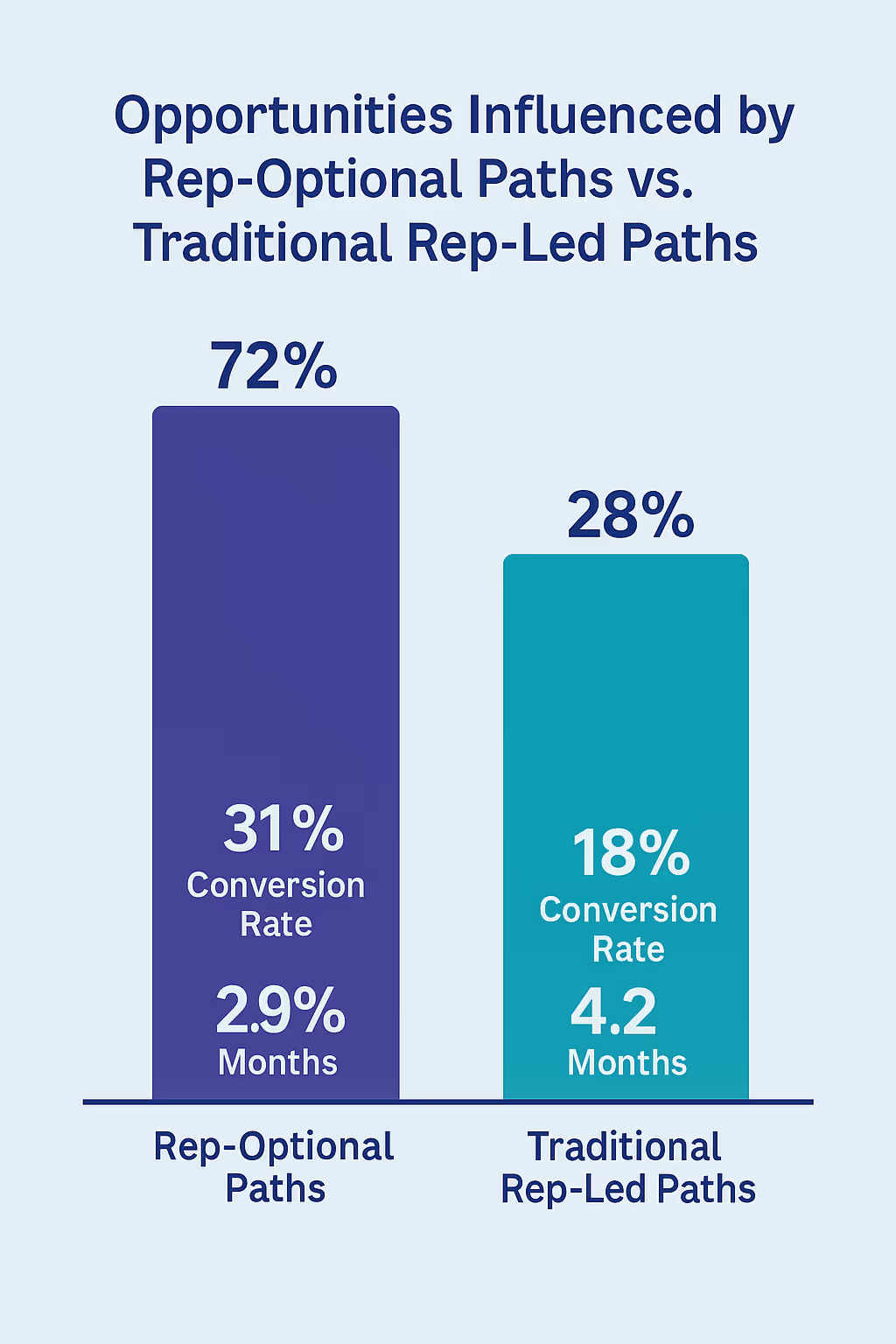
(A pipeline view that compares opportunities influenced by rep optional paths versus traditional rep-led paths, with conversion and velocity data.)
What metrics should replace MQLs for CMO dashboards?
You do not need to erase MQLs overnight. You do need to demote them.
A more useful CMO dashboard for 2026 splits metrics into three groups.
Signals of demand creation
- Share of relevant search demand that your content captures in your key categories
- Reach and engagement among priority accounts in critical channels
- Growth in direct and branded search traffic from target industries
These metrics show whether your brand and message are landing upstream, before buyers raise their hands.
Signals of demand capture
- Volume of opportunities created from high-intent pages and offers
- Conversion rates from key intent points, demo requests, pricing pages, and key feature pages
- Speed from first high-intent action to first value moment, such as a working session, proof of concept, or initial usage
These metrics show how well your system converts real demand into active opportunities.
Signals of efficient revenue
- Pipeline quality, mix by segment and predicted value
- Win rate and average deal size for priority segments
- Time to pay back for new acquisition motions
- Net revenue retention and expansion rates within key cohorts
These metrics show whether your funnel design is creating sustainable growth, not just one-time spikes.
Roadmap to reset your B2B funnel in the next 12 months
A funnel reset is not a two-week project. It is also not a five-year transformation.
A practical twelve-month roadmap looks like this -
Step 1: Audit your current funnel against buyer reality
Bring together people from marketing, sales, customer success, and operations.
Map what your current funnel and stages look like on paper, and then compare that to real buyer journeys taken from analytics, CRM and a handful of recent deals. Look for points where buyers move but your internal stages do not, or where your stages move but buyers do not.
This becomes your baseline.
Step 2: Map journeys for your top segments
Pick two or three high-value segments or plays. For each, build a detailed journey map that shows questions, channels and stakeholders across the full cycle, from first signal to renewal or expansion.
Ground this in both data and customer and frontline team interviews. The point is not to make a perfect diagram, but to understand where you need to be present and useful.
Step 3: Redefine stages and measurement
Using those journeys, redefine your internal stages to reflect meaningful progress for buyers, not just internal activities.
Clarify what counts as high intent, who owns which stages, and which metrics will tell you if demand creation, capture and expansion are working. Align leaders on these definitions and document them in simple language.
Step 4: Redesign key touchpoints and offers
You do not have to redesign everything at once.
Start with the touchpoints that have the biggest leverage.
That often means high-intent pages on your website, core content assets that drive search traffic, your main demo or consultation flows, and your outbound follow-up sequences. Simplify forms, clarify messaging, align offers with real buyer motivations and remove steps that do not add value.
Step 5: Rebalance spend between demand creation and capture
Look at your budget split.
How much is going into catching existing intent through search and performance media? How much is going into creating demand through brand, thought leadership, and partnerships?
In many organisations, capture is overweight and creation is underfunded. Rebalancing does not mean huge swings. It means a deliberate choice to protect long-term brand and category building while still funding the short-term pipeline.
Step 6: Train teams and reset incentives
Finally, make sure that people are rewarded for the behaviour you want.
If you want sales to value high-intent signals, give them better visibility and adjust targets away from activity counts alone. If you want marketing to care about revenue, make part of their variable pay depend on pipeline and closed-won results in named segments.
Change the stories you celebrate internally as well. Highlight wins where a better journey, a smoother self-serve path, or a stronger piece of content made the difference, not just the largest campaign by spend.
Bringing it together for 2026
By 2026, the question is no longer whether the classic B2B funnel needs a reset. It is whether you are willing to treat that reset as a leadership decision rather than a tactical tweak.
The signals are clear. Buyers want more control, more clarity, and more proof before they commit. They do most of that work digitally, often without ever speaking to a rep. At the same time, internal teams are under pressure to prove return on every dollar and to do more with less.
In that environment, chasing more low-intent leads is an expensive distraction.
A modern demand engine looks different. It respects how buyers actually move. It focuses on signals of real intent, not vanity metrics. It invests in content and experiences that are discoverable and useful, rather than just collectable. And it aligns marketing, sales, and customer success around shared revenue outcomes.
For CMOs, the practical choice is simple.
Either keep optimising a funnel that buyers have already left behind or take the next year to rebuild around the way they buy now.
Ready to reset your B2B demand engine for 2026?
Use this quarter to stress test your funnel against how your best customers really buy
Ready to reset your B2B demand engine for 2026?
Use this quarter to stress test your funnel against how your best customers really buy
Table of contents
Case Studies
About FTA
Keep Reading


Author Bio
.avif)
Hi, I’m Rachita Sharma. I lead Strategy and Growth at FTA Global, a performance-first agency built by operators, not pitch artists. My focus is simple. Build strategies that move. Content that sells. Campaigns that don’t just look good but work hard across every stage of the funnel. At FTA, I oversee new business pitches, performance frameworks, demand gen strategy, content marketing, thought leadership, and platform innovation. From GTM plans to creative studio direction, I work closely with brands to solve real problems with clarity, speed, and accountability. Before FTA, I led strategy at NP Digital India. I helped scale category-leading mandates across BFSI, retail, and D2C — owning everything from funnel architecture to narrative building. Prior to that, I was Business Head at Ethinos, managing full-service accounts for brands like KTM, Chetak, Tata Capital, and Kotak Mutual Fund. Media. Content. Analytics. Growth. It all sat under one roof. What ties it all together is a sharp operating lens. I’m not here to drop frameworks and walk away. I stay close to execution. Because the gap between a good deck and a good outcome is often discipline.
VP - Strategy and Growth