
What’s really changing in how people search today?
Search behaviour has always evolved, but the last two years have led to a seismic shift.
Generative AI platforms such as Google AI Overviews, ChatGPT, Gemini, and Perplexity now answer queries directly rather than just listing links.
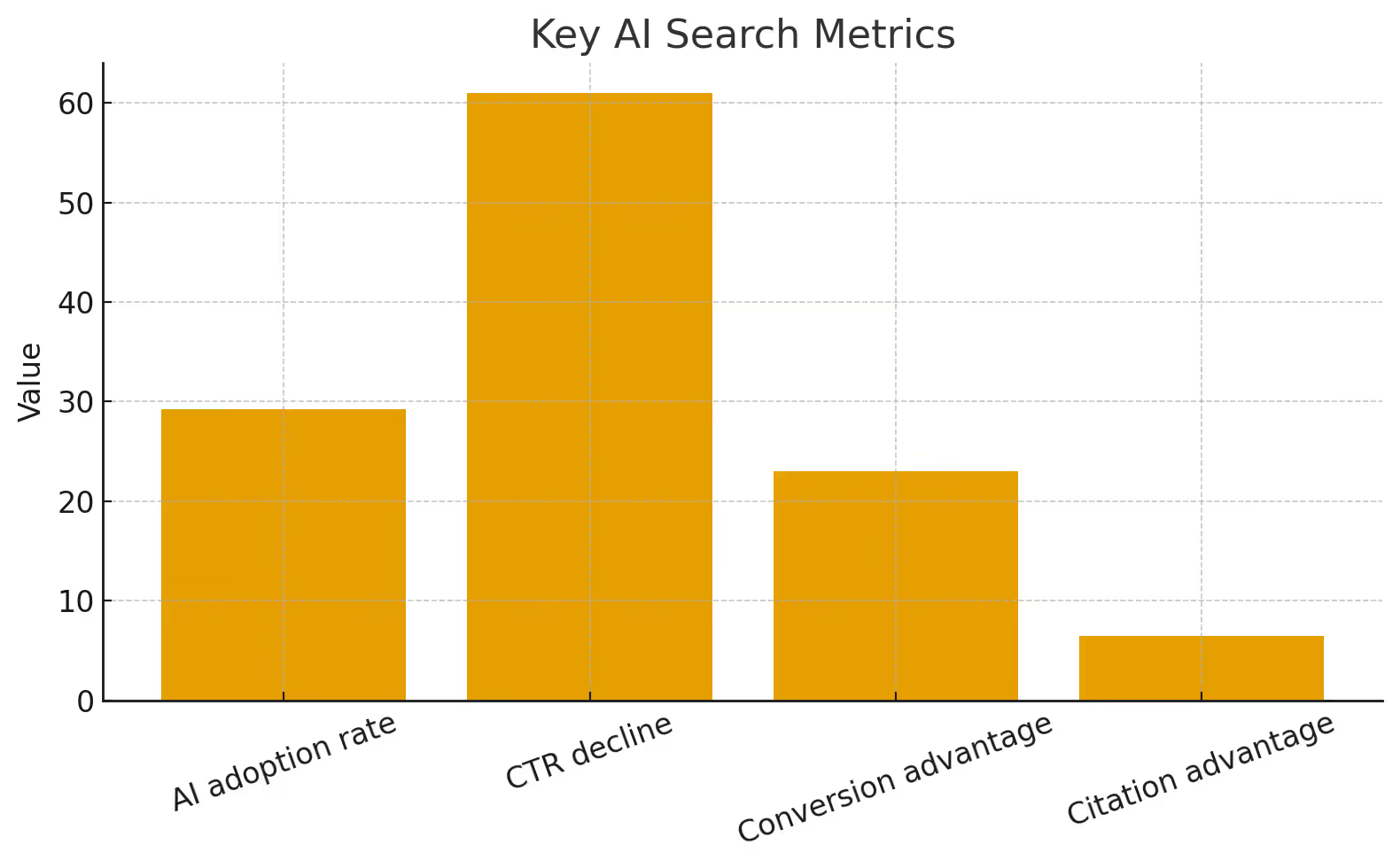
AI Adoption has surged: in the United States, heavy AI users, those interacting with tools like ChatGPT, Perplexity, and Gemini more than 10 times a month, jumped from 8% in 2023 to 38% in 2025.
At the same time, Google and Bing are still part of daily life; 95% of Americans continue to use traditional search engines, and heavy Google usage rose to 87%. This means more people are splitting their queries across classic search and AI answer engines.
Generative search is reducing the need to click through pages. Studies show that up to 60% of Google queries now end without a click. In tests with AI Overviews, organic click‑through rates dropped 34.5% on average, and some sites saw traffic fall by more than half. Yet this does not translate to a loss of discovery. Research shows AI Overviews increase search impressions by 49%, even as clicks fall. Visibility is up, engagement is down, and conversions are shifting.
The nature of queries has changed. People use sentences, ask follow‑up questions and let the model carry the context.
Google reports that AI Mode queries average 7.22 words and sessions last 4-6 minutes. Generative engines break a single query into sub‑queries, gather sources and synthesise answers.
In short, search is becoming a conversation, and that conversation is happening with machines that decide which brands to cite and whose content to trust.
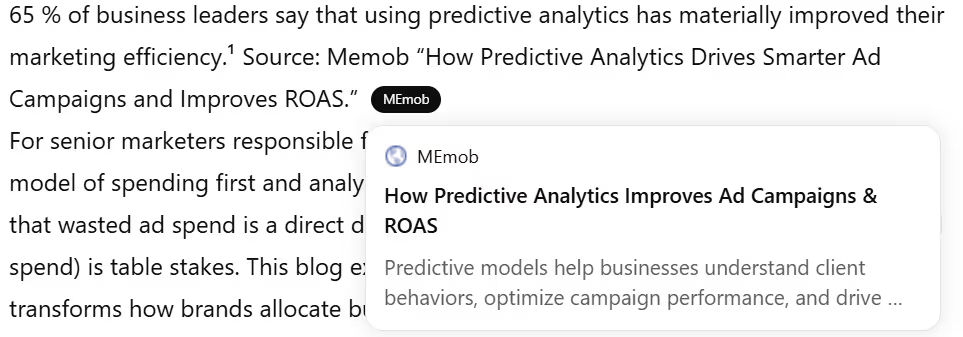
(ChatGPT cites credible, well-cited articles in its response to the query.) An example of how GPT is referring to a site to a query on predictive analytics.)
Why aren’t traditional SEO metrics enough anymore?
In the era of link lists, success meant ranking in the top ten and collecting backlinks. Those KPIs still matter, but AI search layers a new dimension: citations and mentions. Up to 80% of sources cited by ChatGPT and other AI assistants do not appear in Google’s top 100 results.
Only 12% of ChatGPT citations overlap with Google’s top ten. This means a site can be invisible in organic SERPs yet become a trusted source for AI answers.
AI models favour structured, conversational, fact‑dense content over keyword‑stuffed pages. Research shows that 32.5% of AI citations come from comparison articles, 10% from opinion pieces and thought leadership, and nearly half reference Wikipedia.
Structured lists, bullet points and clear headings increase the chance of citation by 30-40%. In practical terms, entity clarity and source authority are more influential than sheer backlink volume.
Traditional SEO metrics like rankings and backlinks are still useful for building authority, but they are no longer sufficient to predict AI visibility. Click‑through rate, bounce rate and dwell time do not capture whether your brand appears in an AI answer. You must now measure mentions, citations, accuracy and sentiment within AI platforms. This raises new questions for marketing leaders.
SEO vs AI visibility comparison
What does “AI visibility” actually mean for a brand?
AI visibility answers a bigger question than “do I rank?” - it asks “am I part of the answer?”
When someone asks an AI assistant for the best cybersecurity provider or the top ERP system, does your brand appear? AI visibility has four dimensions:
- Inclusion: whether the model mentions your brand at all in response to relevant prompts. Heavy AI users may never see you if you are excluded.
- Prominence: how visible your brand is within the answer. Are you cited in the first sentence, buried at the end, or listed alongside ten competitors?
- Accuracy: whether the information is correct. AI can hallucinate or pull outdated data; brands need to monitor misinformation.
- Sentiment: the tone and context in which your brand is presented. Balanced answers often cite both positives and negatives.
In practice, AI visibility is an upstream signal used to measure brand awareness long before demand shows up in traffic or leads. These dimensions show how to check search visibility of a website. It’s not enough to produce content; you must ensure models learn the right facts and draw from authoritative sources. This requires attention to structured data, consistent messaging, up‑to‑date content and strong off‑site presence.
Where B2B marketing teams should track brand reputation?
For B2B marketing teams, brand reputation tracking on Quora, Reddit, and StackExchange gives you the earliest signal of how buyers actually describe your product. Your prospects are reading peer answers on these forums long before they open your website, and the language they encounter there sets their expectations for every sales call that follows.
How can brand strategists audit their brand’s AI visibility step‑by‑step?
Auditing AI visibility requires discipline and repeatability. Here’s a practical framework that growth leaders can follow to assess their brand’s presence across AI platforms:
- Define your scope. Identify the questions, topics, languages and regions that matter to your business. Choose the AI tools to test: ChatGPT, Gemini, Perplexity, Google AI Overviews, Claude and any vertical‑specific models.
- Gather baseline data. Run prompts manually or with a tracking tool to see how often and where your brand appears. Note the context, accuracy and sentiment of each mention. Include both branded queries (e.g., “FTA Global TaaS model”) and category queries (e.g., “best marketing subscription service”). Capture screenshots for reference.
- Quantify share of voice. Calculate the percentage of AI answers that mention your brand versus competitors. If your brand is cited in 40% of AI answers and users notice three sources per answer, your visibility per query is 1.2, about 7.5 times higher than a typical organic search result. Sharing even a small share of AI citations can dramatically expand reach.
- Assess accuracy and sentiment. Check whether the facts and tone align with your messaging. If the model misstates your features or uses outdated pricing, flag it and update your content and structured data.
- Identify citation sources. Determine which pages, publications and platforms the AI references. According to recent studies, brands are 6.5 times more likely to be cited through third‑party sources than their own domain. Being active on high‑authority sites like Wikipedia, Reddit, industry publications, and analyst reports increases your chances of being cited.
- Benchmark over time. Track how your visibility changes after publishing new content or adjusting your SEO and PR strategy. AI answers are volatile; Google AI Mode results change by 70% for the same query. Continuous measurement uncovers trends and helps you spot issues early.
- Document your findings. Record prompts, results, citation sources and opportunities in a standardised spreadsheet or dashboard. This creates a baseline for improvement and highlights quick wins.
Which metrics and tools actually matter for measuring AI visibility?
A robust AI visibility program uses a blend of metrics. The most important include:
- Brand mentions: the raw count of times your brand appears in AI answers across prompts and platforms.
- Citation frequency: the percentage of answers that link back to your domains or third‑party pages mentioning your brand.
- Share of voice: your mentions divided by total mentions across all brands in your category.
- AI visibility score: a composite metric, defined in some toolkits, calculated as (answers mentioning your brand ÷ total answers) × 100.
- Accuracy rate: the percentage of answers that convey correct information about your brand.
- Sentiment index: an assessment of the positive, neutral or negative tone of your mentions.
- Citation sources: the domains or pages models pull from. Research shows that Reddit is the most-cited domain across AI platforms, followed by YouTube and Wikipedia. Knowledge of top domains helps prioritise outreach and partnerships.
- Conversion metrics: track how AI‑referred visitors behave. Studies show that although AI search referrals account for less than 1% of web traffic, they convert 23 times better than traditional search visitors. These visitors spend more time on the site and are often further along the buying journey.
Tools are emerging to collect these metrics. Established SEO suites like Semrush, Ahrefs and Moz now include AI visibility dashboards.
Specialised platforms such as Profound, SparkToro and Pulsar track share of voice, sentiment and citation patterns across generative engines. Manual methods (running prompts and logging results) are helpful for niche queries.
What can an AI visibility audit reveal about your brand?
An audit often uncovers surprises. Many brands assume their high organic rankings guarantee AI visibility; audits prove otherwise.
Analysis of 8,500 prompts showed that only 12% of ChatGPT citations match Google’s top 10 results. In Google AI Mode, 76.1% of cited URLs also rank in the top ten, but the overlap with ChatGPT is lower. In other words, the algorithmic gatekeepers differ across platforms.
Audits may reveal that your brand is absent from category queries, misrepresented in AI answers or cited primarily through outdated third‑party articles. They also expose competitor positioning.
Here are some insights from the AI visibility audit report (Based on 2025 AI search and AI SEO benchmark studies from SE Ranking, Ahrefs, Profound and Position Digital.) -
- If a competitor appears in 40% of generative answers and your brand shows up in only 5%, that gap tells you exactly where to increase content and PR focus.
- AI answers are highly volatile. Google AI Mode results can change more than 70% of the time, so citation patterns shift daily.
- Ongoing monitoring helps you catch risks early and act on new opportunities for visibility.
- The most cited domains in AI answers are not brand sites. Reddit leads with 3.11% of citations, followed by YouTube at 2.13% and Wikipedia at 1.35%.
- Brands active on these platforms through thought leadership, communities, and customer reviews surface more often in AI responses.
How to check the search visibility of a website?
This is the most practical way to understand how to check search visibility of a website in an environment where impressions grow but clicks do not. If you are trying to improve clicks and impressions, start with one practical question: how to check the search visibility of a website without getting lost in vanity metrics?
Use this 3-layer approach:
- Google Search Console for real impressions, clicks, and query-level movement
- Your rank tracking tool for trend direction across your tracked keyword set
- AI answer engines for whether you are being mentioned or cited for category prompts
This matters because impressions can rise while clicks remain flat, especially when answers are being resolved within AI and SERP features. The audit should tell you whether you are being seen, not just whether you are being visited.
What does a search engine visibility score actually mean?
A rising search engine visibility score shows improving exposure, but it must be interpreted alongside AI mentions and citation data to reflect real discovery. It is a directional signal that condenses many keyword positions into a single number.
You should remember this:
• Different tools calculate visibility differently
• Rankings, estimated CTR by position usually drive visibility scores, and search volume weighting
So a rising visibility score often means your tracked keyword set is moving up overall, but it does not automatically mean your business impact improved. Use it as a trend line, then validate with Search Console and conversion data.
How to interpret Moz visibility score?
The Moz visibility score is one example of a traditional SEO visibility metric. Use it to understand momentum across your keyword set, not as a KPI to optimise.
It is best used for:
• Spotting whether your tracked keyword set is gaining or losing ground over time
• Seeing whether content refreshes improve performance across a topic cluster
• Catching early declines before traffic drops become obvious
Not best used for:
• Explaining why a specific page lost clicks in a given week
• Proving ROI on its own without validation from business outcomes
Use the Moz visibility score for directional trend analysis, then validate decisions with page-level data inside Google Search Console.
Visibility metrics on their own do not create growth. They become valuable only when they explain whether your brand is being remembered, recalled, and repeated across search and AI answers. This is where visibility measurement connects directly to brand building.
Visibility is the input to measure brand awareness
Most B2B brands do not have visibility problems; they have recall problems. Hence you should connect AI visibility and organic visibility to your ability to measure brand awareness.
A simple way to do this inside your audit:
• Track branded query impressions and branded click growth in Search Console
• Track how often AI answers mention your brand in category prompts
• Track how often third-party sources cite you when AI answers shortlist vendors
When you can see those three together, you stop guessing whether you are becoming more familiar with the market.
Brand awareness metrics that tie to visibility and demand
For a clean, executive-friendly dashboard, keep your brand awareness metrics limited to what can be measured consistently:
• Branded impressions trend
• Branded query breadth (how many different branded queries appear)
• Direct traffic trend (supporting signal, not proof)
• AI mention rate for category prompts
• Share of voice trend versus your competitor set
This keeps the conversation focused on market presence rather than tool screenshots.
Measuring share of voice across search and AI platforms
You do not need a complex model to start. The basic share of voice formula works well for both classic search and AI prompts:
Share of voice = your brand mentions divided by total brand mentions across the same prompt set
Run the same fixed set of prompts every month, log which brands appear, and track the trend. This creates a repeatable AI visibility baseline you can improve.
The SEO visibility search metrics that actually drive decisions
Teams often track too much and act too little. These SEO visibility search metrics help explain why impressions rise, clicks shift, and buyer consideration starts earlier in AI led journeys. The SEO visibility search metrics that are worth keeping in your operating rhythm are:
• Query-level impressions trend for priority topics
• Page-level clicks and CTR trend for your money pages
• Visibility score trend for your tracked keyword portfolio
• AI mentions and citations trend for your category prompt set
• Accuracy check on how AI describes your offering
How to benchmark your website against competitors in a way that leads to action?
Most competitor benchmarking ends up as a report nobody uses. In order to benchmark your website against competitors and make it worthwhile, compare only what changes your next quarter plan in 2026:
• Which competitors appear most in the AI category answers
• Which third-party domains are getting cited for the category
• Which content formats dominate citations (comparisons, definitions, checklists)
• Which topic clusters are you missing completely
• Which of your pages should be refreshed first based on impression growth, but weak CTR
The outcome should be a short list of content upgrades, authority placements, and narrative fixes. This is what improves impressions and earns clicks over time.
How should CMOs act on these insights?
Audits and metrics only matter if they inform action. Growth leaders can translate AI visibility insights into a concrete plan:
1. Fix the fundamentals - Traditional SEO best practices still matter; sites with more organic traffic get cited more often. Resolve technical issues, ensure mobile responsiveness and maintain fast page speed. Update your content frequently; pages updated within the last 12 months are more likely to retain citations.
2. Optimise for AI extraction - Use clear headings, bullet points and short paragraphs. Provide specific metrics, lists and TL;DR summaries so AI can easily summarise your content. Include structured data (schema markup) to help models understand your entity information.
3. Strengthen your off‑site presence - Since AI models cite third‑party sources more than brand sites, be active where they look: contribute to Wikipedia, answer questions on Reddit and Quora, publish thought leadership on Forbes or relevant industry journals and get listed in review platforms like G2 and Gartner. Earned media amplifies authority.
4. Align with PR and customer success stories - AI search visibility is as much about reputation as it is about ranking. PR teams should engage in narrative management, monitor conversation threads and seed balanced stories. Customer success teams should encourage reviews and testimonials on high‑authority platforms, since AI favours genuine conversations.
5. Build a governance loop - Treat AI visibility as a living program. Assign ownership, set recurring quarterly review activities, and maintain a changelog. Use dashboards to track metrics over time and tie them to business outcomes such as revenue, lead velocity, and brand favourability. Continuous measurement helps you pivot when AI algorithms change or new platforms emerge.
What mistakes should marketers avoid when managing AI visibility?
Many brands rush into generative optimization without a clear strategy. These common mistakes include:
- Teams, at times, treat AI visibility like SEO. Keyword stuffing and link building do not drive citations. Models reward structured, factual content and clear entity signals.
- Relying on one AI platform creates blind spots. Each model cites differently. ChatGPT leans on Wikipedia and Reddit. Google AI Mode leans on brand sites and YouTube. Always measure across engines.
- Accuracy and sentiment often go unchecked. Wrong or negative information spreads if you do not correct it. Keep content updated and engage where conversations happen.
- No ownership means no progress. AI visibility sits between SEO, PR and analytics. A cross-functional owner is essential to drive fixes and governance.
- Offline and paid signals matter. AI models capture event activity, email nurture, and partner influence. In one case, 40% of closed deals were tied to event-sourced contacts, even though the last click did not.
How does AI visibility link to revenue and brand equity?
Ultimately, CMOs need to justify investment in AI visibility with tangible outcomes. Early data suggests that AI search referrals, though scarce, are extremely valuable. Visitors arriving from AI platforms convert 23 times better than those from traditional organic search. These users spend more time on the site, view more pages per session and often skip the awareness phase. They are pre‑qualified and ready to engage.
Generative engines also compress the buyer journey. Instead of conducting multiple searches, users ask follow‑up questions within a single conversation. This means the narrative you inject into AI answers has an outsized influence on perceptions and decisions. A strong presence can accelerate sales cycles; absence can exclude you from consideration entirely.
Brand equity grows through repeated exposure. Studies show that repeated citation across queries and platforms builds passive trust.
Even when users do not click, the mere presence of your brand name in authoritative answers reinforces familiarity. This familiarity pays dividends when prospects eventually seek a vendor or partner.
Where should CMOs start their AI visibility audit journey?
Not every organisation is primed for an AI audit. To decide if now is the right time, you should ask yourself these crucial questions:
- Do we have a clear view of our primary acquisition and revenue drivers?
- Is our performance budget large enough that small efficiency gains matter?
- Are our current agency or vendor relationships delivering the visibility we need?
- Are internal teams stretched, making it hard to sustain test‑and‑learn cycles?
- Does finance want more predictability and clearer ROI reporting?
- Is our martech stack stable and integrated enough for external tools to plug in?
- Can we safely share data and revenue information with a trusted partner?
- Is there an internal owner who will coordinate, unblock and review progress?
If you answer “yes” to most of these questions, start your audit. If not, stabilise your data, processes and staffing first.
Remember that the goal is not to chase quick wins but to build an always‑on visibility engine. This requires the right mindset, cross‑functional collaboration and a willingness to experiment.
AI search is rewriting the rules of digital discovery
It rewards brands that provide clear, structured, authoritative content and actively participate in trusted communities. Traditional SEO remains necessary but insufficient; the new game is about being part of the answer.
A disciplined audit framework, a focus on citation‑friendly content and a commitment to ongoing measurement will ensure your brand shows up where it counts.
The companies that move now will shape how AI models talk about their industries. Those who wait risk becoming invisible in the conversations where future customers make their decisions.

Do you want more traffic?


Why AI Search Visibility Depends on Context & Not Just Prompts?
.jpg)
Are You Measuring Demand or Just Measuring Traffic?