
TL;DR
- A prompt tells you what someone asked. Context tells you what they were actually trying to decide.
- The same search need can produce different brand recommendations across markets, platforms, and research stages.
- Tracking isolated prompts shows mentions. Tracking context shows where a brand is genuinely strong or weak.
- Useful AI visibility measurement connects prompts with topics, competitors, citations, sources, location, and buyer intent.
- Brands should aim to become consistently understood across important buying situations, not simply appear in a few AI answers.
Why prompt tracking alone is not enough for AI search visibility?
Prompt tracking has become the standard method for brands to measure their visibility inside ChatGPT, Perplexity, Gemini, and other AI search experiences. The logic is straightforward: a team compiles a list of questions potential customers might ask, runs them across various AI platforms, and records whether or not the brand appears.
While this approach offers a necessary baseline, it often provides a shallow view of performance. Measurement significantly weakens when you treat every prompt as an isolated data point rather than a signal within a broader decision journey.
For example, consider a health insurer tracking the prompt "best health insurance plans for families in India." A brand might appear in one AI response but be excluded from the next, or see its own site replaced by a comparison aggregator in a third.
Taken at face value, these inconsistent results can seem like random noise. However, this variation is rarely an accident; it reflects deeper factors at play. It doesn't necessarily mean the brand’s authority dropped overnight; instead, it highlights how shifts in underlying sources, competitor coverage, user intent, or research stage dictate which brands are deemed relevant at a given moment.
This reveals the core limitation of standard strategies: a prompt captures only the surface-level question, whereas "context" reveals the actual conditions under which a brand is being evaluated.
AI visibility becomes far more useful when teams pivot from measuring isolated mentions to measuring where, why, and under what conditions a brand is being recommended.
What does context mean in AI search and LLM visibility?
Context is the set of signals surrounding a prompt that helps define the meaning of the request and the kind of answer that is useful.
Topic tells you the broader subject a buyer is researching. Intent separates learning from comparison and vendor selection. The market determines which geography and competitive environment matter. Platform identifies the AI system generating the answer. Sources reveal which pages and domains support the response. Competitor presence shows which brands are being considered alongside yours.
Buyer persona can add another useful layer for products or services serving distinct audiences.
A small business owner researching working capital has different needs than a finance team comparing enterprise banking partners. Both searches can fall under a commercial topic, but the relevance criteria differ.
Similar patterns appear across industries. A private university trying to figure out its flagship MBA program’s visibility should know whether it appears during course research, fee comparisons, placement research, and final shortlisting. A handful of isolated prompts cannot explain the full decision journey. Context turns a list of prompts into a clearer market model.
How does context change AI answers?
AI systems do not interpret a prompt in isolation. They read the words alongside signals such as the topic, the level of detail requested, the user’s intent, the geography, the platform being used, and the sources available at that moment.
A broad question usually creates a broad answer. Once the request becomes more specific, the set of relevant brands can change quickly.
Consider someone searching for the best health insurance in India. A broad answer may include several large insurers. The same user may then ask for a plan suitable for parents above 60, followed by a question about coverage for pre-existing conditions and cashless hospitals in a particular city.
The buying need has not changed completely, but the context has become much more specific. AI systems now have more information about what matters, so they can narrow the brands, products, and sources they consider relevant.
Here are some of the factors that can change the answer:
- Intent: A user looking to understand a category may receive a very different response from someone actively comparing providers.
- Specificity: Adding requirements such as industry, company size, budget, use case, or location can remove brands that appeared in a broader answer.
- Conversation history: Earlier questions can influence how the next request is interpreted, even when the final prompt looks simple.
- Platform: ChatGPT, Gemini, Perplexity, and other AI platforms may rely on different sources and interpret the same request differently.
- Available sources: Clear product pages, comparison articles, case studies, reviews, and third-party coverage can influence which brands an AI system has enough evidence to mention.
- Freshness: Changes in content, new citations, and updated third-party information can affect what an AI system finds and uses over time.
For brands, the implications matter. One strong response does not prove strong AI visibility. A brand needs to remain relevant as the buyer adds more detail and moves closer to a decision.
AI search measurement should therefore look at groups of related prompts and the context surrounding them. The stronger signal is not whether a brand appears once, but whether it keeps appearing as the conversation becomes more specific and commercially important.
How should brands measure AI visibility beyond individual prompts?
Prompt-level data still matters. The change lies in how teams organize and interpret it.
Start with an important business topic and map the different ways buyers approach it. Separate informational research from comparison and vendor selection. Review performance across relevant markets and AI platforms. Connect each response to the citations and sources helping to form it.
Competitor presence should sit beside brand visibility. A missing mention becomes actionable when the team can see which competitor appeared instead and which pages supported the recommendation.
Historical movement matters as well. A brand appearing in 12 of 20 tracked responses over several runs has a very different visibility pattern from a brand that appears once and disappears.
Good measurement reveals stability, gaps, and movement. Raw prompt counts rarely provide that level of understanding.
How does fta.visibility connect prompts, citations, sources, and competitors?
FTA.visibility moves analysis beyond a list of AI prompts. The platform tracks brand performance across AI answers, prompts, citations, and traffic. It also shows which sources and competitors help or limit visibility.
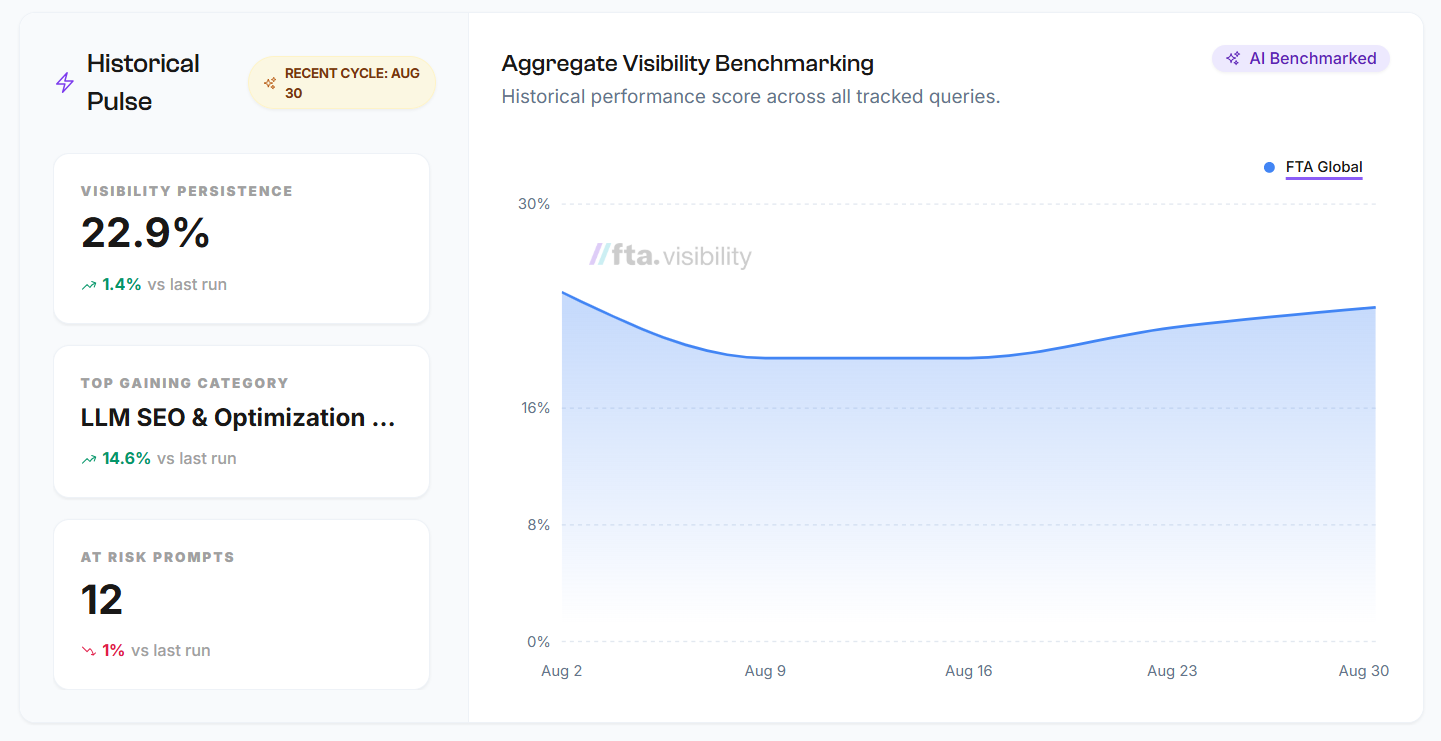
In the screenshot above from fta.visibility, you can see how your AI visibility is changing over time, which categories are gaining, and where prompts are starting to lose ground.
The visibility trend view compares platform performance over time instead of reducing everything to one percentage. Citation and source intelligence adds the evidence behind that visibility by showing where mentions and citations are coming from.
A brand can therefore see a very different picture across OpenAI, Gemini, Perplexity, and other AI environments instead of assuming one visibility score represents the entire market.
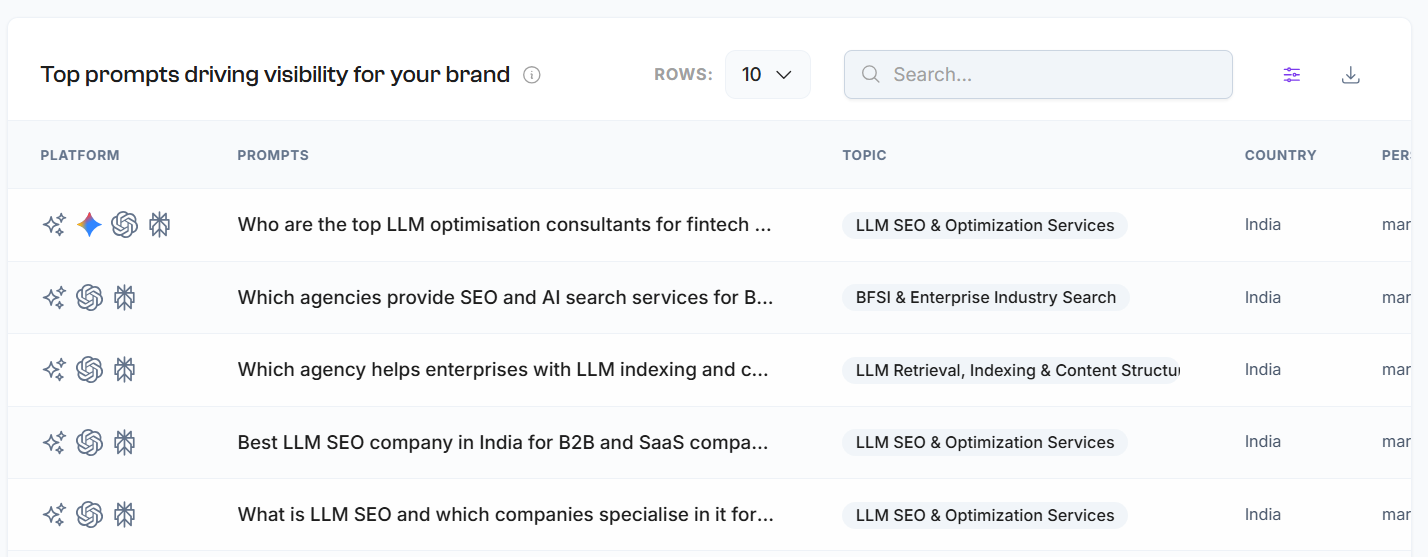
Here, you can see exactly which prompts drive your brand’s AI visibility, mapped across distinct search topics, buyer personas, geographic markets, and AI platforms.
The Top Performing Prompts view connects each prompt with owned pages, competitor pages, third-party pages, and mention frequency.
A team can see whether its own content supports the answer or whether AI systems rely more heavily on competitors and external sources.
A brand with strong mentions but weak owned page presence may need better source content. A brand repeatedly losing an important commercial context to competitors may need stronger category coverage. Prompt counts alone won't show the difference.
How Search Engineering turns context into stronger AI visibility
Prompt tracking is measurement. Search Engineering turns the findings into action.
Search Engineering starts with the moments when buyers discover, compare, and select brands, then works backward into the content, authority, and source signals required to compete in those moments.
AI discovery now spans Google, ChatGPT, Perplexity, AI Overviews, social platforms, and third-party sources before a buyer reaches a company website. FTA Global’s Search Engineering approach focuses on identifying those decision moments and engineering visibility around them, rather than measuring rankings alone.
A weak context often traces back to a practical problem. A service page may lack a clear explanation. An important use case may have no dedicated content. External sources may describe competitors more precisely. Different pages may use inconsistent category language.
Search Engineering connects those gaps to the work required across owned content, external authority, technical structure, and measurement.
Build AI visibility around context, not isolated prompts
Brands still need prompts. They remain one of the clearest ways to observe how AI systems respond to real buyer questions.
A mature AI visibility program treats every prompt as part of something larger.
Topics reveal where demand exists. Intent explains what the buyer needs. Platforms show where visibility changes. Citations reveal which evidence AI systems use. Competitor data shows who is winning relevant conversations. Historical tracking shows whether the position is improving or weakening.
Context connects those signals into one useful picture. The goal is not to manufacture hundreds of prompts and report how many times the brand appeared.
The goal is to understand the buying contexts that matter, measure whether the brand is present across them, and identify what needs to change when competitors are being understood more clearly.
FTA.visibility helps teams move from isolated AI mentions to a clearer view of where the brand is being discovered, understood, and recommended.
Prompts tell you what happened. Context tells you what to do next.

Do you want more traffic?

.jpg)
Are You Measuring Demand or Just Measuring Traffic?
Brand Mentions vs Citations in AI Search: Which One Actually Moves the Pipeline?