

Traffic becomes a vanity metric if it does not lead to revenue growth. High visitor numbers mean very little if they do not turn into a measurable pipeline.
We found out that 49% of marketers report that organic search delivers their highest ROI.
However, they see the gains much later, after ranking at the top of a page. It typically takes 4 to 12 months for search efforts to deliver a significant financial return.
Organic search is responsible for over 53% of all trackable website traffic. Failing to rank on page one means missing out on 91.5% of all search clicks.
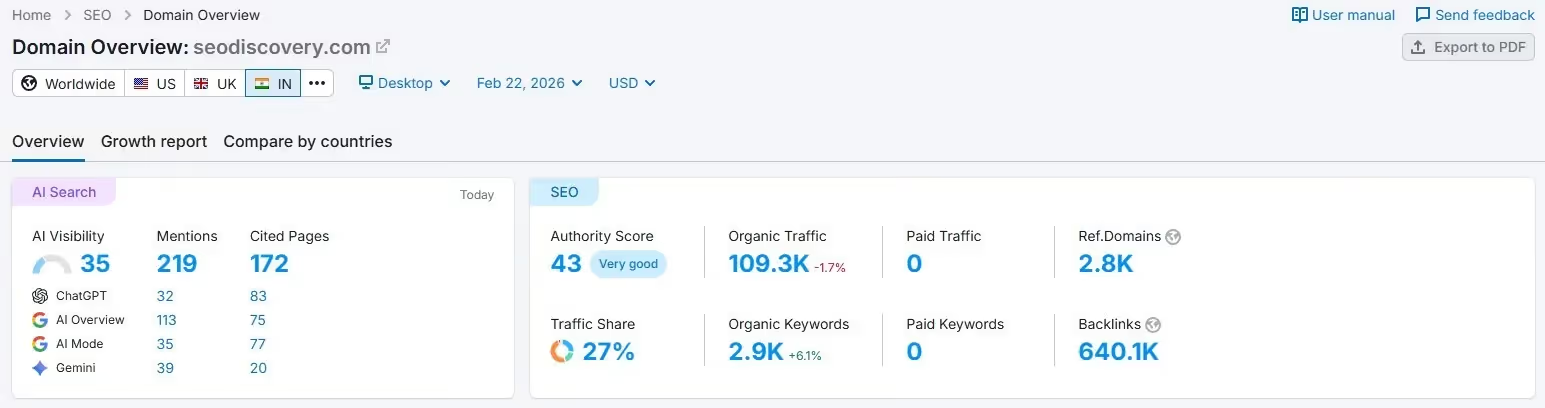
The SEMrush domain overview for a brand ‘seodiscovery’, showing traffic value alongside organic traffic. You can compare the traffic value vs traffic share using any of the SEO tools that you prefer.
This blog shows exactly how to calculate the value of every search click and provides a framework for shifting SEO focus from vanity metrics like rankings to measurable business outcomes such as revenue and a sales pipeline.
How do you track revenue from organic search clicks?
Once you know your costs, isolate search revenue using tools like Google Analytics 4.
For e-commerce sites, pull sales data directly from online transactions by filtering reports for organic traffic to see exactly what search visitors bought.
Lead generation businesses must assign a dollar value to actions such as form submissions, demo requests, or phone calls.
Use your Customer Lifetime Value. Multiply your average LTV by your lead-to-sale conversion rate to get a lead value.
For example, if a customer is worth $20,000 and you close 15% of leads, each lead is worth $3,000. This allows you to plug in a concrete number into your revenue-tracking reports.
Integrating your data with a CRM lets you track a lead through the deal lifecycle and demonstrates the role of search throughout the sales funnel.
Why is attribution the biggest challenge in your pipeline?
Customers rarely buy after their first search. The journey from an informational search to a sale can involve up to 10 to 15 interactions.
SEO often plays an assist role by introducing people to your brand early in the funnel. Traditional models often give credit to the last click.
Use Assisted Conversion Reports in Google Analytics to see the real pipeline. These reports show the monetary value of sales that search helped initiate or support.
If you only look at last click data, you will consistently undervalue your search efforts.
Adjust for branded versus non-branded traffic. Non-branded traffic measures true organic demand rather than existing brand awareness.
Isolating specific projects with tags can help track the impact of targeted campaigns and show how new pages contribute to the pipeline over time.
How can you value traffic when direct revenue isn't tracked?
Sometimes, direct sales tracking is not possible. In these cases, use the Traffic Value model.
Traffic Value estimates what you would have to pay if you bought that traffic through ads. It uses the Cost Per Click of your keywords to calculate a total dollar value.
If you rank for a keyword that costs 5 per click and gets 1,000 visits, that traffic is worth 5,000.
Acquiring that same volume through paid ads would require significant spend. Framing SEO as a cost-saving asset helps leadership see it as a long-term investment.
How to calculate the traffic cost of your organic clicks?
Every organic visit either generates revenue or replaces paid ad spend. We have presented 2 scenarios to help you better understand this.
One calculates revenue impact. The other calculates the traffic replacement value.
Situation 1: Top-Level SEO Revenue Estimate
Using traffic, conversion rate, and average order value
This answers:
If I rank and get traffic, how much money can that realistically bring?
Step 1: Estimate Potential Traffic
Start with keyword search volume.
For example: You target 3 keywords -
- Keyword A: 10,000 searches per month
- Keyword B: 5,000 searches per month
- Keyword C: 5,000 searches per month
Total search volume = 20,000 searches per month
Now, assume you rank in the top 3 positions.
Average CTR for the top 3 ≈ is 20% to 30%
Let’s take 25% for simplicity.
Estimated traffic =
20,000 × 25% = 5,000 visitors per month
Step 2: Apply Conversion Rate
Now ask: What percentage of visitors buy?
Let’s assume: Website conversion rate = 2%
5,000 visitors × 2% = 100 sales per month
Step 3: Multiply by Average Order Value
Let’s assume: Average Order Value = 5,000 rupees
100 sales × 5,000 = 5,00,000 rupees per month
Annual revenue potential =
5,00,000 × 12 = 60,00,000 rupees
That is your top-level SEO revenue estimate.
What’s the formula?
SEO Revenue =
Search Volume × CTR × Conversion Rate × AOV
In numbers:
20,000 × 0.25 × 0.02 × 5,000
= 5,00,000 per month
Method 2: Traffic value based on keyword bidding
Sometimes, direct revenue tracking is incomplete. In that case, calculate what your organic traffic would cost if you had to buy it through paid ads. This is called Traffic Value.
Here is the formula -
Traffic Value = Organic Clicks × Average Cost Per Click
Total SEO Traffic Worth Based on Keyword Bidding
This answers:
If I had to buy this same traffic via Google Ads, how much would it cost me?
This is traffic value estimation.
Step 1: Identify CPC for Keywords
Let’s assume:
Keyword A CPC = 50 rupees
Keyword B CPC = 40 rupees
Keyword C CPC = 60 rupees
Let’s assume average CPC = 50 rupees
From earlier, estimated SEO traffic = 5,000 visitors per month
Step 2: Calculate Equivalent Paid Media Cost
Traffic value =
5,000 × 50 rupees
= 2,50,000 rupees per month
Annual value = 30,00,000 rupees
What This Means
If SEO delivers 5,000 organic visitors per month,
and you had to buy them at 50 rupees per click,
You would spend 2.5 lakh every month.
So your organic traffic is “worth” 2.5 lakh monthly in ad terms.
Method 1 quantifies direct revenue impact, while Method 2 calculates the paid media value of the same traffic.
Together, they position SEO as both a growth driver and a cost-saving asset.
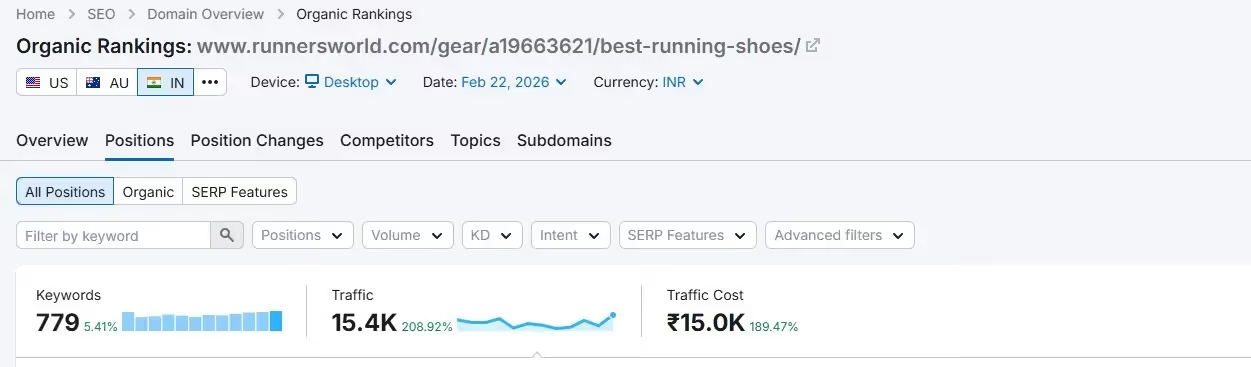
This page targeting the best running shoes for men ranks for 779 keywords in India and drives approximately 15,400 organic visits per month.
SEMrush estimates its Traffic Cost at ₹15,000 per month.
How do you find the best opportunities for pipeline growth?
To grow your pipeline quickly, focus on keywords that are close to ranking well. Data analysis helps you identify where small changes will lead to the biggest returns.
- Identify low-hanging fruit: Filter your tracking tools for keywords currently ranking in positions 4-10. These pages are already on the first page but have not yet reached their full traffic potential.
- Analyze search intent: Focus on keywords with transactional or product-led intent rather than general information. You want to attract visitors who are looking for a solution or a product to buy.
- Check keyword difficulty: Target keywords with high search volume and low competition. This ensures your resources are spent on rankings that are realistic to achieve in a shorter timeframe.
- Monitor position changes: Set up alerts to notify you when a high-value keyword drops out of the top three positions. Taking immediate action to regain these spots protects your existing pipeline revenue.
- Use scenario modelling to forecast how much revenue a 10% jump in rankings would generate. It is often easier to jump from position 60 to 50 than from position 5 to 4.
By moving a keyword from position 10 to position 1, you can see an exponential increase in clicks. This targeted approach ensures your SEO work is always aligned with revenue growth.
What conversion rates should you realistically expect?
A healthy pipeline is built on realistic expectations and industry benchmarks. Organic search traffic generally converts at a much higher rate than paid ads.
Research shows that SEO traffic converts at an average rate of 4.1%. In comparison, paid search leads typically convert at around 2.7%.
- B2B SaaS: These companies usually see a lead conversion rate of 2.5%.
- Manufacturing: This sector averages a higher rate of 3.1% because buyers often know exactly what they need.
- Professional Services: Legal and financial services typically hover around 2.4-2.5%.
- eCommerce: Online stores often achieve a 3.2% rate by using visually appealing product pages.
- High-Volume Lead Gen: Sectors like Pest Control can see rates as high as 3.7% due to the urgent nature of the service.
Landing page type also affects conversion. White papers and service pages perform better than educational blog posts.
Knowing these benchmarks helps determine whether your challenge is traffic quality or conversion performance.
How will AI search change your measurable pipeline?
The way people search is shifting toward AI-driven discovery. A modern pipeline must account for visibility in Large Language Models like ChatGPT.
You need to track brand mentions and citations in AI search results.
AI bots now access your pages to summarize information in search overviews. Monitoring this activity is becoming part of technical SEO audits.
If your brand is not cited by AI engines, you are losing a new stream of top-of-funnel traffic.
Tracking AI search traffic and its specific conversions is becoming part of ROI measurement.
The pipeline is no longer just about Google. It is about being found wherever your customer searches.
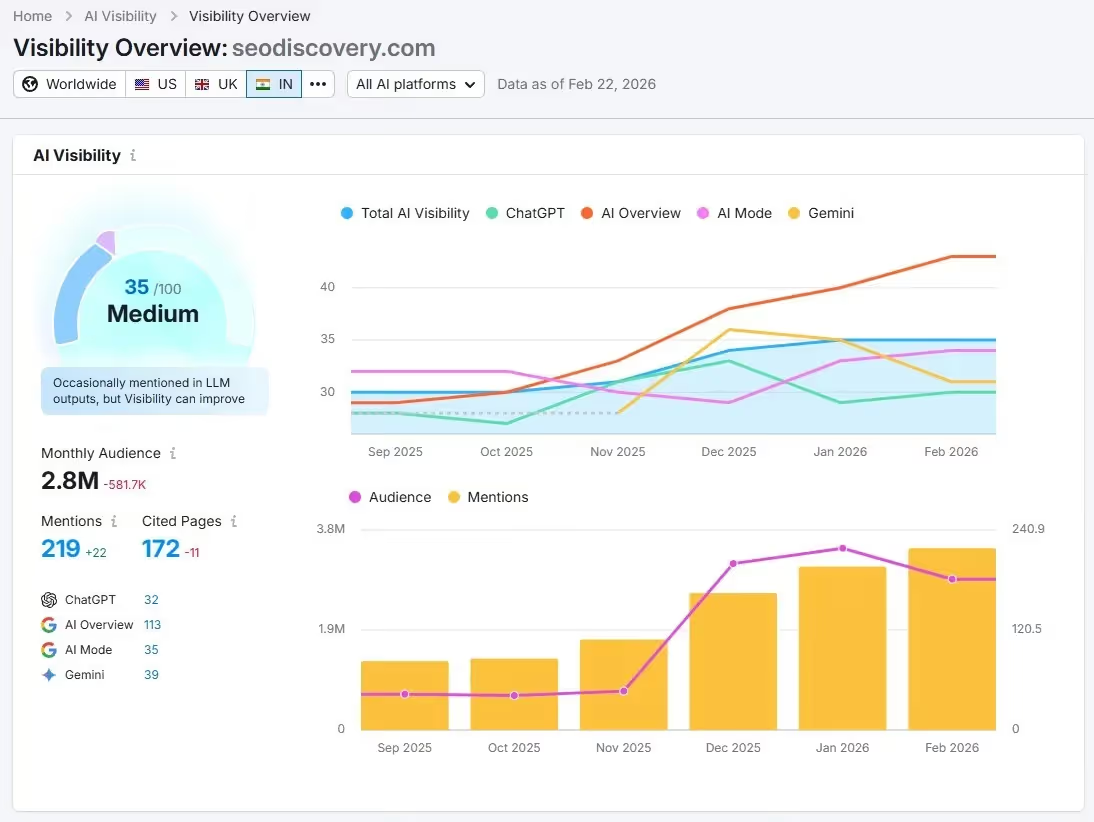
SEMRush provides an AI Visibility Overview that tracks the frequency of seodiscovery.com's appearance across major AI platforms, specifically ChatGPT, AI Overviews, and Gemini.
Turn your organic visibility into a predictable revenue engine
Proving the true value of search requires moving past technical vanity metrics to focus on measurable business outcomes that demonstrate a clear financial impact.
By treating SEO as a compounding growth asset rather than a monthly expense, you can secure stakeholder buy-in to build a sustainable, highly profitable sales pipeline.

Do you want more traffic?


OpenAI Dots Explained: How ChatGPT’s Always-On Agents Work, and How They Compare to Meta Muse
.jpg)