
TL;DR
- Context Authority scores how strongly and how consistently AI recommends your brand to your real buyers, not to a blank user with no city, language or role.
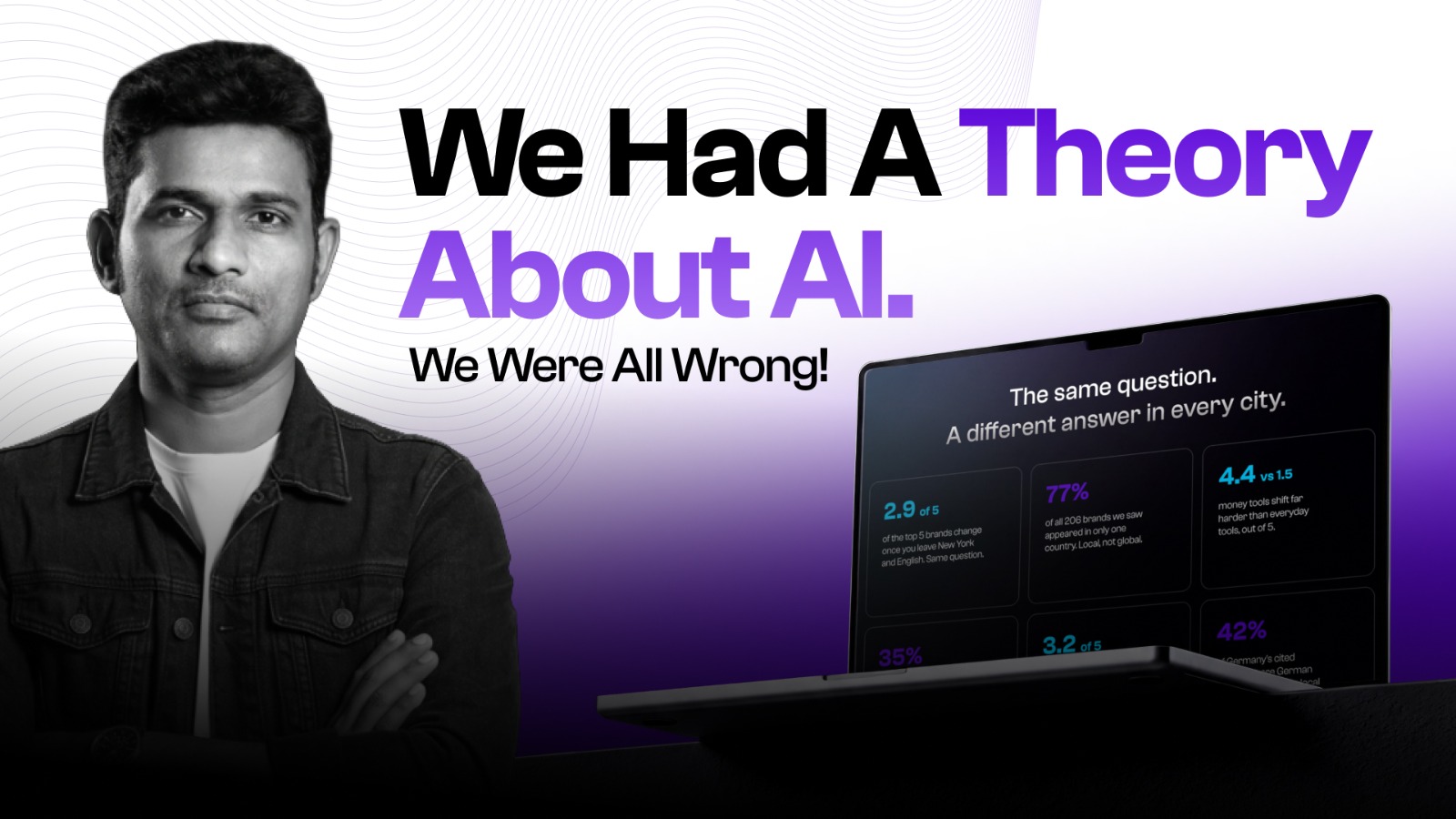
- AI answers shift with who is asking, where they are, the language they type in, the AI tool they use, and even between two identical asks.
- One generic visibility score averages those shifts away, so you can look healthy on paper and still be missing for the buyers who matter.
- Context Authority separates owning an answer from simply appearing in it, and shows you where a competitor has taken your spot.
- Buyers now build vendor shortlists inside AI chats before they reach your website, which turns your position in each context into a revenue question.
Open ChatGPT and type, "Which is the best group health insurance for a 50-person startup?" Note the names you get. Now ask a friend in another city to type the exact same line. There is a good chance their list looks different. Switch the language, move to Gemini, or just hit regenerate, and the answer shifts again.
Most marketing teams never see this happen. They check their AI brand visibility with a tool that asks one plain question from nowhere in particular, then hands back a single number. Real buyers never ask from nowhere. They ask from Pune or Dubai, in English or Hindi, as a founder or a finance head, on whichever AI app they happen to trust.
Context Authority measures your brand against those real buyers. Here is a blog to what it means, what shapes it, and why it deserves a place on your marketing dashboard right now.
What is Context Authority?
Context Authority is a score that shows how strongly and how consistently AI recommends your brand for the buying needs that matter to your business. FTA Global developed it as the core measure inside fta.visibility, our AI search visibility platform.
Picture a trusted advisor who gets asked the same question by hundreds of different people every day. Context Authority tells you how often that advisor names you, how high up in the answer, and whether the advice changes depending on who walks through the door.
The important word here is context. Two brands can both appear in AI answers and still sit in very different positions. One gets named first, cited from its own pages, and described in a positive tone. The other shows up fourth, now and then, with a line lifted from a review site. Both count as a mention on a basic tracker. Only one of them owns the answer, and Context Authority is designed to tell you which one you are.
Why a Single Visibility Score Falls Short
Most AI tracking works the same way. A team writes a list of prompts, runs them through a few AI tools, and counts how often the brand comes up. As a starting point, it helps. The weak spot is the person asking.
Every prompt comes from a blank user with no location, no language preference, no job title and no history. Nobody buys like that.
AI assistants, by contrast, pay close attention to context. For example, a student asking about photo editing apps wants free and simple options, whereas a professional designer asking the same prompt expects advanced desktop tools.
Roll all of that into one number, and you get a comfortable average that hides the gaps. You could lead in one market, trail in a second, and be completely absent in a third, while your dashboard shows a calm, steady line.
The Five Things That Shape Your Context Authority
Five factors decide where your brand lands in an AI answer. Context Authority looks at all of them together:
- The person asking. A CFO cares about cost control and risk. A startup founder cares about speed and a fair price. The AI picks up on those signals and recommends different brands to each, so you can be the default choice for one type of buyer and invisible to another.
- The city they ask from. When a question carries a location, AI tools lean on local review sites, regional media and local company pages. A brand with strong coverage at home and thin coverage abroad will slip the moment the buyer's city changes.
- The language they type in. Someone asking in Hindi, Hinglish, Arabic or German often gets a more local answer than someone asking in English. If every page you own is in English, you are only competing for a slice of the market.
- The AI tool they open. ChatGPT, Gemini and Perplexity pull from different sources and weigh them in their own way. A top spot on one gives you no guarantee on the others.
- The repeat test. Ask the same question five times, and the top recommendation can change on some of those runs. A strong position stays put across repeated asks. A weak one shows up once, on a lucky day, and disappears on the next try.
How Context Authority Gets Measured
Measuring context takes more than a prompt tracker. An AI visibility tool built for Context Authority asks the buying questions your customers actually ask, for each buyer type, across the regions and languages you sell in, on every major AI engine.
Inside fta.visibility, we run those questions repeatedly and at different times, so your score reflects a pattern instead of one lucky or unlucky snapshot. We group questions by buyer and intent, so one strong page can cover a whole cluster of related prompts.
You get one number to track, backed by clear views of the pages AI cites as your source, the tone of every mention, and your share of the answer against competitors, topic by topic.
How to Build Stronger Context Authority?
Once you have measured your score, here is how you can strengthen and elevate it:
- Your brand needs to live on local pages. Global review platforms help, but they rarely win a local answer on their own. Get featured on the regional review sites, trade publications and directories that AI reads in each of your key markets.
- Write for each buyer, not an average reader. A page built around a CFO's concerns about risk, and another built around a founder's budget, will each earn its own spot in AI answers.
- Show up in the languages your buyers use. You can also try this: pick your five most important service pages and create versions in the two regional languages your sales team hears most often.
- Keep your facts identical everywhere. Product names, pricing, locations and category descriptions should match across your website, listings and third-party profiles, so every AI tool describes you the same way.
- Fix the weakest context first. Look at the markets, languages and buyer types where your score is lowest, and put your effort there before polishing places where you already lead.
At FTA Global, all of this sits inside Search Engineering: our approach starts at the moment a buyer decides and builds every page, signal, and citation back from there.
Why Context Authority Matters More Today
Buying has moved into the chat window. A buyer describes a problem, gets back three or four names, and often makes a shortlist without opening a single website. Your analytics will never show the visits you lost, since those visits never happened.
When the shortlist gets built somewhere you can't see, guessing gets expensive. A generic score tells you that your brand exists somewhere in AI. Context Authority tells you whether you win the conversations that bring in revenue: the founder in Bengaluru, the finance team in Dubai, the procurement lead comparing vendors in German.
Strong AI brand visibility today means being the name AI trusts for each buyer, in each market, on each engine, every time the question comes up. Brands that start measuring by context now can close gaps while competitors are still reading one average number. Brands that wait will find out through deals that quietly went somewhere else.

Do you want more traffic?


Jev the new AI model that "can't hallucinate" got it wrong 4 out of 10 times.