

You already know the most challenging part is getting the right person to your website. What most teams miss is what happens next. A chunk of those visitors do not browse; they search. They type exactly what they want: product, use case, category, pricing, and they expect an instant, accurate answer.
When your site search fails, you do not just lose a few clicks. You lose the highest intent sessions you paid to acquire. This is why site search users typically convert at a rate two to three times that of non-search users. So if search is weak, you are effectively paying premium CAC to send ready-to-buy visitors into a dead end. Fixing search is not a tech upgrade. It is a conversion lever that protects every rupee you spend on acquisition.
The immediate problem is not traffic volume. The problem is the search experience. For senior marketers, the question is practical. How do you turn search into a conversion driver rather than a leakage point? The answer starts with the search stack.
This blog article explains what a search stack is, why it matters for marketing, how to evaluate options, an operational checklist your team can apply, and an actionable rollout plan that ties search investment to measurable business outcomes. In the end, we show how FTA’s search approach delivers predictable gains in visibility, relevance, and conversion.
What is a search stack?
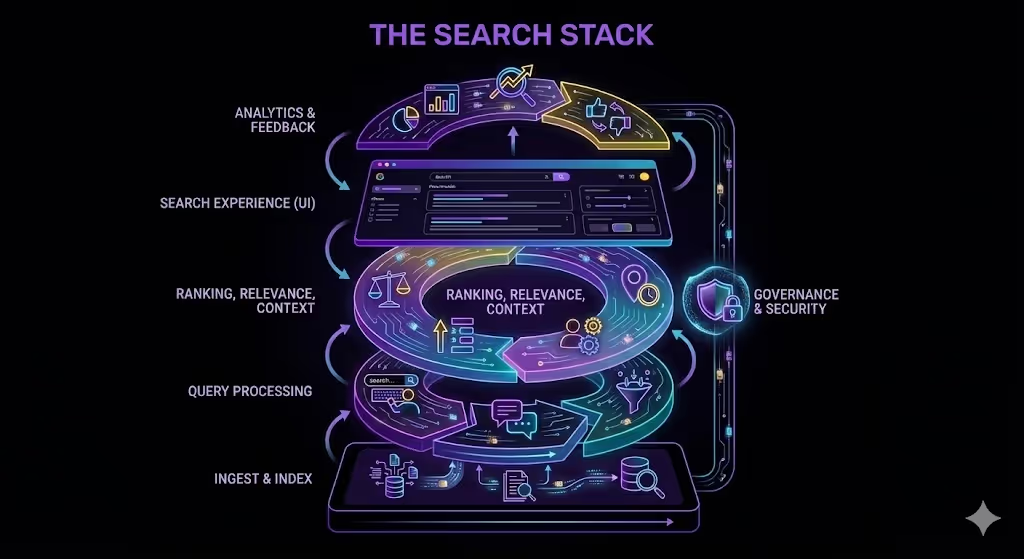
A search stack is the set of systems and services that together capture user queries, find relevant content or products, rank those results, and report on behaviour. Think of it as an internal search product team, where each layer plays a distinct role.
The core components include -
- Content ingestion and indexing
- Query processing and parsing
- Ranking and relevance models
- Personalization and context
- Search experience layer, including UI components
- Analytics and feedback loop
- Governance and security
Search is not a single tool. It is an assembly line. Each stage adds value or introduces friction. A weak piece anywhere in the stack reduces the overall return on your marketing investment.
Why should a CMO care about the search stack?
A search stack matters now because discovery has fragmented. Users bounce between Google, marketplaces, social platforms, and AI answers, and when they finally land on your site, they want confirmation fast. Your site search is the moment of truth where interest either turns into revenue or exits to a competitor.
It directly affects three KPIs that matter to modern marketing -
- Conversion and revenue per visit
- Customer acquisition cost and retention
- Growth of owned search-driven channels and content monetisation
Site search users demonstrate higher intent. When search returns relevant results quickly and surfaces the right offers, conversion rates climb, and acquisition spend becomes more efficient. Search analytics also reveal the language customers use. That language is pure input for organic search strategy, paid search creative and on-site merchandising.
Which problems does a search stack solve for marketing?
Here are some specific problems that your team expect the stack to solve -
- Higher intent discovery
Search surfaces the items or content people actually want. That removes friction between attention and conversion. - Better cross-sell and upsell
Relevance plus simple personalization creates targeted recommendations at the right moment. - Faster product-to-market learning
Search queries expose unmet demand. Marketing can use that signal for messaging product roadmaps and paid creatives. - Lower bounce and wasted ad spend
If the search fails, users leave. Optimising search reduces churn and improves return on ad spend. - Governance and brand safety
Search controls what is shown where. It protects promotions, brand messages, and regulatory compliance.
How do the layers of a search stack work together? From crawl to conversion
Think of your search stack like a retail store.
Ingestion is stocking the shelves. Query processing is understanding what the customer asked for. Ranking is deciding what to show first. Personalization is the store associate who remembers preferences. The experience layer is the aisle layout and signage. Analytics is the CCTV plus sales report. Governance is the security and compliance checklist.
When these layers work together, search becomes a conversion engine rather than a site feature.
1. Content ingestion and indexing
What it does
Pulls in your products, collections, pages, blogs, help docs, and metadata, then structures everything so search can retrieve it in milliseconds.
What marketing should own
- Ensure product and content feeds include campaign tags, category, use case, audience, seasonality, price band, margin tier, availability, and hero SKUs
- Define a clean taxonomy that matches how customers think, not how internal teams label things
- Maintain canonical naming so the same thing is not described five different ways across the site
What engineering should own
- Building reliable pipelines, structured fields, and index freshness so new launches and price changes reflect quickly
- Ensuring performance at scale and handling duplicates and broken data
2. Query processing and parsing
What it does
Interprets what the user typed. Fixes typos, understands intent, expands synonyms, and handles natural-language searches like "best running shoes under 5000".
What marketing should own
- Synonym and intent mapping based on real customer language
Example laptop bag, office bag, work backpack - Branded phrase mapping so your product lines and campaign names always resolve correctly
- A list of high-value queries that deserve special handling
What engineering should own
- The underlying query logic, tokenization, typo tolerance, and language support
3. Ranking and relevance models
What it does
Decides what results appear first. It balances relevance with business priorities.
What marketing should own
- Clear rules for campaigns and priorities
Example boost this collection during the sale, suppress out of stock, prioritize high margin variants where relevant - Define what success means for ranking
Conversion, revenue, lead quality, not clicks alone - Partner with data and product to align ranking to business outcomes
What engineering should own
- Implementing ranking models, blending rules with behavioural signals, and managing performance and stability
4. Personalization and context
What it does
Adapts results based on the user. Location, device, industry segment, returning vs new visitor, lifecycle stage.
What marketing should own
- Define practical segments that matter commercially
New vs returning, high intent category visitors, enterprise vs SMB, region-based offers - Set guardrails so personalization never breaks relevance
- Decide where personalization helps most
Recommendations, filters, merchandising slots
What engineering should own
- Data plumbing, identity resolution, privacy safe personalization, and real-time scoring
5. Search experience layer
What it does
This is what the visitor touches. Search bar, autosuggest filters, sorting result cards and empty state messages.
What marketing should own
- Search UI copy and intent cues
Autosuggest that nudges people to high-converting paths - Merchandising placements
Hero slots, promoted categories, bundles, buying guides - Continuous optimization through experimentation
Measure how layout and messaging shift conversion
What engineering should own
- Front-end performance, accessibility, filter logic, and UI integration across web and app
6. Analytics and feedback loop
What it does
Tracks what people searched, what they clicked, what they bought, and where search failed. Then uses that data to improve the next search.
What marketing should own
- The search KPI scorecard
Search conversion rate, zero result rate, exit rate from search, top queries, revenue per search session - A weekly search ops rhythm
Fix top failures, add synonyms, adjust rules, run tests - Use search insights to improve SEO, paid ads, content strategy, and merchandising
What engineering should own
- Event tracking, dashboards, logging, and feeding behaviour signals back into ranking
7. Governance and security
What it does
Controls who can change what, what content is eligible to appear, and how data is protected.
What marketing should own
- Visibility rules for campaigns, regulated products, region-based restrictions, and brand safety
- Approval workflow for changes that affect pricing promotions and compliance
- A clear playbook for launch days and peak seasons
What engineering should own
- Role-based access, audit logs, privacy compliance, and system security
Search performance measurement framework for marketing teams
To identify a marketing lever, you need a KPI map that links technical metrics to business outcomes.
Primary conversion KPIs
Search conversion rate Average order value Time to conversion
Engagement KPIs
Search depth, Session duration, Click-through rate on top results
Quality KPIs
Search success rate, Zero result rate, Query reformulation rate
Operational KPIs
Index freshness, Query latency, Feature adoption for new merchandising rules
These metrics matter because they allow marketing to attribute revenue to search improvements and to test whether changes in ranking or UX translate into commercial uplift.
Which capabilities should your marketing team require from any search vendor?
Here is an FTA proprietary procurement checklist for your marketing team -
- Relevance controls and rules engine
- Real-time or near-real-time indexing
- Query and result analytics with raw query access
- Personalization framework that maps to segments
- A/B testing framework for search relevance and UI changes
- Merchandising hooks for campaign prioritization
- Secure role-based access and audit logs
- Clear SLAs for latency and uptime
- Easy integration with tagging and CDP systems
- Transparent pricing model that aligns with business growth
This checklist becomes your negotiation leverage. Vendors promising AI without analytics or control create risk.
Search platform trade-offs that impact conversion and CAC
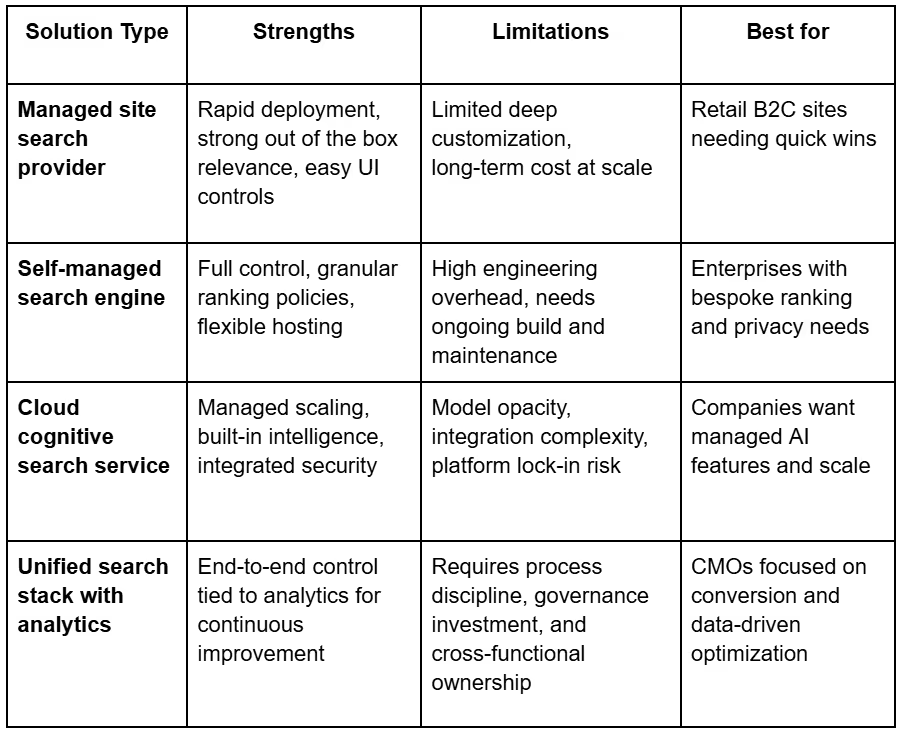
The table shows how each solution type maps to business fit, expected returns, and operational trade-offs. It helps marketing teams choose the simplest option that still meets conversion, relevance, and personalization targets.
Where should marketing invest first?
Start with three activities that require modest investment but produce measurable gains
- Fix zero result queries and synonyms for high traffic terms
- Implement business rules for promotions and inventory-sensitive ranking
- Add simple personalization for returning users and high-value segments
These three moves improve relevance, speed, and revenue without heavy engineering.
How do you demonstrate ROI?
A pragmatic ROI approach that CMOs can defend in a budget review -
- Establish baseline metrics for search conversion and revenue per search session
- Run controlled experiments on rule changes or personalization segments
- Measure delta in revenue and cost to deliver the change
- Report attribution as incremental revenue per month with confidence intervals
ROI becomes repeatable once you standardize measurement and maintain a rolling experiment backlog.
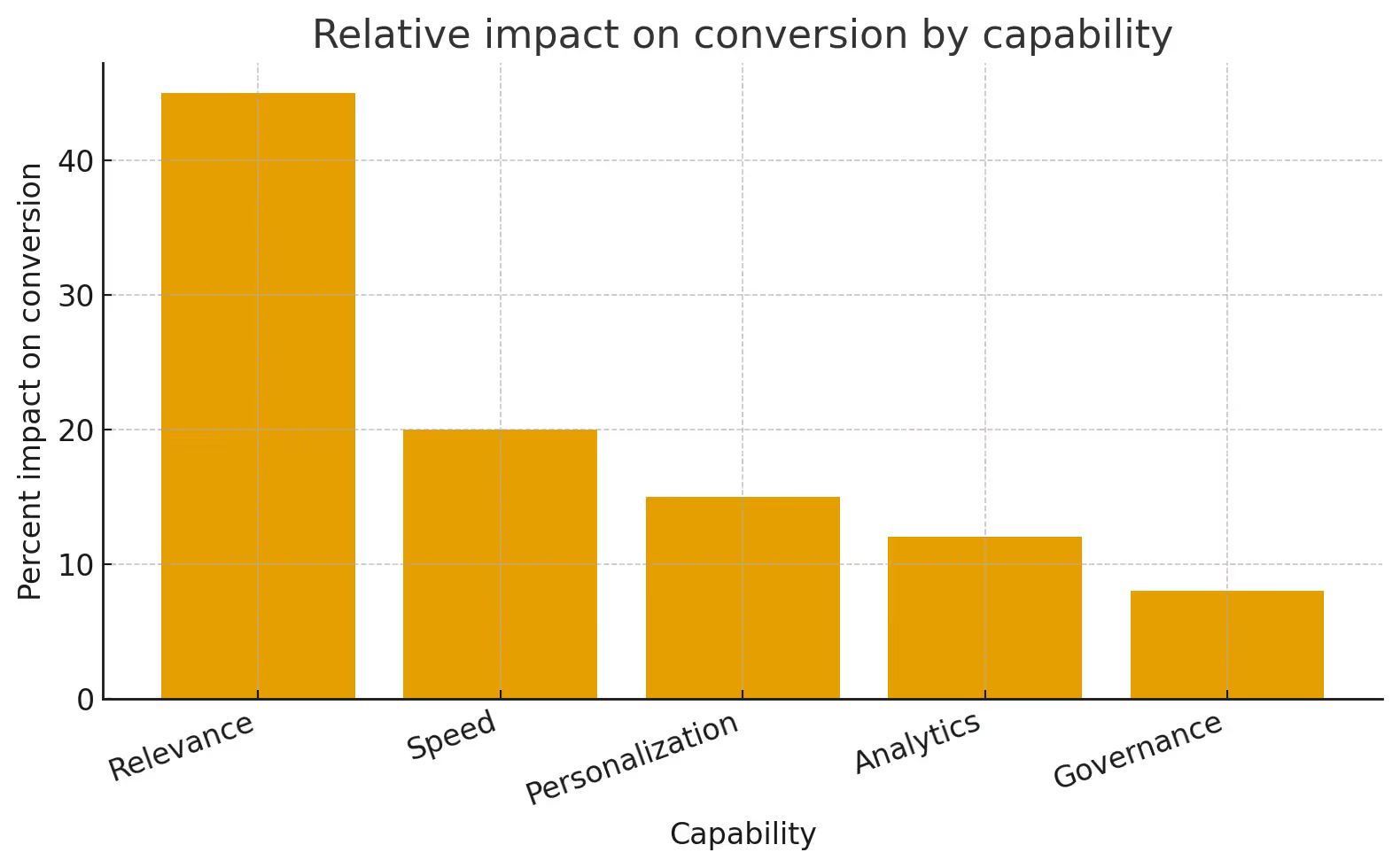
Bar chart showing the percent impact on conversion, with relevance driving the largest share.
Search stack mistakes that quietly kill ROI and how to fix them
- Treating search as a one-time project rather than an ongoing product
Avoid by assigning a search strategy owner and a cadence of experiments. - Blindly trusting default AI models without analytics
Avoid by instrumenting logs and measuring business outcomes. - Over-personalization that erodes relevance for new users
Avoid by guarding exploration and balancing relevance with discovery. - Neglecting governance, which leads to inconsistent promotions or compliance failures
Avoid by defining rules and audit processes.
How FTA approaches the search stack for marketing teams
FTA treats search as a revenue function. We focus on three elements that CMOs value
- Rapid time to measurable uplift through targeted rules and merchandising
- A data-driven loop where query analytics feed content, SEO and paid strategy
- A governance framework that protects brand messaging and campaign priorities
FTA’s approach aligns technical capabilities with commercial KPIs, searching for a repeatable growth lever rather than just a technical feature.
Search is a high-return lever if treated as a product
Optimize the stack by fixing core relevance issues, shipping merchandising controls and building a feedback loop that ties query signals to content and campaigns. Start with a compact cross-functional team, map a pragmatic procurement choice to your scale and then operationalize measurement.

Do you want more traffic?


OpenAI Dots Explained: How ChatGPT’s Always-On Agents Work, and How They Compare to Meta Muse
.jpg)