
Key findings
The big AI agents got into India's ecommerce sites far more often than a generic bot did, and completed 80% of simple shopping tasks. What stopped them was rarely a firewall. It was unclear information, content that needs JavaScript, and location or login walls. We tested 50 sites in two parts in September 2026: a technical crawl, then 450 real tasks run by Claude, GPT and Gemini.
- Real agents completed 358 of 450 tasks (80%). Return windows were easiest (91%). Delivery charges (74%) and finding a product with its price (73%) were harder.
- Generic bots get blocked; named AI agents mostly do not. 21 of 50 sites blocked or failed our generic cloud crawler. Yet on those same sites, the real agents succeeded almost as often as on open sites: 77% of tasks on sites that fully blocked our crawler, against 82% on open sites.
- robots.txt still matters. The only site that blocks shoppers' AI agents in robots.txt was also one of the four sites where agents completed a third of tasks or fewer. Claude and Gemini were both refused there.
- The most common reason agents failed was unclear information, not blocking. Of 92 failed tasks, 26 failed because the answer was not clearly stated on the site, mostly delivery charges. 13 failed because content needed JavaScript. Only 11 failed because of a block or error response.
- Agents often disagree when policies are complicated. All three agents gave the same return window on 29 of 50 sites. On 13 sites they gave different answers, usually because the site has several return rules or contradicts itself.
- Half of product pages hide the price from simple readers. On 12 of 24 product pages we could fully test, the price was not in the server HTML, only in JavaScript. Agents that cannot run JavaScript said so when they failed.
- Platform defaults decide who is ready for new standards. All 8 sites showing WebMCP run on Shopify, which switched it on for its stores in August 2026.
The cross-check between the two parts is the most important result. Without Part 2, we would have reported that four in ten sites block AI agents. With it, we can say what is actually true: most sites block unknown bots, but let the major AI agents in.
Part 2: What real AI agents experienced
Claude, GPT and Gemini completed 80% of the shopping tasks we gave them, including on most of the sites that had blocked our generic crawler. Each agent tried three tasks on all 50 sites, using its own built-in web tools, and had to answer from the official site.
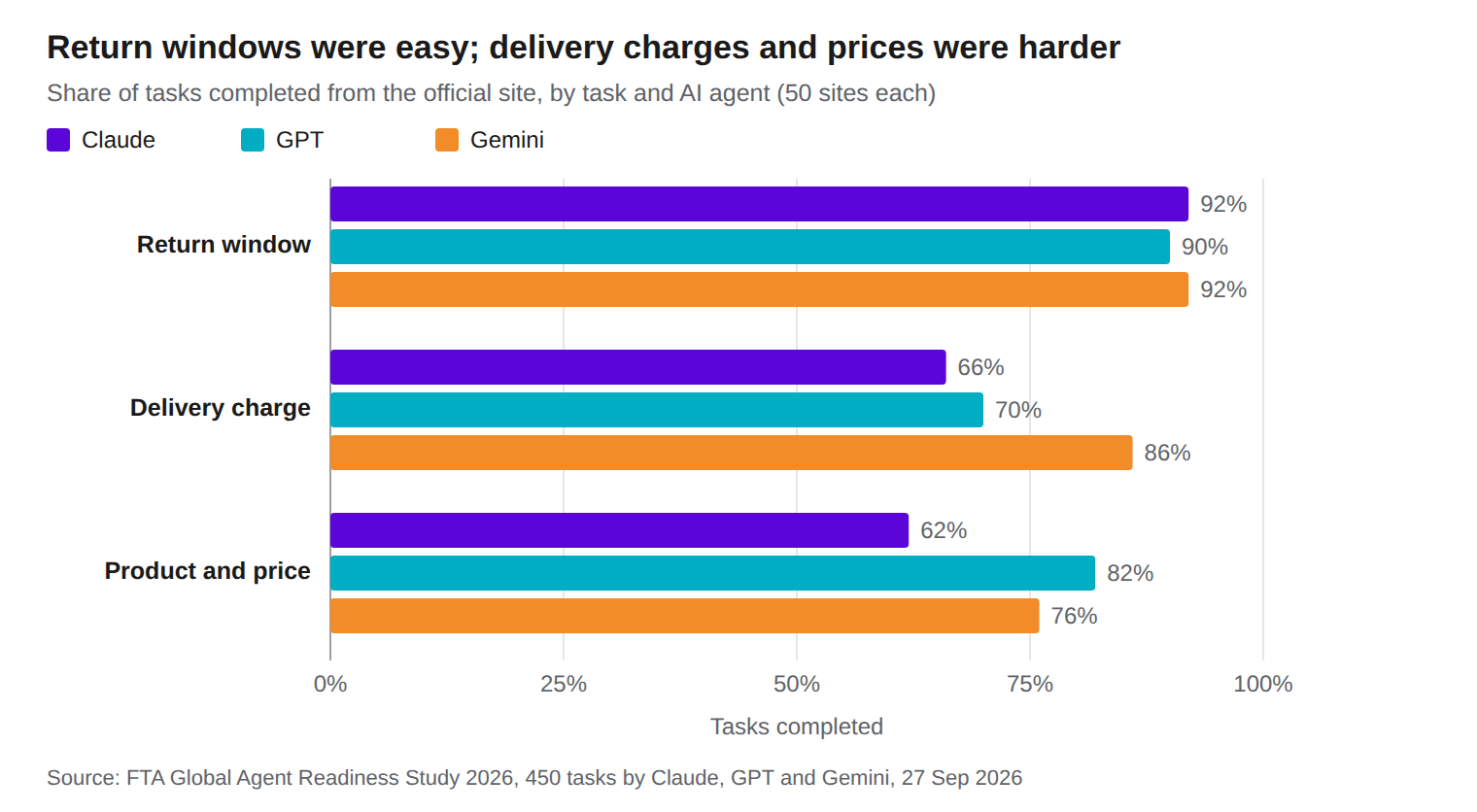
We counted a task as complete only when the agent said it found the answer on the official site, cited an official page, and gave a clear value. Gemini did best on delivery charges, GPT on finding a product and price, and all three were strong on return windows.
The cross-check: blocked to our crawler, but not to real agents
The sites that fully blocked our crawler still let real agents complete three in four tasks. Five of them let all three agents complete all nine tasks. So the firewalls on these sites are doing what they should: stopping unknown automated traffic, while letting the major AI agents through.
The exceptions were telling. On one large marketplace whose robots.txt disallows shoppers' AI agents, Claude and Gemini were refused, and GPT could open the homepage but not product pages. On a quick commerce site, GPT got "403 Forbidden" on the policy pages. On a large fashion site, two agents got the same "Site Maintenance" page our crawler saw.
Why agents failed
We sorted every failed answer by the reason the agent gave. Of the 92 tasks agents could not complete:
Most of the "not clearly stated" failures were delivery charges. Many sites mention free delivery without a clear threshold, or give different figures on different pages.
Do agents agree with each other?
When a site has one clear rule, agents agree. When it has several, or states the same rule differently on two pages, a shopper's answer depends on which agent they happen to use.
Were the product answers real?
Agents gave an official product link and price in 110 of 150 product tasks. We then opened those links from our own servers. Of the 74 we could check:
The other 36 links sat on sites that blocked our checker, so we could not verify them. The three dead links show that agents can still invent or misremember product URLs, even when told to use the official site.
Part 1: The technical crawl in numbers
Every number below comes from our own crawl of 50 sites, run on 26 September 2026. The base changes by row, because a site that blocked us could not be tested further.
Part 2: Who lets a generic bot in
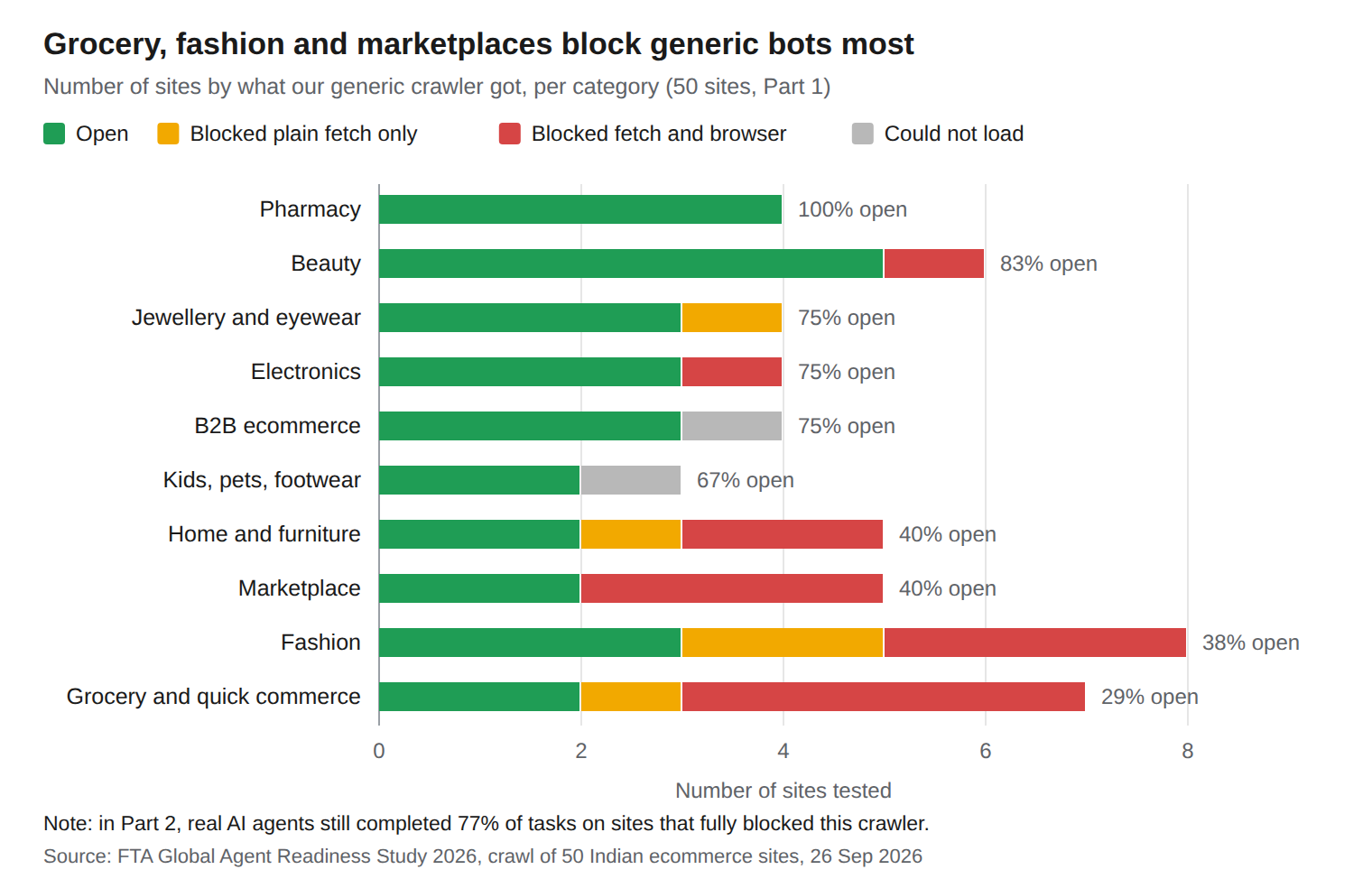
Every pharmacy site we tested showed a normal page. Grocery and quick commerce did worst: 5 of 7 sites blocked an automated visit in some way. But in Part 2, the major AI agents still completed 63% of tasks on grocery sites, so most of these blocks stop unknown bots rather than ChatGPT, Claude or Gemini.
Finding 1: Firewalls block generic bots, but mostly let the major AI agents in
Almost every site says "yes" to AI agents in robots.txt, and many firewalls say "no" to unknown automated visitors. Part 2 showed that most of those firewalls still let the major AI agents through, so the real risk is for smaller or newer agents, not for ChatGPT, Claude and Gemini.
What robots.txt says
Only one site, a large marketplace, blocks shoppers' AI agents in robots.txt on purpose. One fashion site blocks the product pages we tested for every bot, AI or not. Four sites limit training crawlers: two block only Common Crawl or ByteDance, one blocks almost all of them, and one is the fashion site above. None of the 50 sites used Cloudflare's new Content-Signal line to state how AI may use their content.
What happened when our generic crawler visited
The firewall told a different story. 14 sites refused both a plain fetch and a full headless browser. They returned "Access Denied" pages, HTTP 403 errors, "Just a moment" challenge pages or empty 202 responses. 5 more sites blocked the plain fetch but let the browser through after a JavaScript challenge. One large fashion site served a "Site Maintenance" page to both.
We could not read robots.txt at all for 16 sites, mostly because the firewall blocked that file too. So for those sites, even the site's own instructions to bots were unreachable.
Why this matters
In Part 2, real agents completed 77% of tasks on the 14 sites that fully blocked our crawler, close to the 82% on open sites. So these firewalls tell known AI agents apart from unknown traffic. That is good for today's big assistants, but it means any new agent, a smaller AI company or a brand's own procurement bot may still hit the wall. The one clear exception was robots.txt: the marketplace that disallows shoppers' agents there was one of the hardest sites for agents to use.
Caution: we ran this crawl from Google Cloud servers, as an unknown bot. The blocks in this finding describe what unknown automated traffic gets. Part 2 describes what the major AI agents get, and the two are very different.
Finding 2: JavaScript hides key content, including prices
Most homepages are readable without JavaScript, but product pages are not: half of them hide the price from simple agents. And the price is the one fact every shopping agent needs.
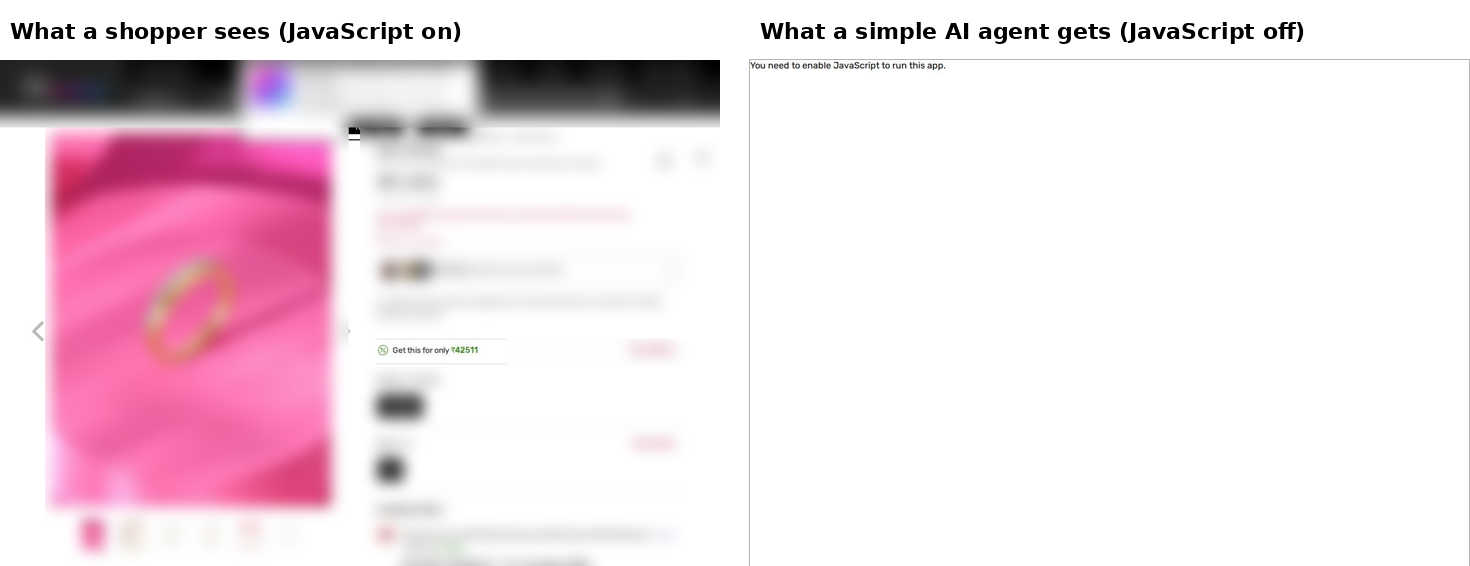
The same product page from one site in our study, loaded with JavaScript on (left) and off (right). With JavaScript off, the page shows one line: "You need to enable JavaScript to run this app." Brand details are blurred.
Homepages
Across the 29 sites that showed a normal homepage, the median site showed 90% of its homepage text without JavaScript. But 7 of the 29 showed less than half. Two, a large marketplace and a dairy delivery brand, showed nothing at all.
Product pages
We could fully test 24 product pages. The results:
So on some pages the price sits inside schema but not in the visible text. Whether AI agents read schema is still debated, which makes these pages a gamble.
Why this matters
Most AI crawlers and many AI assistants read only the HTML the server sends, without running JavaScript. When the price is missing from that HTML, the agent cannot confirm the price. It may skip the product, guess, or pick a rival whose price it can read. Part 2 bore this out: 13 failed tasks were put down to content that needed JavaScript, 11 of them by Claude, whose page reader does not run JavaScript.
Finding 3: Product schema is common, but return and delivery data is missing
Indian ecommerce sites have done the basic schema work, but not the parts that answer a shopper's real questions: can I return it, and when will it arrive?
Two more patterns stood out:
- Schema that only appears after JavaScript. 2 sites added Product schema through JavaScript. Agents that read only the server HTML never see it.
- Price in schema but not on the page. 7 sites had the price in schema but not in the visible server HTML. If an agent ignores schema, it sees no price at all.
At site level, 23 of 29 open homepages carried Organization schema, and 17 of 50 sites described their site search in schema, which helps agents search the catalogue directly.
Why this matters
Returns and delivery are the two questions shoppers ask most before buying. When they are missing from structured data, an agent must dig through policy pages, often with vague wording. Sites that add return and delivery schema give agents a direct, trusted answer.
Finding 4: Buttons are labelled, forms are not, and pop-ups get in the way
Most buttons tell an agent what they do, but most form fields do not. That matters most for the fields agents need to fill: pincode, phone number and search.
What the pop-ups were
The three full-screen pop-ups were a login prompt on a marketplace homepage, a "call back" request form on a mattress product page, and a "you are visiting from a different country" prompt on an electronics site. Each one stands between an agent and the product.
What we could not find
On 6 of 24 product pages we found no clearly named add to cart control. Some of these sites ask for a delivery location first, and others use unlabelled icons. Either way, an agent has to guess.
Why this matters
Browser agents read the names and labels on a page, much like screen readers do. Placeholder text disappears as soon as someone types, and is often ignored by assistive tools. A proper label on the pincode field is one of the cheapest AXO fixes there is.
Finding 5: Platform defaults decide who is ready for new standards
Almost every Indian ecommerce site that supports the newest agent standards got them from its platform, not from its own team. That is good news for brands on those platforms, and a warning for everyone else.
WebMCP
8 of 50 sites showed signs of WebMCP, the new browser standard that lets a site tell agents which actions it supports. All 8 run on Shopify. Shopify switched on WebMCP tools for its standard storefronts in August 2026, with no work needed from store owners. No site on any other platform showed WebMCP.
llms.txt
15 of 50 sites had an llms.txt file. But look closer:
So only 6 of 50 sites (12%) chose to write their own llms.txt.
Why this matters
Platform choice is becoming an AXO decision. A brand on a platform that ships agent features by default gets them for free. A brand on a custom stack must build them. Neither WebMCP nor llms.txt is proven to change results yet, so we did not include them in the readiness score. But brands on custom stacks should watch these standards closely, because their competitors on big platforms may get them overnight.
Finding 6: Agents come from abroad, and some sites treat them as foreign shoppers
AI agents usually run on servers outside India, so sites that change their content by country may show agents the wrong store. Our crawl ran from cloud servers outside India, and two open sites reacted to that.
- An eyewear brand redirected us to its US store. Every page we reached, including the return policy, was the US version, with US prices and US rules.
- An electronics brand covered every page with a full-screen "you are visiting from a different country" prompt. A human can click "continue". Many agents will not, or will read the prompt instead of the product.
This is a quiet but real risk. Vercel and MERJ found that the major AI crawlers they measured operate from US data centres. When an Indian shopper asks an AI assistant about a product, the assistant may fetch the page from the US. If the site then shows US prices or a country pop-up, the answer the Indian shopper gets is wrong.
What to do about it
Serve the Indian store by default on Indian domains, whatever the visitor's location, and offer other regions as a choice rather than a forced redirect. Never cover the page with a country prompt. A small banner does the same job without blocking agents.
Agent Readiness Scores
The average site scored 43 out of 100, but the spread is huge: 12 sites scored 80 or more, while 18 scored under 20. Almost all of the low scores come from sites that blocked our generic crawler at the door.
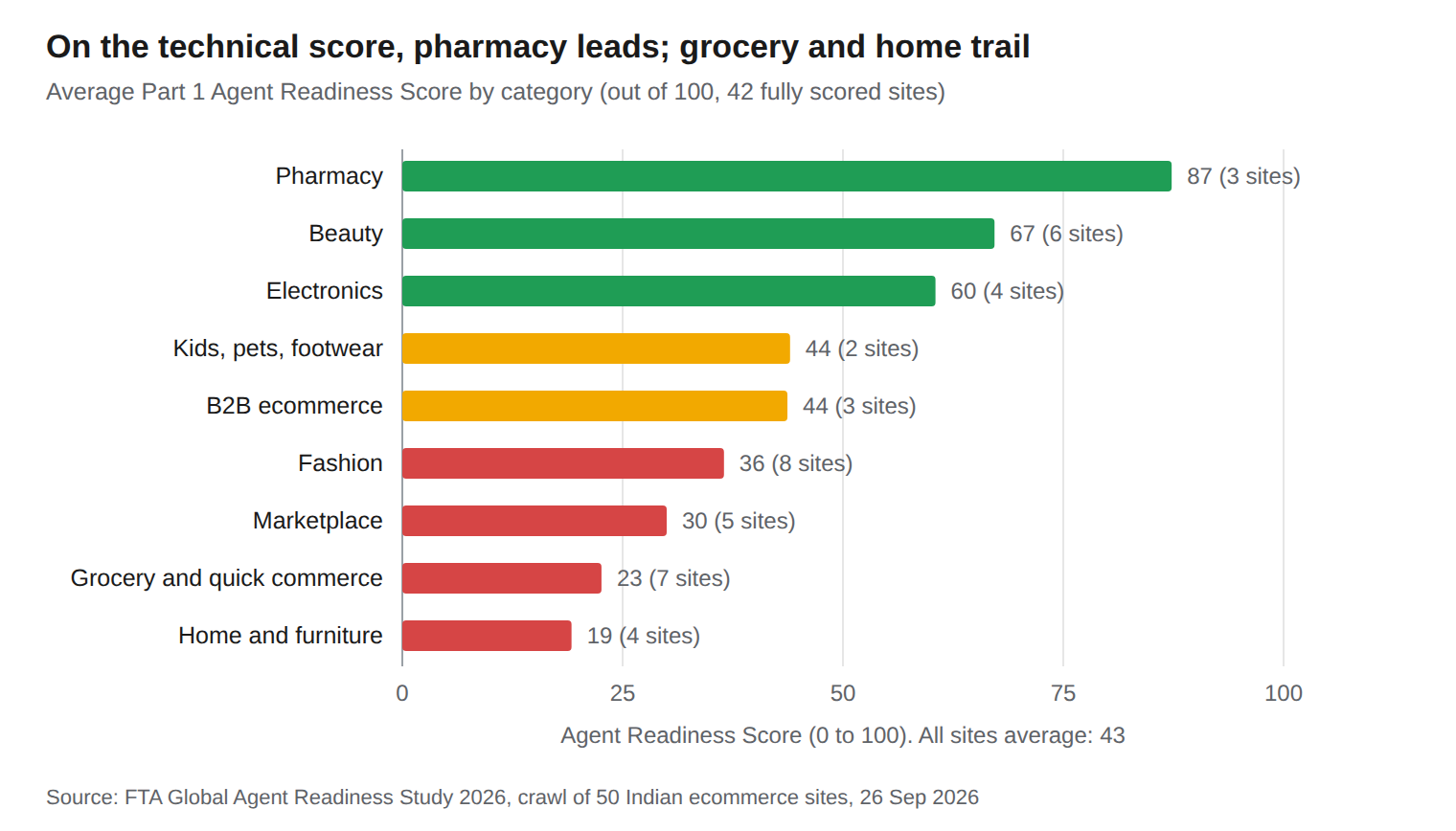
Jewellery and eyewear has no category score, because the product pages we captured for those four sites were listing pages, not single products. We left them out rather than mark them down for our mistake.
Read these scores with Part 2 in mind. The Reach pillar reflects what our generic crawler got, so sites that blocked it scored near zero, even though real agents did well on most of them. Home and furniture, for example, averaged 19 on this score, yet real agents completed 89% of tasks there. Among the 29 open sites, where the score measures the pages themselves, it tracks real agent success reasonably well, with a correlation of 0.63. In the next edition we will rebuild the Reach pillar around what real agents get.
The top 5 sites
Pillar scores are rounded. The total is scaled to 100 from the 90 points we could measure, because Trust was not scored in Part 1.
What the leaders share: they let agents in, they send their key content in the server HTML, and their product pages carry schema with price and stock. None of them is perfect. Most lose points for unlabelled form fields, and only two of the five describe returns and delivery in schema.
How the 42 scores are spread
The middle is thin. Most sites are either broadly ready or not reachable at all, which means the single biggest lever for most brands is access, not fine-tuning.
What Indian ecommerce brands should do now
Make your delivery and return rules unmistakable, make the price readable without JavaScript, and keep your bot rules open to shoppers' agents. In Part 2, unclear information caused more failed tasks than blocking did, so clarity comes first. Firewall rules still matter for smaller and newer agents.
How to check your own site in 15 minutes
- Open a product page, turn off JavaScript in your browser and reload. If the price disappears, you have a Read problem.
- Open yoursite.com/robots.txt from a phone on mobile data and from a laptop on office Wi-Fi. If either shows an error or "Access Denied", your firewall is blocking even that file.
- Ask ChatGPT, Claude or Perplexity: "What is the price of [one of your products] on [your site]?" If it says it cannot access your site, or quotes a different site, you have a Reach problem.
For the full list of practices, see the FTA guide to Agent Experience Optimization.
Method
We crawled 50 Indian ecommerce sites on 26 September 2026 with an open, repeatable script and scored each one on the FTA AXO Framework, then ran 450 real agent tasks on the same sites on 27 September.
The sites
50 leading Indian ecommerce sites across 10 categories: marketplaces (5), fashion (8), beauty (6), electronics (4), grocery and quick commerce (7), pharmacy (4), home and furniture (5), jewellery and eyewear (4), kids, pets and footwear (3), and B2B ecommerce (4). This is a selection of leading sites across categories, not a ranking of the top 50 by revenue.
The pages
For each site, the script visited four pages: the homepage, one category page, one product page and the return policy page. It found these pages on its own by following the site's links and sitemap.
The visits
Each page was visited three ways:
- A plain fetch with a normal browser identity, the way many AI assistants read a page.
- A plain fetch with a clearly named research bot identity, to see how sites treat declared bots. We never pretended to be any AI company's crawler.
- A full headless Chrome browser with JavaScript on, plus a second load with JavaScript off for screenshots.
The script also read each site's robots.txt and checked it against 13 AI user agents, and looked for llms.txt, WebMCP and Content-Signal.
The checks
The score
Reach 25 points, Read 25, Understand 20, Act 20. Trust (10 points in the full framework) needs a human review of policies, so it was not scored here. We scaled the 90 measured points to 100. A site that blocked both the plain fetch and the browser scored zero on Read, Understand and Act, because an agent would see nothing.
Quality checks
We reviewed the page data for every site and checked screenshots wherever a result looked unusual. On 8 sites the script captured a listing page instead of a single product. We excluded those 8 from product-level results and from scoring, rather than mark them down for our error. Our pop-up check also flagged invisible full-screen page elements on two sites; we counted only pop-ups that showed visible text.
The real agent test (Part 2)
On 27 September 2026, three AI models each received the same three tasks for every site: Claude (claude-haiku-4-5), GPT (gpt-5-mini) and Gemini (gemini-3.8-flash). Each ran through its company's API with its own web search and page-reading tools switched on, and was told to use only the official website and to say so if it could not. That made 450 tasks in total.
We counted a task as complete only when the agent said it found the answer on the official site, cited an official page, and gave a clear value. We then opened every official product link the agents gave, from our own servers, to check that the page existed and showed the stated price. The test cost about USD 25 in API fees.
These are the faster, lower-cost models from each company, used through their APIs. Consumer agents such as ChatGPT agent mode or Claude in Chrome run full browsers with larger models, and may do better on JavaScript-heavy pages.
Limitations, and what comes next
Part 1 measures what an unknown automated visitor gets. Part 2 measures what three major AI agents get. Both are snapshots, and both have limits worth knowing.
What to keep in mind
- Cloud location. We ran the Part 1 crawl from Google Cloud servers outside India, as an unknown bot. Part 2 confirmed that many of those blocks do not apply to the major AI agents, so Part 1's access results describe unknown traffic, not ChatGPT, Claude or Gemini.
- One visit per page. Sites change often, and a block or pop-up can depend on time of day, traffic or A/B tests. These results are a snapshot of 26 September 2026.
- One product page per site. A site's other product templates may do better or worse.
- Automated checks have limits. Our checks can miss a well-hidden add to cart button or misread a complex page. Where results looked odd, we checked screenshots by hand.
- Trust not scored. Policy clarity and consistency need human review, so the Trust pillar is not in these scores.
- Standards not scored. WebMCP and llms.txt are reported but not scored, because their benefit is not yet proven.
- Agent answers are not all checked by hand. We verified product links and prices automatically, and compared return windows across agents. We did not hand-check every delivery answer against the site.
- Model choice. Part 2 used each company's faster, lower-cost model. Larger models and full browser agents may do better.
What comes next
The next edition will rebuild the Reach pillar around real agent access, fix the product pages for the 8 sites we could not score, add a hand-checked accuracy review of delivery answers, and test full browser agents such as ChatGPT agent mode and Claude in Chrome on a sample of sites.
Read our complete guide to Agent Experience Optimization to see what AI ready websites need to get right.
Sources
All study data comes from FTA's own crawl of 26 September 2026. Outside sources used for context:
- The rise of the AI crawler, Vercel and MERJ, December 2024: AI crawlers and JavaScript, and where they run from
- WebMCP for Liquid storefronts and Hydrogen, Shopify developer changelog, August 2026
- Overview of OpenAI crawlers, OpenAI: the difference between training, search and user-triggered agents
- Join the WebMCP origin trial, Chrome for Developers, June 2026

Do you want more traffic?


OpenAI Dots Explained: How ChatGPT’s Always-On Agents Work, and How They Compare to Meta Muse

Agent Experience Optimization