
TL;DR
- LLMO and GEO are additional layers on top of traditional SEO, focusing on how AI models synthesize and cite information rather than just ranking links.
- Traditional SEO aims for a website to be found in search results; GEO aims for a brand to be included and cited within a generative AI’s direct response.
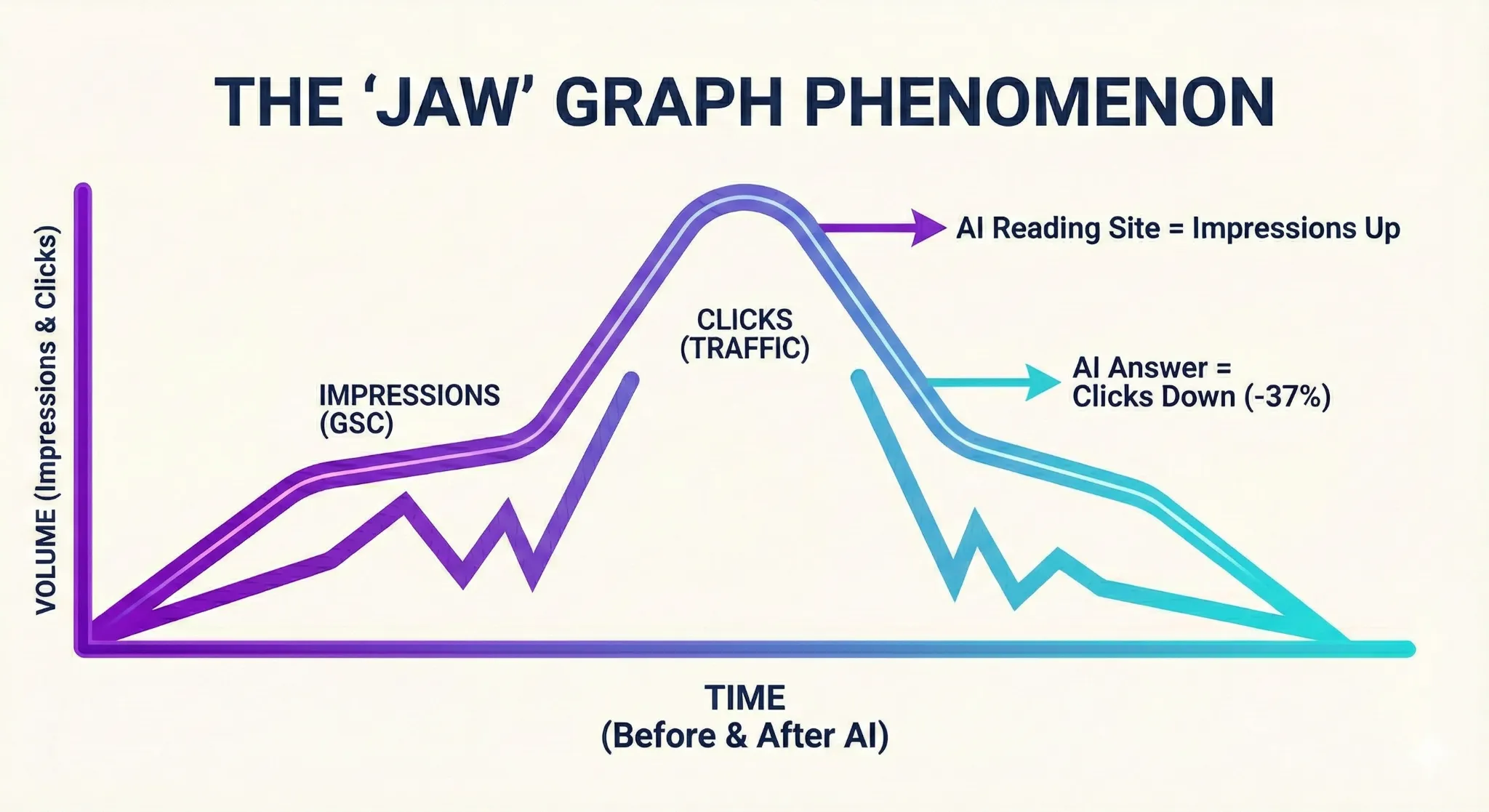
- The "Jaw" Graph Phenomenon: We are entering an era where impressions may rise due to AI overviews, but clicks often decline as users get answers directly on the search page.
- High-quality branded mentions on credible third-party sites now have a stronger correlation with AI visibility than traditional metrics like domain rating or link juice.
- LLMs evaluate whether your content provides a coherent, logical path to solve a user's problem, requiring "snackable," well-structured, and factual content.
Who is this blog for?
This blog article is designed for marketing leaders, CMOs, and SEO practitioners who have noticed a shift in their Google Search Console data, specifically those seeing a "jaw" graph where visibility is high but organic traffic is plateauing or dipping.
What is Search Everywhere Optimization?
For over a decade, the goal of search was simple: rank on page one of Google. However, the game changed more in the last year than in the previous ten.
Search is fragmenting across platforms like ChatGPT, Reddit, YouTube, and TikTok, leading to a strategy known as "Search Everywhere Optimization".
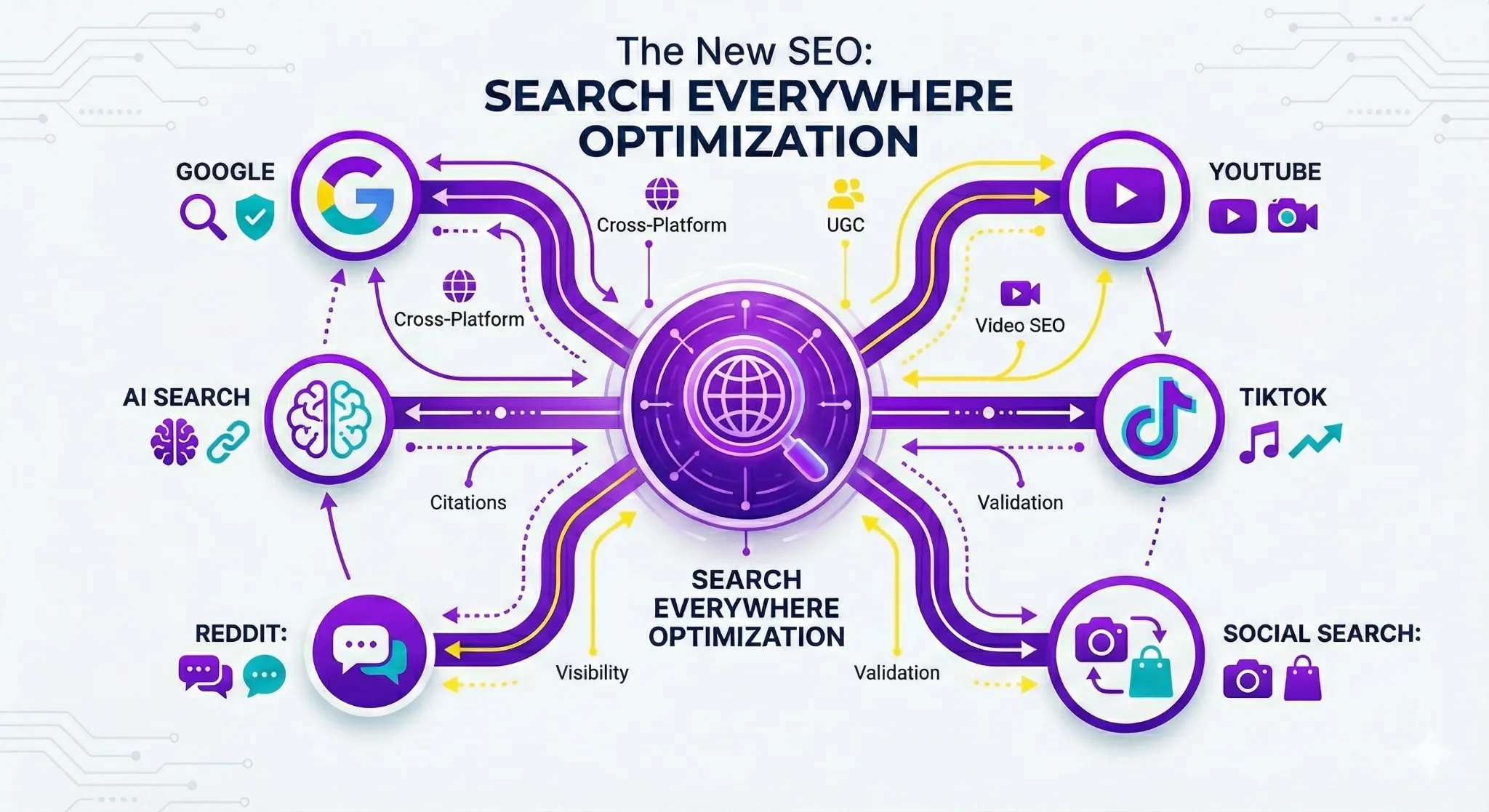
Modern search optimization is an evolution of traditional techniques rather than a completely new discipline. While SEO has long moved past simple keyword matching to focus on authority and intent, the rise of AI search adds a layer of complex reasoning to the process.
Artificial intelligence does not just retrieve links; it evaluates whether a source can help it construct a coherent answer for the user.
High-quality content and strong backlinks remain essential, but they are no longer sufficient on their own to guarantee a mention.
Success now depends on ensuring information fits the logical path and situational context the AI uses to solve problems. Ultimately, this requires moving beyond rankings to understand how machines use data to confidently explain concepts.
Comparing SEO, GEO/LLMO & AEO
To understand if these disciplines are truly different, we must look at their goals, the crawlers involved, and how they measure success -
.webp)
Why Your Search Strategy Needs Search Everywhere Optimization?
Traditional SEOs are often "one-trick ponies," focusing solely on Google.
As AI overviews become the norm, we are seeing the "jaw" graph: your impressions in Google Search Console go up because your site is being "read" by the AI, but your clicks go down by as much as 37% because the user doesn't need to visit your site to get the answer.
To survive this, you must optimize for where your audience actually hangs out. This means:
- Amazon for shoppers.
- Reddit for community-driven advice.
- YouTube (the world's second-largest search engine) for "how-to" intent.
- TikTok and Instagram for younger demographics.
Humans are infinitely curious and will always search; only the mediums change. The message remains the same, but you must adapt to each channel's "meta".
The Power of Branded Mentions and Entities
In the GEO world, your brand is an entity that the AI needs to be "educated" about. Ahrefs analyzed 25 million AI overviews and found that branded mentions on credible sites have the strongest correlation with AI visibility, even stronger than backlinks or domain rating.
When an LLM sees your brand name consistently connected to a topic on high-traffic or highly-linked pages, it builds confidence in associating you with that subject. Hence, digital PR is becoming a core pillar of SEO.
Interestingly, while traditional SEO might avoid appearing on a listicle alongside competitors, in GEO, you want to be seen alongside them.
If an AI is asked for the "top 5 law firms in Manchester" and you aren't mentioned on the same lists as your rivals, the AI may not even understand that you are a law firm.
LLMO vs SEO - Understanding the Shift from Retrieval to Reasoning
- LLMO is not separate from SEO. It is the next layer in the evolution of search.
- Traditional SEO is built on retrieval. Keywords help systems find and rank pages.
- LLMO is built on reasoning. Prompts guide AI systems in constructing an answer.
- The real difference in LLMO vs SEO lies in how information is processed, not whether optimization exists.
- Many brands show strong rankings and stable keyword positions yet fail to appear in AI-generated answers. Their content was built for ranking, not reasoning.
- The shift from SEO to LLMO marks a move from information matching to problem solving.
- A keyword mindset focuses on definitions, features, and search volume.
- A reasoning mindset focuses on whether the content helps an AI clearly explain a solution.
- Effective LLMO ensures your brand is not only retrieved in response to a query but also selected in the AI’s decision path when building a response.
Technical GEO: Schema Markup, Robots.txt, and HTML Accessibility
You cannot rank in AI results if the AI cannot see you. While search engines have improved at rendering JavaScript, many AI systems still primarily read raw HTML.
- Robots.txt: Ensure you are not accidentally blocking OpenAI's GPTBot, Google's crawlers, or Bingbot. About 5.9% of websites currently block the very bots they want to rank for.
- Schema Markup: This is the code for robots that tells an AI precisely what a page is about. Organization and Article schema are essential for helping AI identify your brand, author, and publication date.
- HTML Clarity: Avoid hiding your most important information behind JavaScript interactions or burying it in images without descriptive Alt Text.
How Do You Ensure Your Content is Chunk Optimised?
AI assistants like Google and ChatGPT do chunking of your content based on their algorithm's retrieval. They read your semantic HTML structure from top to bottom, "chunking" your content into smaller pieces to decide which parts are useful.
You can optimise your content structure by keeping in mind:
- Don't bury the lead: Put the most valuable information and direct answers at the very top of the page.
- Use clear hierarchies: Proper H1, H2, and H3 tags direct the AI to the specific sections that answer user queries.
- Be "Snackable": Use bullet points, numbered lists, and tables. These formats are easily parsed by AI and often quoted verbatim in AI responses.
- FAQ Styling: Explicitly stating a question as a heading followed by a concise answer helps "hold the hand" of the AI tool.
Retrieval Augmented Generation (RAG) and Information Freshness
A critical retrieval signal in the AI era is freshness of your content. Most AI assistants use RAG (Retrieval-Augmented Generation) to fetch the latest information from the web when their internal training data is outdated.
Data shows that content cited by AI is 25.7% fresher than content appearing in traditional Google results. ChatGPT and Perplexity, in particular, tend to list citations from newest to oldest.
To stay relevant, you must adopt a regular refresh cycle for your content, updating statistics, quotes, and facts to signal to the AI that your information is the most current available.
How Do I Choose the Right LLMO Solution for Enterprise Needs?
For an enterprise to choose the right solution, it must first shift its primary question from "What keyword should I rank for?" to "In what LLM platform should my brand appear?" The right solution will prioritize "Search Engineering", ensuring that your authority is backed by content that reasoning systems can actually use to provide guidance and comparison.
When evaluating potential services, consider the following:
- Specific vs. Neutral: Does the solution help you move away from broad, keyword-optimised content toward specific, situational clarity?
- Prompt-Ready Content: Does it focus on how to feed instructions to a reasoning system rather than just matching queries?
- Trust and Authority: Does the strategy address how AI systems determine which sources to trust beyond domain authority alone?
As search continues to evolve, the goal is no longer just to be found, but to be the source that the AI uses to make a real decision for the user.
The Future of Search Engineering
The future of search is AI-driven, and while Google remains the "gorilla in the room" with 30x more visitors than ChatGPT, our interaction with information is shifting from results to answers.
LLMO and GEO are not "marketer inventions" to justify employment; they are the necessary response to a world where AI models are the primary filters of information.
By focusing on E-E-A-T (Experience, Expertise, Authoritativeness, and Trustworthiness) and ensuring your site is technically accessible to bots, you can help your brand not just be ranked, but also be remembered and cited.
Stop stressing over the alphabet soup and start building a topical authority that both machines and humans can trust.


Do you want more traffic?