
Every enterprise content library starts with good intentions. Publish enough content, cover every topic, educate the market about every marketing niche, then let SEO compound the results. A few years later, most teams are sitting on hundreds or thousands of pages, yet growth feels capped. Rankings jump around.
Awareness content pulls traffic but does not assist the pipeline. Sales asks for better leads, and marketing keeps producing more content because fixing the old library feels like a daunting task.
Here is what is really happening. Your library is not failing because it lacks information. It is failing because too many pages are not aligned with the searcher's intent at that moment. Some pages explain when the user wants to compare.
Some pages sell when users want to learn. Many pages overlap and compete for the same intent, so performance is split, and authority is diluted.
This is why content audits are now a standard practice in mature marketing teams. They reveal what is broken, outdated, and getting in the way of performance. But audits alone do not unlock value unless you have a decision system that tells you what each page should do next.
Search intent mapping is that system. It turns a library into a portfolio where every asset has a clear role, a clear next step, and a measurable reason to exist. When you map intent properly, you stop publishing blindly, you consolidate what should be one, you elevate what already has demand, and you build conversion pathways that match how real buyers research.
In this blog article, we will show you how to map intent across your content library, find what is blocking results, and get more pipeline from what you already have without creating more content.
What is search intent mapping?
Search intent mapping is the operational process of assigning each content asset to a primary intent, a stage of decision making, and a next action. It is not keyword tagging. It is strategic alignment between what a person wants right now and what your page is built to deliver.
When you have a small site, intent mismatches hide. When you have a large library, intent mismatches compound. You end up with:
- Multiple pages competing for the same intent and keyword cluster
- Pages ranking for informational queries, but pushing hard conversion CTAs too early
- Pages ranking for commercial investigation queries, but reading like generic explainers
- Transactional landing pages are showing up for early-stage searches and bouncing visitors
- Valuable pages are buried in weak internal linking paths, never earning authority
Intent mapping fixes this by giving every page one clear job and guiding the reader to the next right step, whether that is a deeper article, a comparison page, a case study, or a call request.
Search intent mapping framework for large content libraries
A large library needs a system, not a one-time exercise. Here is the FTA framework we use to map at scale without losing precision.
1) Inventory with decision-level metadata
Collect a full URL list and attach a minimum set of fields that help you make decisions fast:
- Primary query theme
- Current top queries and landing keyword clusters
- Page type (blog, pillar, landing, case study, glossary, comparison, template, tool page)
- Audience fit (ICP, non ICP, mixed)
- Current intent match score
- Current conversion path and CTA
- Internal link in and out count
- Update potential (high, medium, low)
2) Decode intent from the SERP, not from assumptions
Intent is visible in what Google chooses to rank. For each target query, you should record:
- Dominant page types ranking on page 1
- SERP features (People Also Ask, videos, product grids, local packs)
- Content patterns (definitions, steps, templates, pricing tables, comparisons, case studies)
This matters because intent is not what you think the query means. It is what the search engine has learned searchers reward with clicks and satisfaction.
3) Map each page to one primary intent and a single primary job
Most pages fail because they try to serve three intents at once. One page should do precisely one job.
FTA intent categories that work for B2B libraries:
- Informational intent: learn and reduce uncertainty
- Commercial investigation intent: compare options and reduce risk
- Transactional intent: take action now
- Navigational intent: reach a specific brand, product, or resource
Now add one more layer that B2B teams forget: decision temperature.
- Cold: exploring
- Warm: shortlisting
- Hot: ready to engage or buy
4) Align the page assets to the intent
Intent alignment is not about copy edits at all. It is page architecture.
- Informational pages need clarity, definitions, steps, examples, and internal links to evaluation pages
- Commercial investigation pages need comparisons, decision criteria, proof, and clear routes to a demo or consultation
- Transactional pages need friction removal, trust, pricing context if relevant, and short forms
- Navigational pages need speed and obvious paths
Why do CMOs lose ROI in content libraries without intent alignment?
If you are a CMO, the risk is not that content underperforms. The real risk is the silent opportunity cost. Large libraries without intent mapping cause:
Wasted crawl attention and diluted quality perception
Search engines evaluate sites at scale. Large volumes of thin or mismatched content can suppress stronger pages because the overall usefulness signal weakens.
Cannibalization that looks like volatility
Three similar pages targeting the same theme will trade rankings over time. Teams misread it as an algorithm issue. Often, it is a portfolio issue.
Conversion friction occurs because CTAs do not match the moment
A common failure pattern: an informational post ranks well, then forces a demo CTA. The user is not ready. They bounce or ignore. Another competitor wins by offering a template, checklist, benchmark report, or comparison guide first.
Sales misalignment
Content that wins traffic but educates the wrong audience creates low-quality leads and gives sales a reason to distrust marketing attribution.
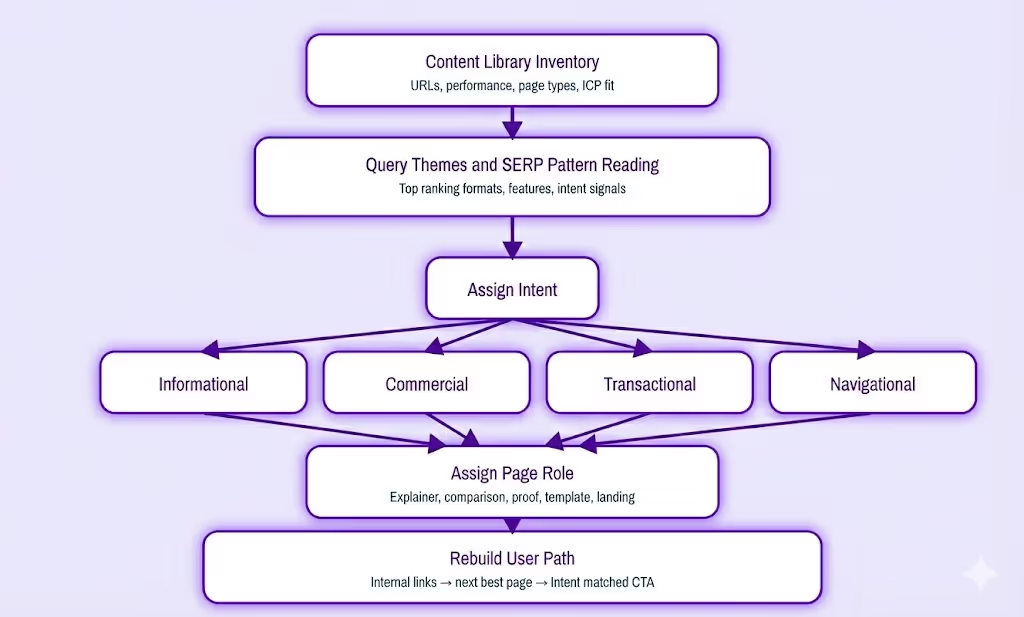
Search Intent Mapping flow for a content library
How FTA Global applies intent mapping to its cyber‑glossary content
FTA’s blog & playbook ecosystem follows a systematic search-engineered strategy to frame their content clusters. The approach, which builds on the framework, is tailored to B2B marketing leaders and industry experts above 35 who need high-intent, well-structured content.
- Inventory and segmentation: We start with a complete inventory of glossary definitions, how‑to posts, top agencies in different categories, comparison guides and solution pages. Each asset is tagged with its current SERP queries, page type, audience fit and conversion path. This audit reveals where content overlaps, where pages compete and where intent is missing.
- SERP‑driven intent research: Using tools like Google Search Console, on‑site analytics and manual SERP reviews, we decode what users expect for each query. For example, a query such as “what is zero‑trust architecture” clearly demands a concise definition, while “zero‑trust architecture vs VPN” signals comparison intent. We document the dominant ranking formats (glossary, listicle, case study, feature page) and note any People‑Also‑Ask questions or snippets we need to target.
- Assignment of primary intent: Each glossary or blog page is assigned a single primary intent: informational, comparative, transactional or navigational and a temperature (cold, warm, hot) based on the buyer journey. No page may serve multiple intents. If multiple pages address the same term, we consolidate them into a pillar page and redirect or repurpose duplicates.
- Content redesign and CTA alignment: For informational glossary terms, we prioritise definitions, context, examples and internal links to deeper guides. Comparative pages include feature tables, pros and cons and links to demo requests or case studies. Transactional pages focus on FTA’s services, clear value propositions and short forms. CTAs are matched to intent; for example, an informational glossary entry might offer a downloadable cheat sheet rather than a “Book a call” button.
- Internal linking and user path engineering: We build clear pathways from broad awareness content to deeper evaluation and finally to conversion. Each page ends with a “next best step” link, perhaps to a related comparison guide, a cyber‑risk assessment tool or a demo request, so users aren’t left to guess where to go next. This internal linking structure mirrors how searchers want to learn and decide.
- Measurement and iteration: After deployment, we track impressions, click‑through rate, dwell time, internal link clicks and assisted conversions. We look for pages that still underperform and refine them. Our experience with leading brands shows that even modest structural changes can yield double‑digit improvements in traffic and conversions.
By grounding the cyber‑glossary in search intent rather than vanity keywords, FTA ensures that each definition, guide or comparison page pulls its weight. The result is a library that doesn’t just generate traffic - it educates, nurtures and converts, turning organic search into a predictable pipeline engine.
Here is a content library inventory flowchart to help you understand the importance of intent mapping -
Operationalize search intent mapping via content intent matrix
The fastest way to operationalize intent mapping is a content intent matrix. This is where the library stops being a spreadsheet and starts becoming a revenue pathway.
The FTA Intent to Asset Matrix
This table shows how to match each intent type to the content formats and CTAs that work best, so every page has a single job and a measurable success signal.
How to prioritize a massive library without boiling the ocean
You do not need to map every page on day one. To unlock value fast, prioritize in this order:
Tier 1: Pages that already have demand signals
Use Search Console and analytics to identify pages with high impressions but low CTR, or with high traffic but low engagement. These are usually intent-mismatch problems.
Actions:
- Rewrite titles and introductions to match query intent
- Restructure the page to match the dominant SERP pattern
- Fix CTA to match the moment
- Add internal links to commercial and transactional pages
Tier 2: Cannibalized clusters
Find pages targeting similar query themes. Consolidate and strengthen one primary URL per intent within the cluster. Use canonical setup and internal links correctly.
Actions:
- Merge overlapping pages
- Create a clear pillar or hub page
- Redirect or canonicalize duplicates where needed
Tier 3: Library gaps that block conversions
Look for topics with high informational coverage but weak evaluation or proof coverage. This is where pipeline leaks happen.
Actions:
- Create comparison pages
- Create use case pages aligned to decision makers
- Create a proof layer: case studies, benchmarks, ROI narratives
Intent mapping for AI-driven search & why it matters
AI summaries and answer engines reward clarity. Intent mapping forces you to write content with an explicit purpose, which improves:
- Extractable answers for definitions and step-by-step queries
- Structured comparisons for evaluation queries
- Better internal architecture so authority flows
- Stronger people first usefulness signals at scale
This is one reason content libraries are splitting into two groups. Libraries built by volume get ignored. Libraries built with intent architecture earn attention, citations, clicks, and pipeline.
Search intent mapping deliverables CMOs should demand
If your team or agency says they do intent mapping, ask for these deliverables. If they cannot provide them, they are doing keyword clustering and calling it intent.
- A library-wide intent map with one primary intent per URL
- An intent to CTA alignment plan
- A consolidation plan for cannibalized clusters
- A hub and spoke architecture map for priority themes
- A measurement plan tied to pipeline, not just traffic
- A 30 to 90-day execution roadmap

Do you want more traffic?


OpenAI Dots Explained: How ChatGPT’s Always-On Agents Work, and How They Compare to Meta Muse
.jpg)