

TL;DR
1. AI answers are dynamic. Large language models build responses in real time from context, conversation history, and probability, so identical questions often yield different outputs.
2. Visibility depends on clarity, not just rankings. Brands disappear from AI answers when their information is inconsistent or poorly defined across sources.
3. Being the safest option matters more than being the best answer. Answer engines reuse content that is clear, specific, internally consistent, and bounded; generic content loses.
4. AI maps your brand from every source. A dense, consistent digital footprint across your website, profiles, and third‑party mentions tells AI who you are. Gaps or conflicting descriptions weaken the map.
5. Search Engineering and AI visibility tools can help. Modern visibility work combines entity clarity, context authority, consistent signals and prompt analytics to ensure your brand is mentioned wherever answers are being assembled.
Who is this blog on brand AI visibility for?
- Marketing leaders, founders and growth teams who saw our earlier post on why AI gives different answers to the same question and want to move from theory to practice.
- If your brand sometimes appears and sometimes disappears in ChatGPT, Gemini, Claude, or Perplexity, this guide will explain why and what to do about it.
- If you are looking for prompt hacks, keyword stuffing or shortcuts, this is not for you. AI visibility is a systems problem
Why brand visibility breaks when AI answers shift?
We have discussed that AI answers vary because large language models construct responses rather than pulling a single result. They use conversation context, fan‑out queries and probability to assemble an answer.
This means two people can ask the same question and receive different answers due to subtle changes in phrasing, timing, or prior conversation.
This dynamic nature unsettles brands used to controlling search rankings. When an AI tool neglects your company in favour of a competitor, it feels arbitrary. However, the issue is rarely about fairness; it’s about confidence. AI systems avoid uncertainty. When information about a brand is inconsistent, contradictory, or poorly defined across sources, the model removes it from the final answer. The shift from ranking to reasoning means you need to become safe to include rather than simply optimised to rank.
This article continues the conversation. Instead of asking why answers differ, we ask how to stay visible when they do.
Why do changing answers create visibility problems?
Traditional search engines return an ordered list of pages. You appear if you outrank someone else. AI answer engines work differently. They generate internal fan‑out queries, pull different pages, and synthesise a single response.
They evaluate which fragments align, which sources agree and which concepts fit the current context. The result is determined by probability, not position.
That means visibility is not guaranteed by being number one on Google. If your brand’s description varies across platforms, AI may see uncertainty and leave you out.
This matters because a growing percentage of queries end without a click; users get the answer directly in the interface. If your brand is not mentioned, you are not in the decision set.
4 signs why your brand is disappearing
· The AI mentions your competitors but not you when asked about your category.
· The brand is described differently on your website, LinkedIn and third‑party profiles, giving the model conflicting signals.
· Old press releases, outdated directory listings or abandoned profiles contain stale information.
· You only show up when the prompt uses your exact name, not when it describes your services or category.
If any of these sound familiar, you need to shift from chasing rankings to engineering visibility.
“AI does not reward the loudest brand. It rewards the brand that can be understood with confidence across multiple contexts.” - Senthil Kumar Hariram, Founder & MD
What does consistent AI visibility actually mean?
Consistency doesn’t mean forcing the same answer every time. AI outputs will always vary because they are context-dependent. Consistent visibility means that your brand appears across different answer variations whenever the question is relevant.
For example, a strong AI‑visible brand might be mentioned when users ask:
· “Which agency helps B2B brands with AI search visibility?”
· “Who offers LLM SEO services in India?”
· “Which company helps brands appear in ChatGPT recommendations?”
· “What are the best partners for Search Engineering?”
The wording and context change, yet the brand appears because the model has enough confidence in its understanding of who you are. To reach that point, you need to align four core signals.
Four signals AI needs before including your brand
The research and our experience at FTA Global show that AI answer engines make inclusion decisions based on four signals. These signals help models reduce uncertainty faster than your competitors. We summarise them below:
These signals form the foundation of a dense digital footprint map. AI assembles your map. A dense, well‑connected map produces confident recommendations; a sparse or conflicting one produces errors or silence.
How to build consistent AI visibility?
1. Build a clear entity foundation
Start by ensuring your brand’s core identity is consistent across all touchpoints. Declare your category, services and expertise on your website in plain terms. Use structured data (schema.org) to label your business type, locations and service areas.
Update your LinkedIn and company profiles to match your website description. Align your founder and leadership bios. Check that directory listings, such as G2 or Crunchbase, describe you the same way. Treat this as your entity definition, the non‑negotiable baseline from which all content flows.
We have a detailed framework for aligning entities across AI search and knowledge graphs. You can learn more on our Search Engineering page.
2. Map your digital footprint and close the gaps
Audit how AI sees you. Ask ChatGPT or Perplexity, “What do you know about [Your Brand]?” Compare the answer against your intended positioning. Then search your brand on Google and review the first two pages. Note which sources appear and what they say.
Check your profiles on G2, Capterra, Crunchbase, LinkedIn and industry directories. Identify inconsistencies, missing platforms, and outdated descriptions.
Update or remove stale entries. Fill gaps by creating profiles on relevant platforms and ensuring they reflect your entity definition.
Visualise this exercise using a footprint map. Each source is a node; agreements between nodes create edges. A dense web of consistent nodes tells AI exactly who you are. The diagram below illustrates this concept:
Example: A mid‑market SaaS firm looked invisible when buyers asked AI tools for “top marketing automation platforms” because its website described it as “an innovative growth accelerator,” while its Crunchbase profile said “email marketing provider,” and its G2 listing positioned it as “CRM.” After aligning descriptions and updating third‑party profiles, the firm started appearing in ChatGPT and Perplexity lists.
3. Create content around real buyer questions
Answer engines prefer specific content that addresses actual decision points. Generic articles are risky because they force the model to guess; specific articles are safer because they state who they are for, what assumptions they use, and where the advice ends . For each service or product, create pages and blogs that answer questions your buyers ask, such as:
· “How do I improve AI search visibility for my SaaS company?”
· “Why do brands disappear from AI answers?”
· “What is Search Engineering and how does it differ from SEO?”
· “How do AI answer engines decide which content to use?”
Use clear headings written as questions, state assumptions (budget, company size, market), and include a “when this fails” section. This structure signals safe reuse to AI.
4. Strengthen third‑party signals
Owned content is essential, but AI also seeks independent validation. Secure mentions on credible industry sites, podcasts, conference listings and news articles. Claim and refine your profiles on software marketplaces (e.g., G2, Capterra), directories and review sites. Encourage partners, clients and industry analysts to describe your brand consistently. These external signals create trust edges that reinforce your map.
5. Align messaging across every digital surface
Use one core narrative across websites, social bios, press releases, case studies and collateral. For example, FTA Global consistently describes itself as a company that helps B2B brands build visibility across AI search and answer engines through Search Engineering. This narrative appears on our site, in founder interviews, and on partner pages. Alignment reduces cognitive load for AI and makes it safe to recommend.
6. Monitor prompts and citation gaps
AI visibility is not static. New models, changing prompts and competitor activities can alter outcomes. Use tools to monitor where you appear and where you don’t.
For instance, FTA.visibility tracks your brand’s citations, prompts and traffic across AI search platforms. You can see which prompts you choose, which competitors you prefer, and which citations feed the model. This data helps prioritise content updates and identify new high‑intent prompts worth targeting. The tool integrates with GA4 and GSC so you can connect AI visibility to traffic and pipeline metrics.
What are some signs of visibility improvement?
Let’s consider an example of a hypothetical manufacturing firm, “PrecisionCo,” that struggled with AI visibility. PrecisionCo provides industrial robotics but markets itself online as an “innovation partner for smart factories.” On LinkedIn, it called itself a “supplier of high‑tech solutions,” and on G2, it was categorised under “automation software.” When asked, “Which companies supply industrial robots for manufacturing?” ChatGPT named competitors, but not PrecisionCo.
After auditing its digital footprint, they aligned its messaging to “industrial robotics supplier for discrete manufacturing.” It updated all profiles, created content that answers questions like “How to select a robotics supplier?”, and secured coverage in a leading manufacturing publication.
Within three months, they appeared in AI answers for relevant prompts. The lesson: clarity and consistent signalling beat vague innovation jargon.
Another example we can take: a fintech startup, “LoanFlow,” ranked first on Google for “best digital lending platform,” yet ChatGPT recommended two competitors. By examining the answer, LoanFlow found that the model cited outdated press releases describing it as a peer‑to‑peer lending platform an outdated positioning. Updating or removing those releases and reinforcing its current positioning across sources solved the problem.
Why Search Engineering matters?
Search Engineering is FTA Global’s discipline that aligns organic, AI and contextual signals to build brand visibility across search and discovery ecosystems.
It starts from your buyer’s decision moment and engineers every page, signal and citation to serve that moment. Traditional SEO still matters, clean code, structured data and links, but it’s now only one pillar.
Search Engineering operates in tandem with Demand Labs, our demand generation practice, Performance Labs and Creative Labs to ensure that every aspect of your marketing ecosystem reinforces the same entity signals. Together, they build a compounding system rather than isolated campaigns.

Do you want more traffic?

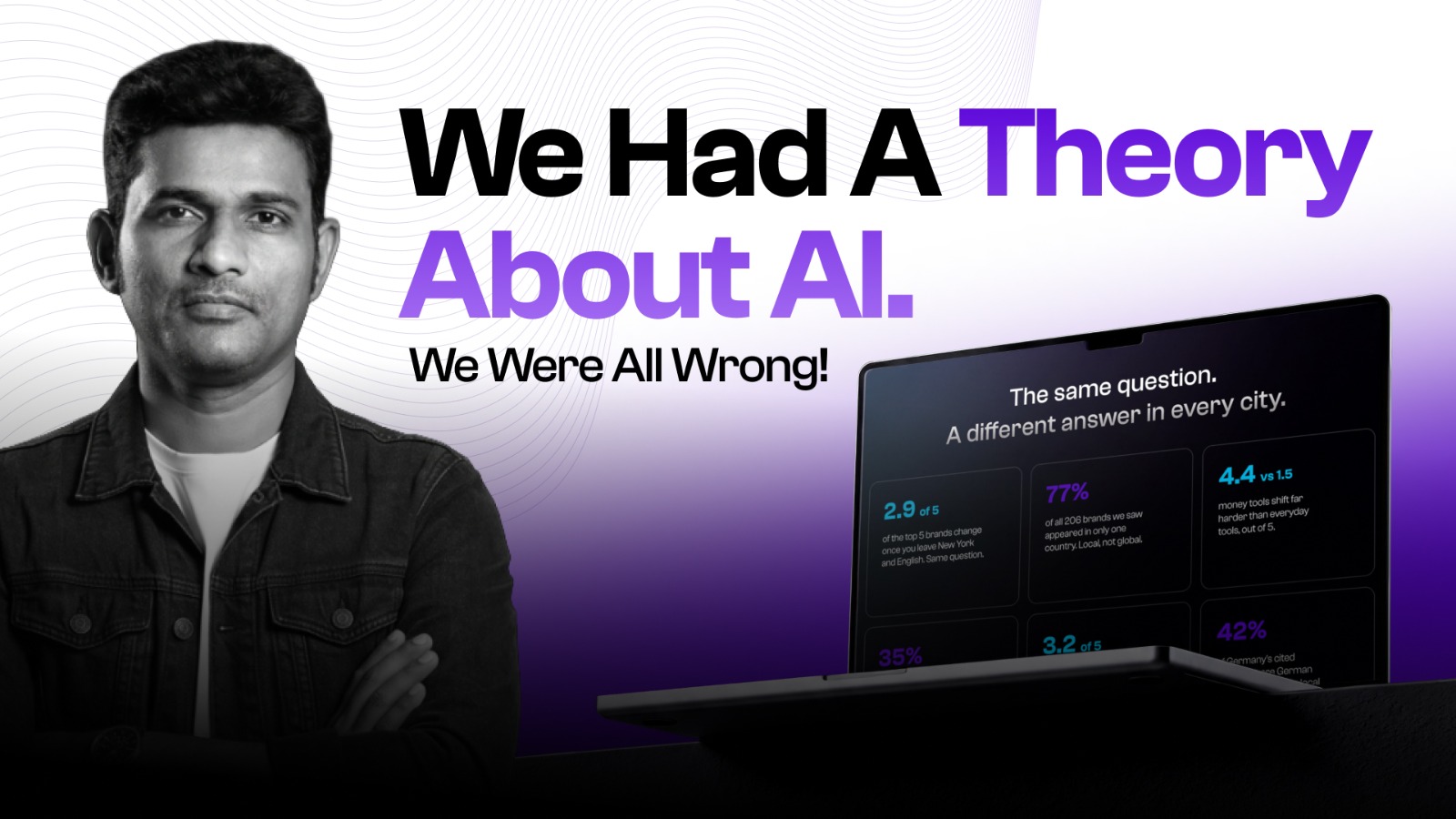
The same question, a different answer in every city