



Something strange is happening to search. Your pages are ranking, but buyers are getting their answers without ever seeing your brand. Today, buyers are asking complex questions inside AI systems. They are reading summarized answers in Google AI Overviews. They are relying on ChatGPT to shape early opinions. In this environment, ranking alone does not guarantee visibility.
This is where AI search visibility becomes critical. Brands that understand LLM SEO and AI search optimization are shaping demand earlier, while others are quietly falling out of consideration.
Blog
Which Proven Marketing Strategies Help You Grow Without Increasing CAC?
Which Proven Marketing Strategies Help You Grow Without Increasing CAC?
CMOs are being asked to hit aggressive growth targets in a market where the supply of paid attention is finite, and the auction keeps getting more expensive. Multiple industry benchmarks now show that CAC has risen materially over the last five years, and the underlying drivers are structural, not seasonal: more advertisers competing for the same intent, weaker signal quality due to privacy changes, and slower conversion efficiency when landing experiences do not match the ad's promise.
At the same time, the margin for error has shrunk. If your funnel leaks at any stage, awareness to click, click to lead, lead to opportunity, revenue opportunity, you are effectively paying a compounding tax on every new customer you win.
This is why CAC control is no longer a media buying problem. It is a full-funnel operating model problem: how quickly you turn attention into trust, trust into trial, and trial into expansion, within the same spend envelope.
This blog article explores four proven strategies that help you achieve sustainable growth while keeping CAC in check. It draws on extensive research and industry data to provide actionable insights without naming third‑party organisations in the narrative. Each section begins with a question that mirrors the queries marketers often use, followed by a more descriptive heading to aid discoverability.
Why Are Acquisition Costs Climbing, and How Does This Impact Growth?
Understanding the CAC Crisis and Its Impact on Growth
Digital advertising costs have skyrocketed. Studies show that industry‑wide acquisition costs have risen by around 60% over the past five years and by more than 200% over the last eight years, driven by channel saturation and privacy‑driven targeting restrictions. This inflation squeezes margins and makes every conversion more expensive. Competitive industries see the steepest increases, but even stable sectors are not immune. In some cases, bottom‑quartile companies spend nearly $2.82 to acquire each dollar of annual recurring revenue, widening the gap between high performers and laggards.
The challenge is not merely rising media prices; it is the inefficiency baked into outdated marketing practices.
Broad‑brush campaigns and “spray and pray” tactics waste spend on audiences with little intent, raising CAC while failing to build long‑term loyalty. In contrast, companies that integrate technology, leverage data, and unify acquisition and retention strategies tend to see lower acquisition costs and higher returns. The lesson is clear: growth without a matching strategy to control CAC is not sustainable. Marketers must pivot from volume‑driven tactics to precision and relationship building.
How Can AI Personalization Cut CAC?
AI‑Powered Personalization: Targeted Engagement That Drives Efficiency
Mass marketing increases CAC because you pay to reach many people who will not buy. Personalization reduces CAC because it focuses spend and effort on audiences with real intent and improves conversion rates.
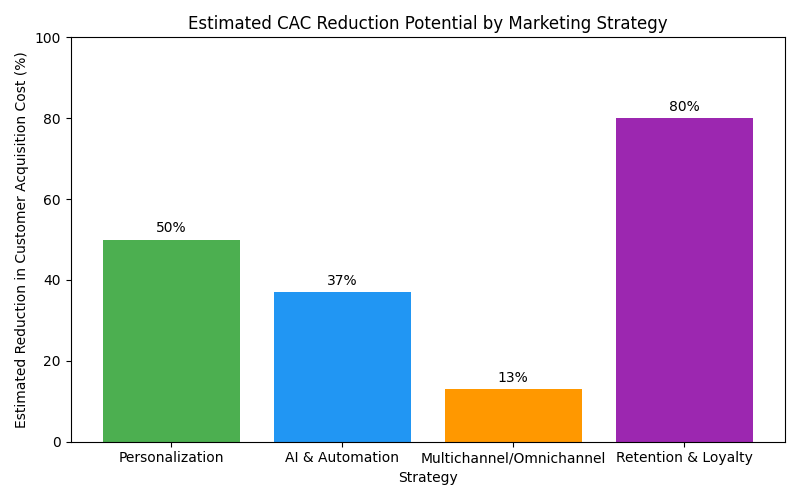
In many programs, strong personalization has been shown to cut acquisition costs by as much as 50% while improving revenue and marketing efficiency. The mechanism is simple: fewer irrelevant impressions, higher click-to-conversion rates, and better lead quality.
AI makes this workable at scale. Teams using AI-driven optimisation have reported roughly a 37% lower CAC and about a 25% higher conversion rate compared with manual routines. AI helps by:
- Segmenting audiences using behaviour and intent signals instead of broad demographics
- Reallocating budget and targeting based on live performance data
- Testing more creative and landing page variations faster
- Prioritising leads so sales focuses on the highest probability opportunities
Personalization also lowers CAC over time because repeat buyers need fewer paid touches. When the experience matches what the buyer expects, churn drops and referral potential increases, reducing the number of net-new customers you must pay to acquire.
Why Should You Shift Your Focus From Acquisition to Retention?
Retention, Loyalty and Advocacy: The Multiplier for Growth
Winning a new customer might need extra funds. Keeping an existing one is affordable and more predictable. Retention typically costs about 5 times less than acquisition, and even a 5% lift in retention can increase profits by 25% - 95%. The odds also favour retention: you have a 60% to 70% chance of selling to an existing customer, compared with 5% to 20% for a new prospect.
Loyal customers do more than make repeat purchases. They spend about 31% more than new customers and are 50% more likely to try new products. That combination lowers your effective CAC because revenue keeps compounding without you paying again for every transaction.
Retention does not improve by sending more emails. It improves when customers feel understood and supported. Personalized communication plays a direct role here. When customers receive tailored experiences, they are far more likely to come back and buy again.
Loyalty programs push this further by giving customers a reason to stay engaged beyond the product itself. A large share of consumers say a loyalty program increases the likelihood they will continue with a brand, and well-run loyalty programs can contribute meaningful annual revenue growth.
Referrals are the cleanest retention multiplier. Customers who come through referrals tend to stay longer and deliver higher lifetime value, which reduces the pressure on paid acquisition to hit growth targets.
Yet many companies still overinvest in acquisitions and underinvest in retention, even though retention is the easier lever to pull once product-market fit is established.
The shift is not about choosing retention over growth. It is about funding growth with retention. Improve the customer experience, tighten service quality, and run personalized outreach to current customers. Layer loyalty benefits and referral incentives on top. Over time, you build a customer base that renews itself, buys more, churns less, and brings in new customers at a lower effective cost than paid campaigns.
Can Multichannel and Omnichannel Strategies Actually Reduce CAC?
Customers move between email, social, search, apps, and offline touchpoints. If each channel runs in isolation, you pay multiple times to influence the same buyer, and measurement gets messy.
A connected multichannel setup solves that by linking touchpoints into one journey, so each channel supports the next step instead of restarting the sale.
Where CAC reduction actually comes from
- Less repetition: you stop paying to re-educate the same buyer in every channel.
- Higher conversion: more buyers complete the journey because the experience is consistent.
- Better retargeting efficiency: audiences carry intent signals across channels, so spend goes to warmer prospects.
How an Integrated MarTech Stack and Data Strategy Lowers CAC
Most marketing teams have more tools than they can use well. When systems are fragmented, the same work gets repeated across platforms, data does not match, and teams end up optimising in silos.
The core problem: wasted capability
Marketing tech utilization has been reported at around 33%, which implies most organisations waste the majority of what they pay for.
This waste increases CAC in three ways:
- Siloed data: segmentation is weaker and targeting is broader than it should be
- Duplicate spend: multiple tools do the same job without sharing outcomes
- Slow decisions: teams react late because insights are delayed
Teams that integrate platforms into a single customer view have been shown to achieve about 35% better results than teams running fragmented stacks.
Integrated measurement and attribution can also drive roughly 20% ROI improvement by showing what actually moves revenue, not just what generates clicks.
What do CDPs unlock?
When customer data is unified, you can:
- Segment in real time
- Trigger the next best action based on behaviour
- Personalize messages across channels without manual effort
AI powered orchestration can automate large parts of this, handling most routine customer interactions and freeing teams to focus on strategy and creative quality.
What KPIs Should a Modern CMO Track to Balance Growth and CAC?
Controlling CAC while driving growth demands clear measurement and governance. The following metrics provide a balanced scorecard:
- LTV: CAC Ratio – Measures the long‑term value of customers relative to acquisition cost. A ratio of 3:1 or higher indicates healthy unit economics.
- Cost per Qualified Lead (CPQL) – Tracks spend on leads that match your target buyer profile. AI‑driven segmentation improves lead quality and reduces waste.
- Conversion Rate by Channel – Assesses effectiveness across organic, paid, email, social and referral channels. Integrated attribution reveals which combinations drive results.
- Retention and Churn Rates – Evaluate customer loyalty. High retention indicates your programs, products and services meet customer expectations; high churn signals gaps.
- Customer Lifetime Value (CLV) – Quantifies the revenue a customer generates over the duration of their relationship. Loyalty and retention initiatives should aim to increase CLV.
- Referral Rate – Measures the percentage of new customers arriving via word of mouth. Strong referral rates reflect customer satisfaction and reduce effective CAC.
Monitoring these KPIs helps marketing leaders allocate resources intelligently. When combined with qualitative feedback and market insights, they provide early warning signs for rising costs or declining engagement, enabling proactive adjustments.
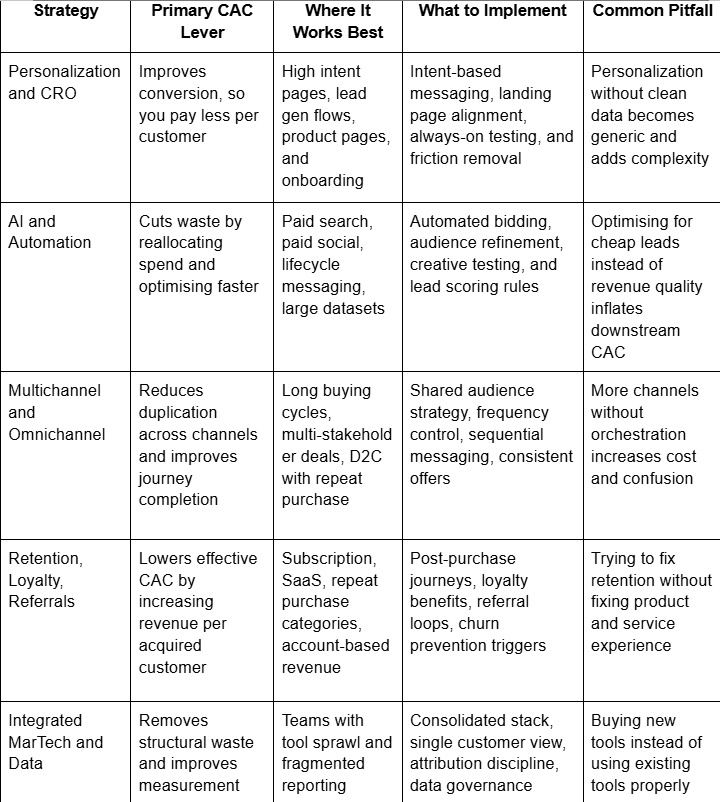
Comparison of Strategies for Reducing CAC
Visualising the Impact of Strategies on CAC
Here is a comparative analysis of the estimated reduction in customer acquisition cost for different strategies.
It conveys how retention and loyalty programs deliver the most significant relative savings, followed by personalization with AI, AI & automation in general, and multichannel/omnichannel approaches. Prioritise initiatives that maximise impact on CAC while aligning with your brand and resources.
From Cost Centre to Value Creation
When marketing operates as a cost centre, growth is fragile. When marketing becomes a value creator by unifying data, personalizing experiences, fostering loyalty and orchestrating cross‑channel journeys it drives profitable growth even as acquisition costs rise. This transformation is both a mindset and a discipline, and it will define the winners of the next decade.
Customer acquisition costs are not going to shrink on their own. The path to sustainable growth lies in three core principles:
- Know your customers deeply
- Invest in their success
- Orchestrate seamless experiences across every touchpoint
As a CMO or marketing leader, you need to make a fair choice for your brand. You can continue pouring money into increasingly expensive acquisition channels, or you can rewire your marketing engine for efficiency and lifetime value. There is plenty of case studies and so many new AI tools in the market today. You just need to start acting on the fundamentals.
Ready to transform your marketing economics?
We combine deep industry expertise with practical execution to reduce your CAC
Ready to transform your marketing economics?
We combine deep industry expertise with practical execution to reduce your CAC
Table of contents
Case Studies
About FTA
Keep Reading

Digital Marketing
January 13, 2026
What Is AI SEO and How Does It Change Traditional SEO?
Artificial intelligence is not just another tool in the marketer’s kit; it is fundamentally reshaping how people discover, consume, and trust information. Over the past decade, search engines moved from keyword matching to intent understanding. Today, they are powered by machine‑learning models that interpret queries, synthesise answers from multiple sources, and display them in conversational formats.
.jpg)
Digital Marketing
January 13, 2026
How AI Answer Engines Decide Which Content Gets Used?
Marketing teams are running into a new kind of invisibility problem. Your content can be accurate, rank well, and still never show up in AI-generated answers. About 60% of searches now end without a click, meaning users often get what they need directly on the results page rather than on your website. This changes the game. Your job is no longer just to be correct. Your job is to be the safest explanation for an answer engine to reuse.
Author Bio

Experienced Performance marketing professional with over a decade of driving measurable ROI for brands across diverse industries. Hands-on expertise in developing data-driven campaigns across paid search, social, programmatic and new emerging channels that consistently outperform industry benchmarks.I trust every aspect of touchpoints ties back to growth - whether it adds to revenue, counts to leads, conversions, or category share. Core competencies: SEM, paid social, Programmatic Display, Marketing Analytics, CRO, Marketing Automation and Performance Strategy.
Director - Performance Marketing