
A patient feels something wrong after dinner. A few years ago, the next step was a Google search and ten blue links to scroll through.
Today, the same patient is just as likely to open ChatGPT, Gemini, or Perplexity and read one clean answer. No links, no scrolling, one verdict.
For pharma and healthcare marketing teams, the shift runs deeper than it looks. Whoever gets named inside that single answer earns the trust, often before a prescription or an appointment is ever discussed.
AI search is not a future prediction. It is happening right now, and the real question is whether the answer mentions a brand, a competitor, or a random forum post.
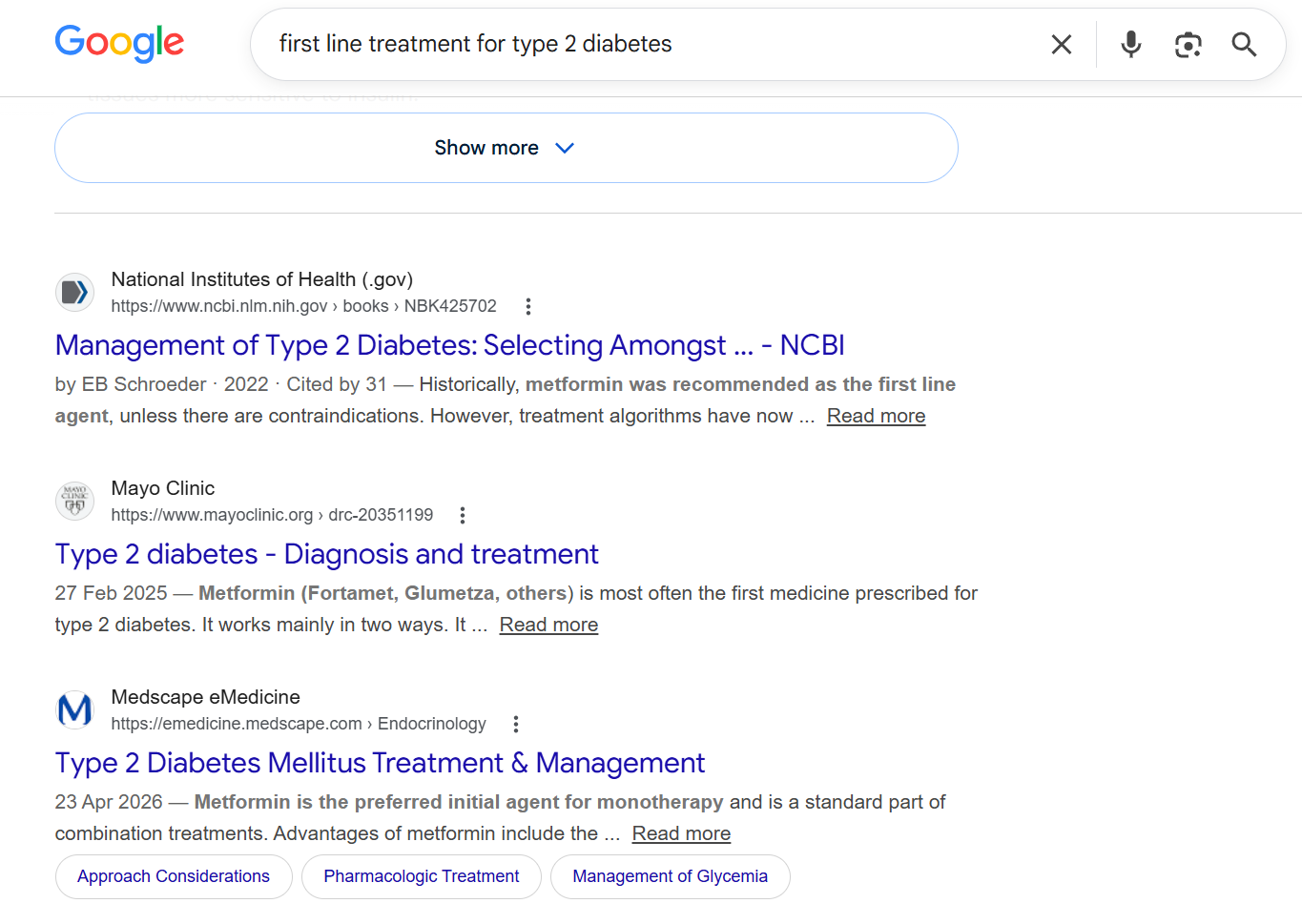
We searched for the healthcare query "first-line treatment for type 2 diabetes" on Google to see what results showed up. The page filled up with ten blue links, each one competing to answer the question. A patient would have to click through several of them to get a clear answer. For this particular comparison result, we are not looking at the AI overview results.
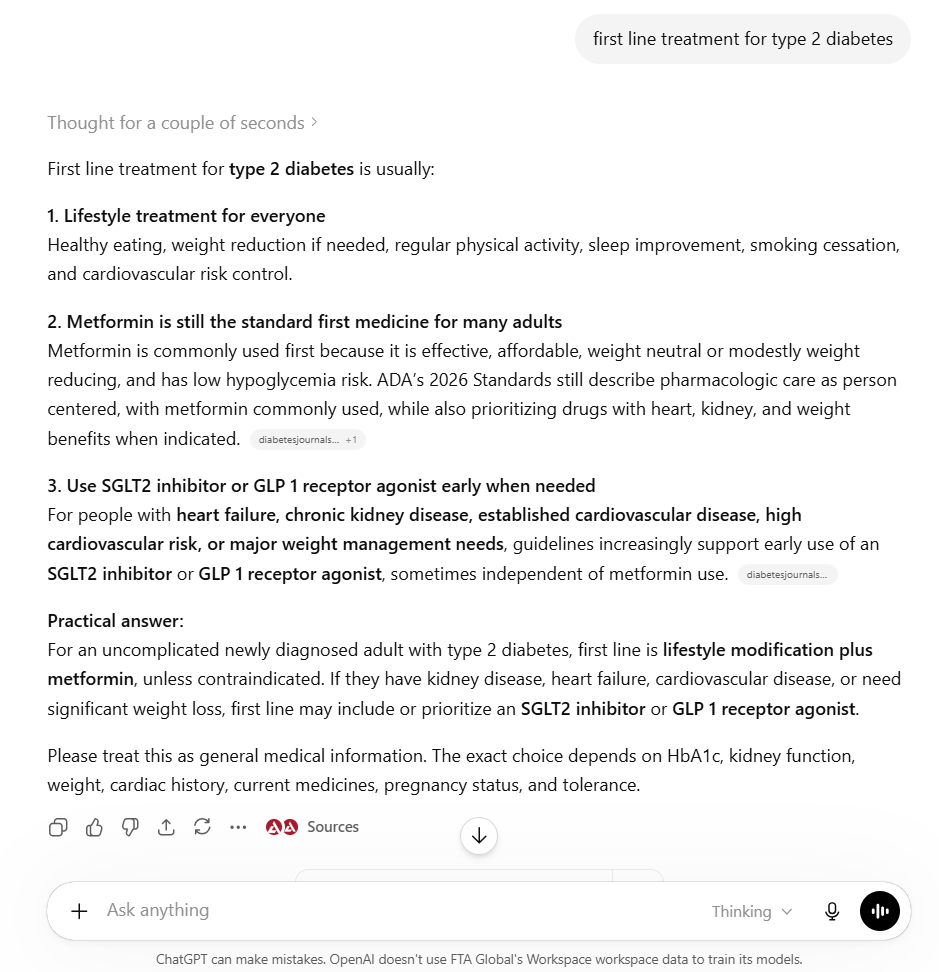
We ran that same search on ChatGPT. Instead of ten links, we got one clean answer right at the top. ChatGPT pulled information from just a few sources and displayed it. Notice which healthcare brand got cited and which ones didn't make the cut.
Why Are Patients and Doctors Turning to AI Search Before a Doctor?
The habit began with "Dr Google." People learned to self-research symptoms, and AI answer engines have simply made that instinct faster and more conversational.
Patients now type how they feel in full sentences. They explore the condition, weigh treatment options, search for a nearby specialist, then keep researching their medication long after treatment begins.
A patient who hears that a diabetes medication is now prescribed for weight loss will arrive with sharper, more specific questions. The information they already absorbed shapes what they ask next.
Doctors are moving the same way. Many no longer rely solely on textbooks, and tools like Perplexity have become trusted sources of scientific and medical information.
The scale of physician adoption is hard to ignore:
- Clinical consultations through digital channels have jumped from 3 million to 18 million in recent years.
- Around 1 million physician queries occur every day.
- About 40% of US doctors use OpenEvidence across more than 10,000 hospitals.
- Roughly 54% of doctors already use large language models, with the highest adoption among those born after 1990.
India tends to follow these global curves, usually faster than people expect. Both patients and doctors have stopped waiting for a website to load, and AI search hands them the answer first.
What Does AI Search Mean for Pharma and Healthcare Marketing?
The old game rewarded ranking. The new game rewards being the answer. Here is how the old search model compares with the new AI search reality that pharma and healthcare marketing teams now face:
The numbers behind the shift are blunt. AI Overviews now appear in more than half of all health-related searches, in nearly every treatment query, and in around 93% of symptom queries.
Clicks follow the answer. One widely cited study found organic click-through rates dropped by more than 60% once an AI Overview appeared on the page.
Healthcare brands experience a 20% to 30% decline in traffic, even while their Google rankings remain perfectly stable.
A traffic drop with steady rankings does not mean healthcare SEO has failed. It means the engine started answering the question before anyone could click, and the brand was not the one being quoted.
We used our FTA.visibility tool’s framework to score pharma brands across seven dimensions that directly influence whether AI search engines cite them or skip them. The dimensions are content depth, technical structure, medical credibility, compliance safety, LLM visibility, omnichannel readiness, and measurement maturity, each scored from 1 to 5.
.png)
Most pharma brands land between 1.5 and 2.5 when first assessed. The light blue shape in the chart shows what that looks like. The brands that have made deliberate fixes to content structure, credibility signals, and compliance readiness push out to the 3.5-4 range, shown in dark purple. No brand has hit a perfect 5 yet.
The gap between the two shapes is the gap between being invisible in AI answers and being the source AI actually cites.
How Do AI Search Engines Decide Which Healthcare Brand to Cite?
Plenty of teams assume AI behaves like Google. The reality is closer to a research assistant than a ranking engine.
When a doctor asks about the first-line treatment for type 2 diabetes, the system does not match the phrase. It breaks the question into smaller intents, draws on sources it already trusts, and then writes a single combined answer.
Different engines rely on different sources; some on one search index and others on another. The system synthesises everything into a single response and quietly decides who to credit.
Three clear signals tend to win this citation:
- Structure. Clean headings, FAQs, and summaries a crawler can read without guessing.
- Accuracy. Medically reviewed, evidence-backed content that holds up to scrutiny.
- Consistency. The same claims about a condition or drug are made across the website, social channels, and third-party mentions.
Vague, promotional, or messy content gets skipped. In traditional healthcare SEO, more pages often meant more rankings, but AI search rewards trust, not volume.
The brand that educates clearly will be the brand AI recommends confidently.
Worth repeating for any pharma marketing lead: ranking number one on Google guarantees nothing inside an AI answer. The two systems judge content on very different rules.
Why Does a Pharma Brand Rank on Google but Vanish from AI Answers?
The honest answer is usually a content gap, not a broken website. The same eight weaknesses keep surfacing across pharma and healthcare brands:
- Thin educational content, slowed by heavy compliance cycles.
- Pages built to rank, not to answer the real questions patients and doctors ask.
- No FAQs or summary signals, so AI cannot easily read the page.
- Critical material locked inside gated PDFs that crawlers never reach.
- Fragmented HCP content scattered across disconnected portals.
- A weak citation footprint, so AI has no way to verify the brand as a source.
- Slow medical, legal, and regulatory (MLR) cycles that throttle content velocity.
- No AI visibility tracking, since platforms share almost no first-party data.
When a brand goes missing, patients and doctors do not stop searching. They land on a competitor, on forums like Reddit or X, on a generic publisher, or on an AI guess when reliable information runs thin.
Every one of these gaps is fixable. The brands winning at AI search are not the loudest; they are the clearest, best-structured, and easiest to verify.
What Content Architecture Do Healthcare Brands Need for AI Visibility?
Patients and doctors search in two very different languages, so pharma marketing now needs two content tracks running side by side.
A strong therapy-area architecture usually rests on eight building blocks:
- A condition and disease education hub, the medically reviewed pillar page for each therapy area.
- A patient education hub, written in plain, grade three to four language.
- An HCP resource centre with prescribing guidance and clinical summaries.
- An FAQ library, where AI engines spend the most time and earn the most citations.
- A medical glossary that signals topical coverage.
- Safety and prescription information, fully structured.
- Clinical study summaries.
- Doctor discussion guides for the patient conversation.
The FAQ library does the heavy lifting, since clean question-and-answer content is one of the strongest ways to earn citations.
Compliance is the real bottleneck, not creativity. Pharma teams can write, but MLR review can take six weeks per asset, and India's UCPMP 2024 now demands accurate, evidence-backed claims and audit-ready records.
Disease awareness is the safe lane. A prescription drug cannot be promoted directly, yet a brand can own the conversation around the condition, its pathway, and its treatment options in plain, balanced language.
A faster model is emerging here. Building a library of pre-approved, modular content blocks lets teams assemble compliant pages quickly, with much of the review already baked in, thereby shortening future approval cycles.
Pharma and life sciences teams can plan this with our life sciences and pharma SEO services, while hospital and diagnostic brands can map it out through our healthcare SEO services for hospitals and clinics.
How Can Pharma Marketing Teams Measure AI Search Visibility?
Old dashboards no longer tell the whole story. Keyword rankings, organic traffic, and click-through rate still matter, but none of them reveals what AI is actually saying about a brand.
A new scorecard is taking shape for healthcare marketing teams. The metrics worth tracking now include:
- AI citation rate, or how often the brand is named in answers.
- Answer inclusion and sentiment, since a negative mention is its own problem.
- Intent and question coverage across the therapy area.
- The share of voice, or the gap between the brand and its competitors, is addressed.
- Content freshness and source authority.
The catch is that platforms hand over almost no first-party data. Brands cannot see exact prompts, so they need a way to track the context of conversations and whether they appear inside them.
A dedicated AI visibility tracking tool like fta.visibility closes that gap. It monitors what patients and doctors explore across ChatGPT, Gemini, and Perplexity, then maps where a brand is cited, where competitors win, and which gaps to fix.
Persona tracking makes it sharper. A cardiologist asking about cardiovascular risk and a patient asking what happens if diabetes goes untreated are two different journeys, and each needs its own set of monitoring prompts.
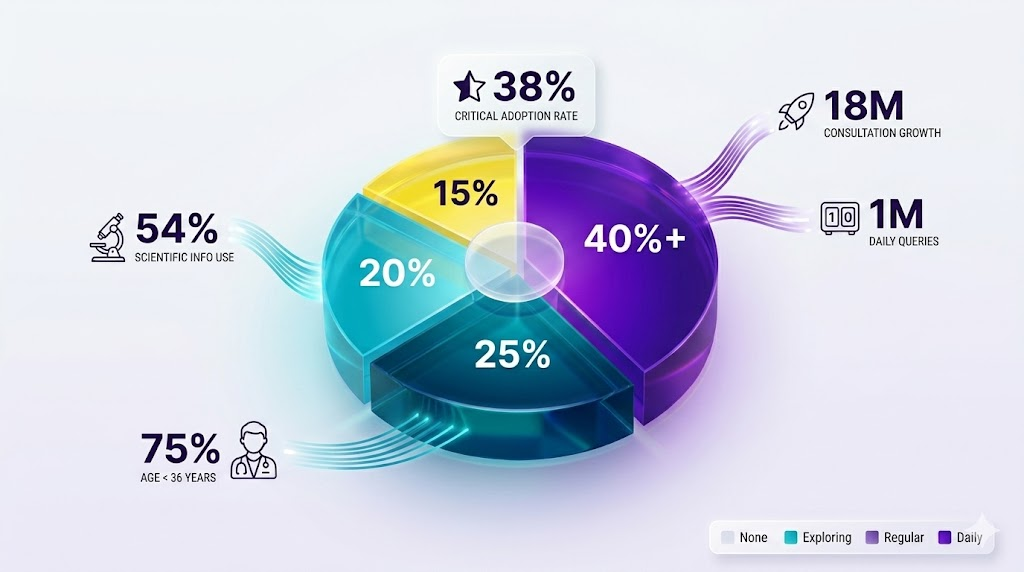
We pulled together the global numbers on how quickly doctors are adopting AI for clinical decisions. The chart breaks it down by usage frequency.
More than 40% of physicians now use AI tools daily, another 25% use them regularly, and only 15% have not tried them at all.
The surrounding numbers tell the bigger story: 18 million consultations a month, 1 million queries every single day, 54% using AI specifically for scientific information, and the fastest adoption coming from doctors under 36. (source: EPG & IQVIA, Mar-Apr 2025)
Where Should Healthcare Marketing Teams Start in the Next 90 Days?
Big shifts feel manageable when they are broken into phases. A simple 90-day plan gives pharma and healthcare marketing teams a clear runway:
- Days 1 to 30, build the foundation. Run an AI search sweep across the top three therapy areas, map content gaps against patient and doctor intent, audit the site structure, and assess how long MLR approvals really take.
- Days 31 to 60, build the engine. Pick one therapy area, build its full content architecture, and create a pre-approved, modular library to speed up future asset creation.
- Days 61 to 90, publish and measure. Ship the priority content hubs, switch on AI citation monitoring for that persona, and run the first AI visibility report to see what is moving.
The goal is not perfection in 90 days. It is momentum, plus a feedback loop that shows leadership exactly where the brand is gaining ground.
These three questions can help your team start with measuring your healthcare brand’s visibility on LLM platforms and Google SERPs.
- Is the brand present in AI answers for its therapy areas?
- When a patient or doctor asks about a condition the brand treats, do they find the brand, a competitor, or a forum post?
- What is the one fix worth shipping this week?
The Brands That Educate Clearly Are the Brands AI Recommends
AI search is not coming for pharma and healthcare marketing. It is already here, quietly deciding which brand a patient or doctor sees first.
The brands that lose are rarely the ones with weak products. They are the ones with great information locked away, scattered, or written for a search engine that no longer behaves the way it used to.
The path forward is refreshingly practical. Structure the content, keep it medically credible and consistent, stay compliant, and measure where AI actually cites the brand, therapy area by therapy area.
AI now reads beyond the website, too, across social posts, podcasts, webinars, and vernacular content, so visibility has to be earned across every channel.
A structured AI SEO services programme turns all of this from a scramble into a system, so the brand appears at the exact moment someone is asking. The window is open, and 90 days is enough to stop losing ground.

Do you want more traffic?

Why AI Search Visibility Depends on Context & Not Just Prompts?
.jpg)
Are You Measuring Demand or Just Measuring Traffic?