Table of contents
Do you want more traffic?
Hey, I'm from FTA Global. I'm determined to grow a business. My only question is, will it be yours?


Step Learning had built something real. Programmes spanning leadership development, sales capability, communication, personal effectiveness, and team building. A four-stage learning model running from assessment through evaluation. A founder with Fortune 500 clients. A 4.8 rating across 88 Google reviews.
This was not a brand that needed to manufacture credibility. It had earned it.
But credibility sitting on a website that search systems can't read clearly, and buyers can't find at the right moment, is credibility that isn't doing any commercial work.
When corporate training buyers search, they don't search broadly. They search by skill gap, by role, by city, by business outcome. "First-time manager training Mumbai." "Consultative selling programme." "Value selling for B2B teams." The buyer arrives already knowing what they need. The question is whether your brand is the one they land on or the one they never see.
Step Learning was losing that moment. Not because the service was weak. Because the discoverability was.
The site was indexed. The programmes were detailed. The proof points were visible. But when we mapped search demand against what the site was actually capturing, the gap was significant.
Zero presence in the top three positions for any target keyword. The highest-visibility SERP real estate, the positions that capture the majority of clicks, wasn't generating a single ranking.
Only three keywords ranking in the top ten. For a brand with the programme depth and founder authority Step Learning had, that number should have been far higher.
No tracking for AI visibility. As search behaviour shifted toward conversational queries and AI-generated answers, there was no way to know whether Step Learning was appearing in those responses at all. The fastest-growing discovery channel was completely unmeasured.
Pages that were indexed but not legible. The programme taxonomy was wide: leadership, sales, communication, behavioural skills, team effectiveness. But without strong internal relationships between those pages, they blurred into each other. Search systems couldn't parse the structure clearly enough to trust it.
Competitors filling the gap. Leadership development. Sales training. First-time manager programmes. These were high-intent commercial searches with real buyer urgency behind them. And Step Learning wasn't showing up where it needed to.
The instinct in this situation is usually to publish more. More blog posts. More programme pages. More content.
That was the wrong move here.
Step Learning didn't have a content volume problem. It had a legibility problem. The expertise existed. The packaging didn't make it easy enough for buyers or machines to understand, extract, and act on.
We stopped asking "what should we publish?" and started asking a better question: when a sales director searches for value selling training, or an HR head looks for leadership development in their city, what does Step Learning need to look like to be the obvious answer?
That question changed everything about the approach.
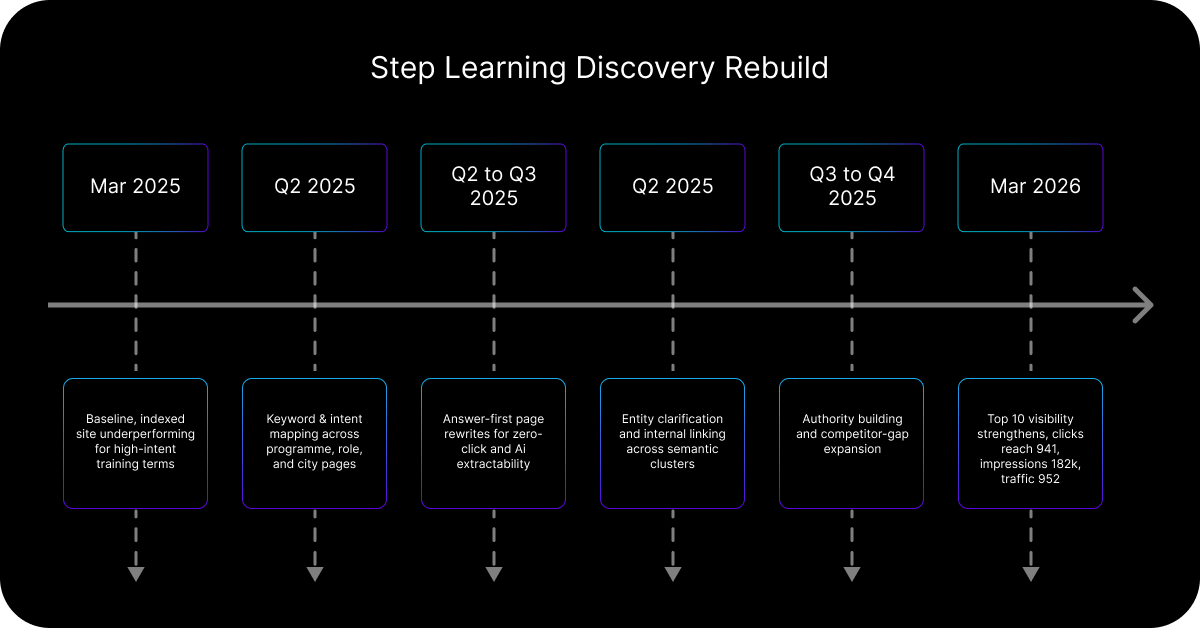
Intent architecture first.We mapped every programme against the actual search terms buyers use: by skill gap, by role level, by city, by business outcome. Core programme pages for leadership and sales became commercial anchors. Sub-pages for first-time manager training, consultative selling, virtual selling, and presentation skills were structured to capture sharper intent and feed authority back up the chain. A hub-and-spoke system built around how buyers actually search, not how the business naturally organises itself.
Pages built to be extracted, not just ranked.Search systems and AI engines don't just rank pages anymore. They summarise them, cite them, and pull answers directly from them. We rebuilt priority pages around a cleaner format: who this programme is for, what the learning outcomes are, what problem it solves, and what the next step looks like. One question, one clear answer, structured for extraction. Buyers and machines both reward the same thing: clarity.
Entity clarification across the full site.Leadership, communication, sales, coaching, and behavioural skills all overlap in a training taxonomy. Without strong internal relationships between pages, they compete with each other rather than reinforce each other. We tightened internal linking to connect related programmes, role-based entry points, and city-level pages into coherent semantic clusters. The site stopped behaving like a stack of services and started behaving like a knowledge system.
Authority building off-site.For a B2B training brand selling to HR leaders and business heads, third-party validation matters not just technically but credibly. Strategic backlink outreach gave Step Learning's pages something to compete with beyond on-page structure: external signals pointing at a brand with real methodology, a measurable learning model, and a founder with verifiable experience.
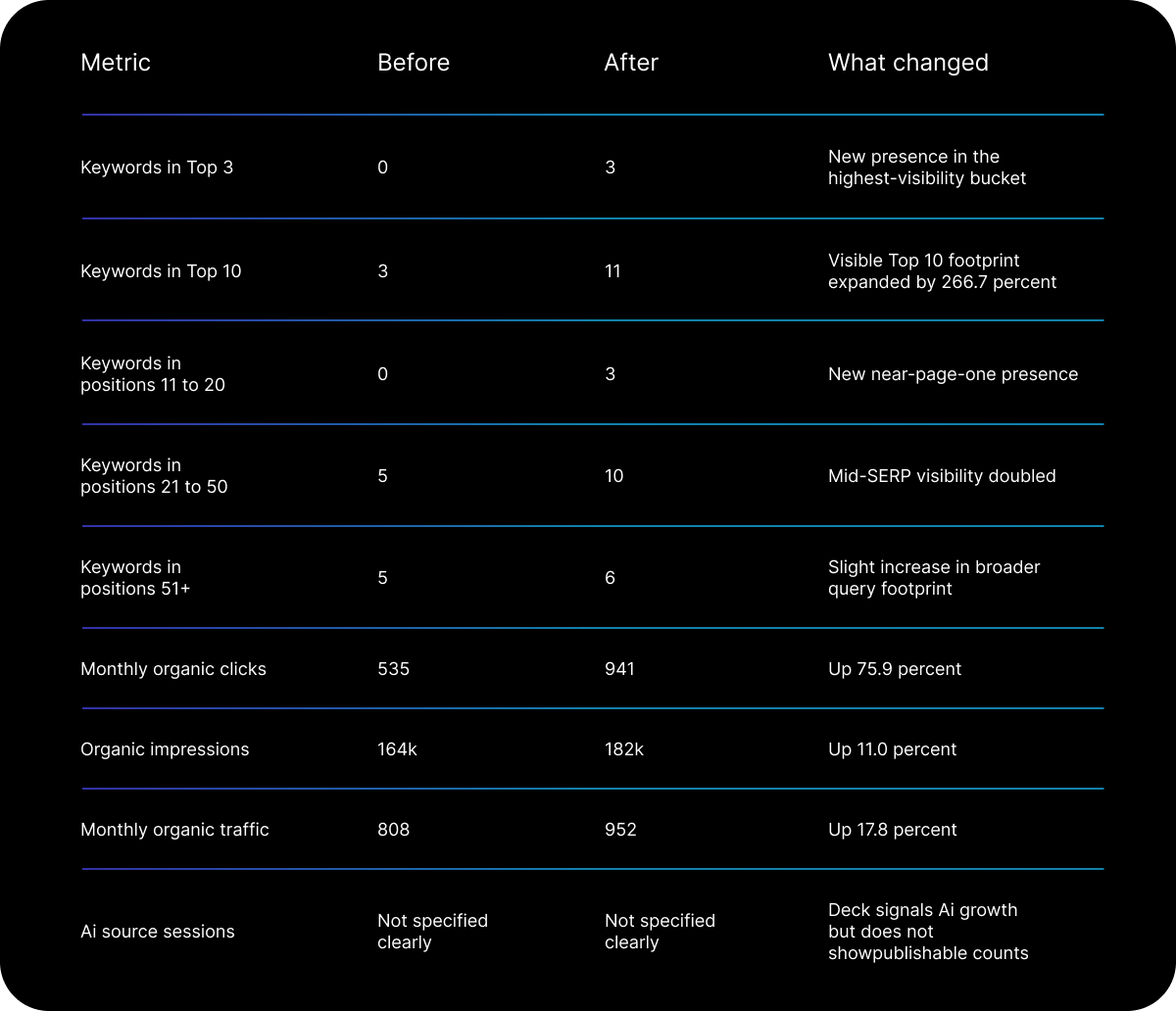
The results showed up where they mattered most: in the positions that actually drive clicks.
Top 3 keyword presence went from zero to three. Top 10 visibility went from three keywords to eleven, a 266.7% increase in the highest-intent SERP real estate. Near-page-one presence in positions 11 to 20 went from zero to three. Mid-SERP coverage doubled.
Monthly organic clicks grew from 535 to 941, up 75.9%. Organic impressions grew from 164K to 182K. Monthly organic traffic moved from 808 to 952.
The numbers tell one part of the story.
The more important part is structural.
Step Learning's pages now intercept the full buyer journey. Someone looking for first-time manager support arrives through an informational page. A sales head searching for value selling training lands on a commercial page. An HR leader looking for a leadership partner in their city enters through a location-intent page. Better discoverability didn't just add traffic. It connected problem recognition to commercial credibility at every stage of the search.

