Table of contents
Do you want more traffic?
Hey, I'm from FTA Global. I'm determined to grow a business. My only question is, will it be yours?



.jpg)
Legend of Toys is not a generic toy catalogue. Every product on the site carries its own character, its own backstory, its own place in the L.O.T Universe. RC drift cars. Drones. Construction toys. Transport models. Comics. Each one crash-tested, BIS compliant, backed by 20-point quality checks, genuine spare parts, and a free lifetime repair commitment.
That is a different promise from most toy brands. And it matters more than most performance marketers realise.
The strongest e-commerce accounts at scale are rarely the ones with the biggest budgets or the cleverest creatives. They are the ones where the product truth is strong enough to hold up under scrutiny, and the performance system is disciplined enough to put that truth in front of the right person at the right moment.
Legend of Toys had the product truth. The job was building the system around it.
Revenue had room to grow. The brand had attention. But as spend scaled, efficiency started to strain.
ACoS was climbing. The funnel lacked the visibility needed to isolate what was actually driving conversions versus what was just generating activity. Traffic acquisition was working. Profitable conversion at scale was not keeping pace.
This is the classic e-commerce breakpoint. It shows up in almost every account that tries to grow quickly without rebuilding the underlying structure first. More spend goes in. Revenue goes up. But the economics underneath start to loosen, quietly, until the growth stops making sense.
The account did not need more budget. It needed a framework.
Start with attribution, not spend.The first move was cleaning up campaign-level revenue attribution and funnel stage analysis. Without that, every scaling decision is a guess dressed up as strategy. With it, spend can follow the audiences, products, and funnel stages that are not just active but profitable. Budget allocation shifted to reflect actual performance, not assumed performance.
Fix the funnel before you flood it.Pre-load bounce rates were addressed. Landing page engagement was tightened. Add-to-cart rates were optimised. This is where Legend of Toys' public brand story became a performance asset. BIS compliance. Quality checks. Spare parts availability. Free lifetime repair service. Those are not just brand claims. They are objection removers. In a category where parents are spending real money on products they cannot touch before buying, reassurance at the right moment in the funnel changes conversion rates materially.
Audience targeting built around intent, not volume.The L.O.T catalogue is not one-dimensional. A parent buying a gift for a seven-year-old, a teenage hobbyist researching RC drift cars, and a collector drawn to the brand universe are not the same buyer. Treating them as the same audience wastes spend on the wrong message at the wrong moment. Interest-based segmentation, lookalike expansion, high-intent retargeting, and dynamic product retargeting were used to align spend with actual buyer motivation.
Scale spend only when the system earns it.Ad spend increased by roughly 31.7% during the scaling period. That number matters less than the discipline behind it. Budget grew only as attribution clarity and funnel stability justified it. The goal was never cheap growth at small scale. It was controlled growth at real scale, with the economics staying visible and manageable throughout.
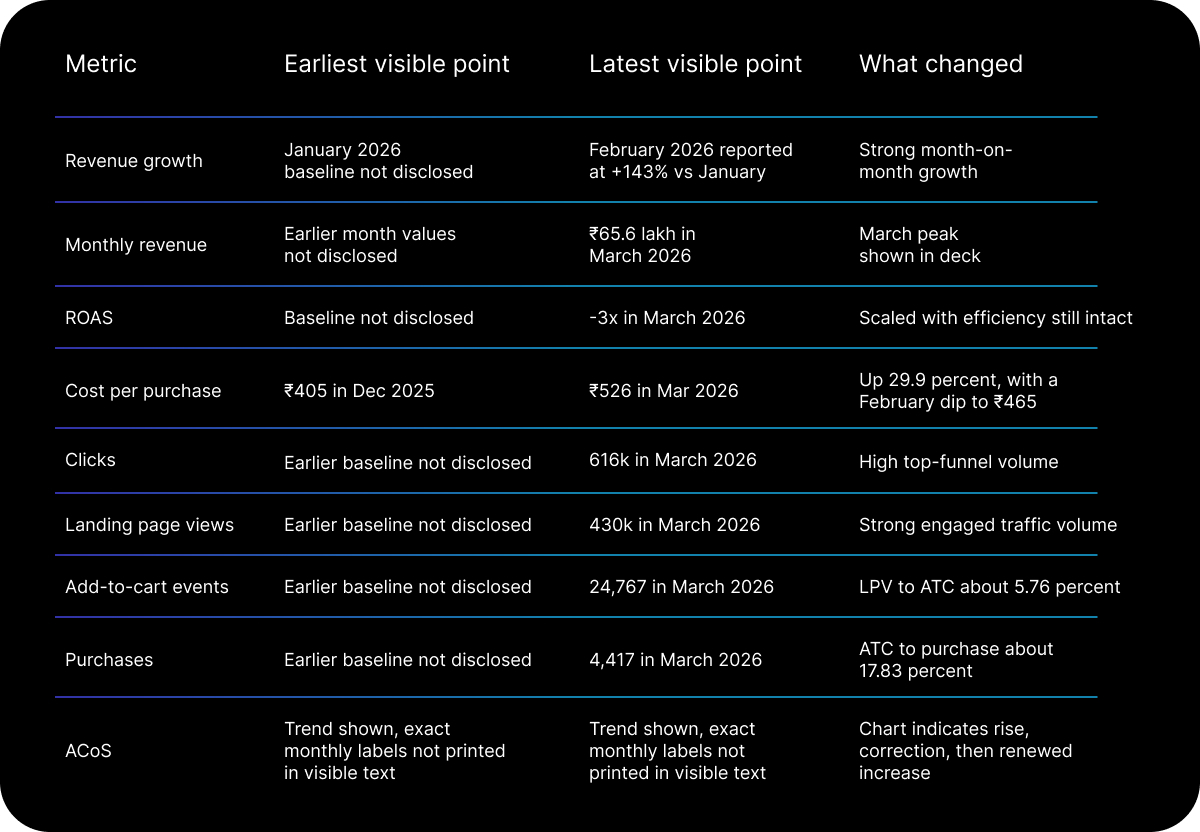
December 2025: Cost per purchase at ₹405. Baseline established.
January 2026: Aggressive scaling begins. ACoS pressure rises. Revenue base established.
February 2026: Revenue up 143% versus January. Cost per purchase eases to ₹465. The funnel starts responding.
March 2026: The framework delivers. Monthly revenue reaches ₹65.6 lakh. ROAS holds at approximately 3x. Meta Ads drive 616K clicks, 430K landing page views, 24,767 add-to-cart events, and 4,417 purchases in a single month.
The funnel conversions behind that March snapshot: landing page view to add-to-cart at 5.76%. Add-to-cart to purchase at 17.83%. Cost per purchase at ₹526, up from December but within a controllable band throughout the entire scaling arc.
That last point is the one worth sitting with. Cost per purchase rose 29.9% while revenue scaled materially and ROAS held at 3x. That is not a perfect outcome. It is a realistic one, and it is what disciplined scaling actually looks like in practice. The economics did not break. They bent within a range the business could work with.
E-commerce scale almost never comes from spend alone.
Attention is the easy part. Meta will sell you as many impressions as your budget allows. The hard part is making every next rupee smarter than the last one: tighter attribution, better segmentation, landing experiences that remove doubt quickly, and the discipline to scale only when the data justifies it.
Legend of Toys had something most brands undervalue at the start of a performance engagement: a product story with genuine conversion power. Quality checks. Compliance marks. Spare parts. Repair commitments. A narrative universe that makes the catalogue feel like something worth collecting. When that kind of product truth is paired with a properly structured performance system, growth becomes more resilient because it is built on something real underneath.
The brands that scale profitably are rarely the ones that spend the most. They are the ones that know exactly what is working, why it is working, and how to repeat it.
Campaign Duration: December 2025 to March 2026Services: Performance Marketing, Meta Ads, Funnel Optimisation Industry: E-Commerce / Toys Location: India

