

Table of contents
Do you want more traffic?
Hey, I'm from FTA Global. I'm determined to grow a business. My only question is, will it be yours?


Here is an example of how we audit site performance after a core Google update -
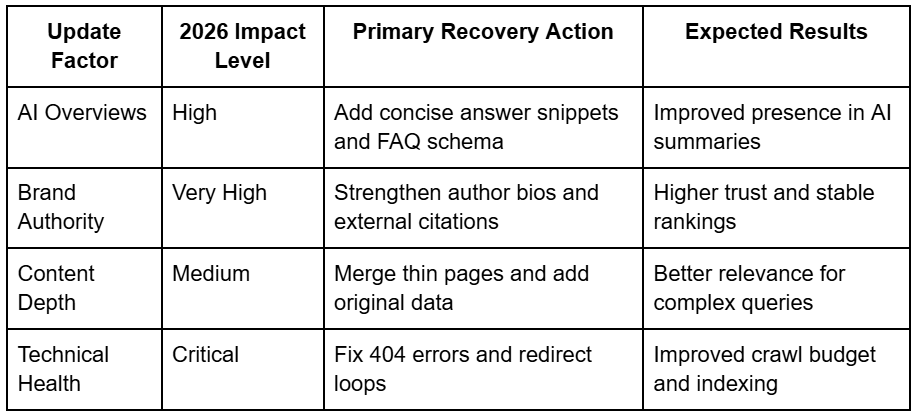
A significant decline in traffic following a major content update is often a sign that Google has reassessed how your pages compare to others. This shift does not necessarily mean you made a mistake; rather, it means the search engine is reshuffling its results to better match what users want right now.
In 2026, Google's core updates place a stronger emphasis on trust, experience, and brand-level authority. If your new content lacks these specific signals, your rankings may slip even if the writing is high quality.
Another common reason for a 38% drop is the expansion of AI-generated answers and summaries directly in search results.
These summaries often appear above traditional links, which reduces click-through rates for many informational queries.
If your update consisted of simple summaries of existing facts, your content may now be absorbed by AI-generated answers rather than attracting clicks.
It is also possible that your content update inadvertently created duplicate intent where multiple pages now compete for the same search terms.
Many site owners fear a manual penalty when they see a sudden drop, but core updates are not punishments for individual sites. A manual penalty typically involves a specific guideline violation and results in a notification in Google Search Console.
If you do not see such a message, you are likely experiencing an algorithmic re-ranking. This means Google is simply re-evaluating your content against competitors that may now better satisfy user intent.
Algorithmic shifts are often characterized by partial drops rather than a total disappearance from search results. You might see some pages falling while others remain stable or even improve slightly.
Recovery from a re-ranking involves improving the real value of your content rather than submitting a reconsideration request. It is a diagnostic challenge where you must identify which parts of your site no longer meet the evolving standards of search quality.
The best way to diagnose the issue is by using the Performance report in Google Search Console. You should compare the date range before your content update with the period after the drop began. Focus on organic search traffic and look for patterns in which specific topics or page types lost the most impressions. Impressions often decline before clicks do, providing an early clue about how Google is reassessing your visibility.
Check whether your drop is concentrated in informational queries or branded searches. If your branded traffic remains stable while your informational pages decline, it is likely a content quality or user experience issue.
You should also compare mobile and desktop performance to determine whether the decline is due to mobile-first indexing or page experience issues. Analyzing the search results that replaced your pages can reveal what Google now prefers, such as sites with higher brand recognition or more identifiable experts.
Technical errors are frequent culprits behind sharp declines in traffic after major updates. Common mistakes include accidental deletion of tracking codes or issues with site speed and mobile-friendliness.
If your update involved changing URLs or site structure, broken redirects and 404 errors can waste link equity and frustrate users. Redirect chains can also slow down crawling and dilute the authority signals that Google uses to rank your pages.
Canonical tag conflicts are another silent killer of search traffic. If multiple versions of a page have inconsistent or missing canonical tags, Google may get confused about which version to index.
This can split your ranking authority and lead to volatile performance for business-critical pages.
Additionally, over-optimization tactics like forcing keywords into headings or using unnatural internal links can backfire during a core update.
Google is now better at identifying content created primarily for crawlers rather than real people.
To recover in 2026, your content must be structured for AI-driven channels like Google AI Overviews and ChatGPT. Adding FAQ sections with conversational questions and answers helps AI systems understand your information quickly.
You should also implement structured data such as LocalBusiness, Product, and HowTo schema to feed AI systems the data they need. This improves your chances of appearing in rich results and AI-assisted summaries.
Placing short and authoritative summaries at the beginning of your content sections can also increase your visibility in AI summaries. You should aim to answer conversational queries directly, moving beyond keyword matching to focus on natural language search.
Providing original perspectives and proprietary data makes your content harder for AI to simply replicate without citing you as a source. Tracking your visibility in AI-driven results is now just as important as monitoring traditional rankings.
Here are the best steps to quickly recover website traffic -
Step 1: Reset content quality
Step 2: Strengthen trust signals
Step 3: Be patient but consistent
