Why Are Your Clicks Dropping as Impressions Rise in 2026?
Founder Hub
Why Are Your Clicks Dropping as Impressions Rise in 2026?
FTA Simulation Library
Traffic Is Down. But Impressions Are Up.
You are reviewing organic performance. Impressions are rising. Rankings are stable. Traffic is still falling. Leadership wants answers. This simulation tests how you think when visibility shifts before the click.
Impressions
+38%
The market sees you more often than before.
Rankings
Stable
Positions are not the obvious problem.
Traffic
−27%
The click is where the tension starts.
Your role
You own the diagnosis and the next move.
Interpret what changed
Choose what to investigate first
Decide how to respond for the long term
The simulation
Swipe through each round.
One round at a time. Choose an option, see micro feedback, then move to the next step. The finalscreen reveals your archetype.
FTA Simulation 01 — Traffic Is Down. But Impressions Are Up.
Round 1 of 10
Diagnosis
TL;DR
Expect impressions to rise while clicks drop; AI Overviews (AIO) often answer user queries directly on the search page.
Focus on keywords ranking in positions 5-15; simple tweaks to titles and intro paragraphs can double your traffic.
Stop chasing high-volume keywords; instead, try to become the definitive source for specific niche topics to earn AI citations.
Search Everywhere Optimization: Diversify your presence across social platforms such as Reddit, Substack, Medium, YouTube, and LinkedIn to protect your brand against algorithmic shifts.
Prioritize building an email list and free tools to ensure you own your traffic rather than renting it from search engines.
What are some of the traffic growth tactics in 2026?
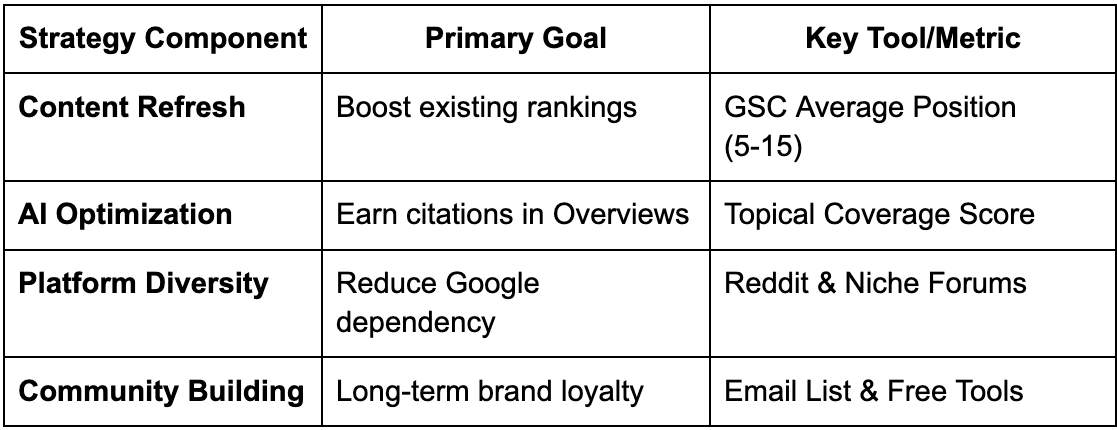
Here are these four essential pillars of a 2026 traffic strategy from mastering AI visibility to securing owned audience assets -
Why is my website traffic dropping, but impressions are increasing?
If your Google Search Console (GSC) shows rising impressions but reducing clicks, you are experiencing a decoupling effect. This phenomenon is primarily driven by Google AI Overviews (AIO), which provide generated summaries at the top of search results.
Double Impressions: Your site may be counted twice, once for the traditional blue link and once as a cited source in the AI summary.
Zero-Click Searches: Because the AI answers the user's question immediately, there is less incentive for them to click through to your website.
Intent Shift: Informational traffic is declining, but users who do click are often higher-intent, seeking deeper details or specific transactions.
Marketers must shift their mindset from a click-focused model to a visibility-focused model.
How to rank in Google AI overviews and search assistants?
To get featured in AI-generated answers, you must move beyond keyword stuffing and focus on topical authority.
Google uses a technique called query fanout, in which it breaks a search query into sub-queries and looks for the best content for each angle.
Cover All Angles: Use an AI content helper to identify fan-out queries related to your topic and ensure your article answers them comprehensively.
Citations are the New Backlinks: AI models like Gemini and Perplexity rank sources based on the number of citations, reviews, and mentions across the web.
Structured Clarity: Use well-organised headers (H2, H3), concise summaries, and schema markup to make it easier for AI agents to parse your data.
High-Value Data: Including unique data or interactive charts can make your content more linkable and likely to be cited as a primary source.
What is the best way to increase organic traffic without adding new content?
The Content refresh technique is the most efficient way to boost traffic using existing assets.
Instead of creating new pages, you optimise pages that are already on the cusp of high-traffic positions.
Identify the Opportunity: Use GSC to filter for keywords with an average position between 5 and 15. These are keywords on the first or second page that just need a small push to reach the top three.
The Three Kings Optimization: Focus your changes on the three most important places Google looks:
Title Tag: Make it more compelling and include your target keyword.
H1 Tag: Ensure your main heading matches the user's search intent.
First Paragraph: Naturally, include the keyword in the introduction to signal relevance immediately.
Semantic Expansion: Use tools like Semrush to find related words used by top-10 competitors and integrate them naturally into your text.
Remove Thin Content: If you have pages with zero impressions or low quality, set them to no-index to improve your overall site reputation.
How to build a marketing strategy that doesn't rely on Google?
Relying solely on traditional SEO is a risk in 2026. Search Everywhere Optimization means playing natively on every platform where your audience spends time.
Leverage Communities: Reddit and niche forums are underrated sources of traffic. Consistently providing helpful answers builds trust and associates your name with credibility.
Build Free Tools: Calculators, checkers, or templates are linkable assets that naturally attract traffic and backlinks. These tools often bypass AI Overviews because they require user interaction.
Own Your Audience: Every visitor should be given a reason to join your email list. Algorithms can change overnight, but your email list remains a direct line to your customers.
Experience-Driven Content: AI can summarize facts, but it cannot replicate first-hand experience. Share your unique perspective, case studies, and stories of why this worked for you to build a human connection that AI can't steal.
How do I fix a sudden drop in search rankings?
Sudden traffic losses are stressful but can be diagnosed through a systematic approach.
Check for Manual Actions: Verify in GSC under Security and Manual Actions to ensure you haven't been penalized for black hat practices.
Monitor Algorithm Updates: Check Twitter or SEO history pages to see if a Google Core Update is rolling out. Never make changes while an update is still rolling out; wait until it is fully deployed before assessing damage.
Technical Health: Run a site audit to identify issues such as broken links, slow page speeds, or robots.txt files that accidentally block crawlers.
Intent Mismatch: Sometimes traffic drops because user intent has shifted. If your informational page is losing to commercial pages, you may need to adjust the content angle to align with what Google is now rewarding.
Pivot to ‘search everywhere’ optimization to master your 2026 website traffic growth
Your content must include unique data, personal case studies, and the ‘why this worked for me’ perspective that searchers now crave for validation.
Don't let your brand be beholden to a single algorithm. Your audience is fragmenting across LinkedIn, Reddit, Substack, Quora and YouTube.
Play natively on these platforms to build trust and authority that Google’s AI Overviews will eventually cite as a primary source.
We are a Search Engineering™ company that helps brands become visible across search engines, AI assistants, and modern discovery systems where decisions happen before clicks. Our integrated model combines Search Engineering for organic and AI visibility, Demand Labs for enterprise B2B growth, Performance Labs for B2C acquisition, FTA Prime for startup marketing, and Creative Labs for storytelling. At the core is a proprietary visibility platform (patent pending) built on ICP-based persona modelling that tracks how brands appear across AI environments. With 80+ A-star professionals across Mumbai, Bengaluru, and Gurugram, we are mentored by an advisory board of SMEs across Retail, Ecommerce, BFSI, Life Sciences, Healthcare, Education, Aviation, and Technology, along with professors from GWU and IIMs. FTA is built as a modern marketing company.
Lorem ipsum dolor sit amet, consectetur adipiscing elit. Suspendisse varius enim in eros elementum tristique. Duis cursus, mi quis viverra ornare, eros dolor interdum nulla, ut commodo diam libero vitae erat. Aenean faucibus nibh et justo cursus id rutrum lorem imperdiet. Nunc ut sem vitae risus tristique posuere.
Founder Hub
Heading
Heading 1
Heading 2
Heading 3
Heading 4
Heading 5
Heading 6
Lorem ipsum dolor sit amet, consectetur adipiscing elit, sed do eiusmod tempor incididunt ut labore et dolore magna aliqua. Ut enim ad minim veniam, quis nostrud exercitation ullamco laboris nisi ut aliquip ex ea commodo consequat. Duis aute irure dolor in reprehenderit in voluptate velit esse cillum dolore eu fugiat nulla pariatur.
We are a Search Engineering™ company that helps brands become visible across search engines, AI assistants, and modern discovery systems where decisions happen before clicks. Our integrated model combines Search Engineering for organic and AI visibility, Demand Labs for enterprise B2B growth, Performance Labs for B2C acquisition, FTA Prime for startup marketing, and Creative Labs for storytelling. At the core is a proprietary visibility platform (patent pending) built on ICP-based persona modelling that tracks how brands appear across AI environments. With 80+ A-star professionals across Mumbai, Bengaluru, and Gurugram, we are mentored by an advisory board of SMEs across Retail, Ecommerce, BFSI, Life Sciences, Healthcare, Education, Aviation, and Technology, along with professors from GWU and IIMs. FTA is built as a modern marketing company.